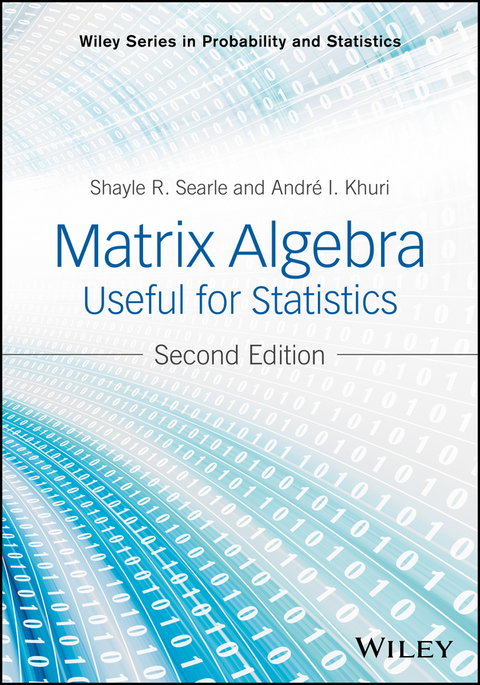
Matrix Algebra Useful for Statistics (eBook)
John Wiley & Sons (Verlag)
978-1-118-93516-3 (ISBN)
A thoroughly updated guide to matrix algebra and it uses in statistical analysis and features SAS®, MATLAB®, and R throughout
This Second Edition addresses matrix algebra that is useful in the statistical analysis of data as well as within statistics as a whole. The material is presented in an explanatory style rather than a formal theorem-proof format and is self-contained. Featuring numerous applied illustrations, numerical examples, and exercises, the book has been updated to include the use of SAS, MATLAB, and R for the execution of matrix computations. In addition, André I. Khuri, who has extensive research and teaching experience in the field, joins this new edition as co-author. The Second Edition also:
- Contains new coverage on vector spaces and linear transformations and discusses computational aspects of matrices
- Covers the analysis of balanced linear models using direct products of matrices
- Analyzes multiresponse linear models where several responses can be of interest
- Includes extensive use of SAS, MATLAB, and R throughout
- Contains over 400 examples and exercises to reinforce understanding along with select solutions
- Includes plentiful new illustrations depicting the importance of geometry as well as historical interludes
Matrix Algebra Useful for Statistics, Second Edition is an ideal textbook for advanced undergraduate and first-year graduate level courses in statistics and other related disciplines. The book is also appropriate as a reference for independent readers who use statistics and wish to improve their knowledge of matrix algebra.
THE LATE SHAYLE R. SEARLE, PHD, was professor emeritus of biometry at Cornell University. He was the author of Linear Models for Unbalanced Data and Linear Models and co-author of Generalized, Linear, and Mixed Models, Second Edition, Matrix Algebra for Applied Economics, and Variance Components, all published by Wiley. Dr. Searle received the Alexander von Humboldt Senior Scientist Award, and he was an honorary fellow of the Royal Society of New Zealand.
ANDRÉ I. KHURI, PHD, is Professor Emeritus of Statistics at the University of Florida. He is the author of Advanced Calculus with Applications in Statistics, Second Edition and co-author of Statistical Tests for Mixed Linear Models, all published by Wiley. Dr. Khuri is a member of numerous academic associations, among them the American Statistical Association and the Institute of Mathematical Statistics.
The late Shayle R. Searle, PhD, was professor emeritus of biometry at Cornell University. He was the author of Linear Models for Unbalanced Data and Linear Models and co-author of Generalized, Linear, and Mixed Models, Second Edition, Matrix Algebra for Applied Economics, and Variance Components, all published by Wiley. Dr. Searle received the Alexander von Humboldt Senior Scientist Award, and he was an honorary fellow of the Royal Society of New Zealand.
André I. Khuri, PhD, is Professor Emeritus of Statistics at the University of Florida. He is the author of Advanced Calculus with Applications in Statistics, Second Edition and co-author of Statistical Tests for Mixed Linear Models, all published by Wiley. Dr. Khuri is a member of numerous academic associations, among them the American Statistical Association and the Institute of Mathematical Statistics.
A thoroughly updated guide to matrix algebra and it uses in statistical analysis and features SAS , MATLAB , and R throughout This Second Edition addresses matrix algebra that is useful in the statistical analysis of data as well as within statistics as a whole. The material is presented in an explanatory style rather than a formal theorem-proof format and is self-contained. Featuring numerous applied illustrations, numerical examples, and exercises, the book has been updated to include the use of SAS, MATLAB, and R for the execution of matrix computations. In addition, Andr I. Khuri, who has extensive research and teaching experience in the field, joins this new edition as co-author. The Second Edition also: Contains new coverage on vector spaces and linear transformations and discusses computational aspects of matrices Covers the analysis of balanced linear models using direct products of matrices Analyzes multiresponse linear models where several responses can be of interest Includes extensive use of SAS, MATLAB, and R throughout Contains over 400 examples and exercises to reinforce understanding along with select solutions Includes plentiful new illustrations depicting the importance of geometry as well as historical interludes Matrix Algebra Useful for Statistics, Second Edition is an ideal textbook for advanced undergraduate and first-year graduate level courses in statistics and other related disciplines. The book is also appropriate as a reference for independent readers who use statistics and wish to improve their knowledge of matrix algebra. THE LATE SHAYLE R. SEARLE, PHD, was professor emeritus of biometry at Cornell University. He was the author of Linear Models for Unbalanced Data and Linear Models and co-author of Generalized, Linear, and Mixed Models, Second Edition, Matrix Algebra for Applied Economics, and Variance Components, all published by Wiley. Dr. Searle received the Alexander von Humboldt Senior Scientist Award, and he was an honorary fellow of the Royal Society of New Zealand. ANDR I. KHURI, PHD, is Professor Emeritus of Statistics at the University of Florida. He is the author of Advanced Calculus with Applications in Statistics, Second Edition and co-author of Statistical Tests for Mixed Linear Models, all published by Wiley. Dr. Khuri is a member of numerous academic associations, among them the American Statistical Association and the Institute of Mathematical Statistics.
The late Shayle R. Searle, PhD, was professor emeritus of biometry at Cornell University. He was the author of Linear Models for Unbalanced Data and Linear Models and co-author of Generalized, Linear, and Mixed Models, Second Edition, Matrix Algebra for Applied Economics, and Variance Components, all published by Wiley. Dr. Searle received the Alexander von Humboldt Senior Scientist Award, and he was an honorary fellow of the Royal Society of New Zealand. André I. Khuri, PhD, is Professor Emeritus of Statistics at the University of Florida. He is the author of Advanced Calculus with Applications in Statistics, Second Edition and co-author of Statistical Tests for Mixed Linear Models, all published by Wiley. Dr. Khuri is a member of numerous academic associations, among them the American Statistical Association and the Institute of Mathematical Statistics.
Matrix Algebra Useful for Statistics 3
Contents 9
Preface 19
Preface to the First Edition 21
Introduction 23
The Introduction of Matrices Into Statistics 26
References 29
About the Companion Website 33
Part 1 Definitions, Basic Concepts, and Matrix Operations 35
1 Vector Spaces, Subspaces, and Linear Transformations 37
1.1 Vector Spaces 37
1.1.1 Euclidean Space 37
1.2 Base of a Vector Space 39
1.3 Linear Transformations 41
1.3.1 The Range and Null Spaces of a Linear Transformation 42
Reference 43
Exercises 43
2 Matrix Notation and Terminology 45
2.1 Plotting of a Matrix 48
2.2 Vectors and Scalars 49
2.3 General Notation 50
Exercises 51
3 Determinants 55
3.1 Expansion by Minors 55
3.1.1 First- and Second-Order Determinants 56
3.1.2 Third-Order Determinants 57
3.1.3 n-Order Determinants 58
3.2 Formal Definition 59
3.3 Basic Properties 61
3.3.1 Determinant of a Transpose 61
3.3.2 Two Rows the Same 62
3.3.3 Cofactors 62
3.3.4 Adding Multiples of a Row (Column) to a Row (Column) 64
3.3.5 Products 64
3.4 Elementary Row Operations 68
3.4.1 Factorization 69
3.4.2 A Row (Column) of Zeros 70
3.4.3 Interchanging Rows (Columns) 70
3.4.4 Adding a Row to a Multiple of a Row 70
3.5 Examples 71
3.6 Diagonal Expansion 73
3.7 The Laplace Expansion 76
3.8 Sums and Differences of Determinants 78
3.9 A Graphical Representation of a Determinant 79
References 80
Exercises 81
4 Matrix Operations 85
4.1 The Transpose of a Matrix 85
4.1.1 A Reflexive Operation 86
4.1.2 Vectors 86
4.2 Partitioned Matrices 86
4.2.1 Example 86
4.2.2 General Specification 88
4.2.3 Transposing a Partitioned Matrix 89
4.2.4 Partitioning Into Vectors 89
4.3 The Trace of a Matrix 89
4.4 Addition 90
4.5 Scalar Multiplication 92
4.6 Equality and the Null Matrix 92
4.7 Multiplication 93
4.7.1 The Inner Product of Two Vectors 93
4.7.2 A Matrix–Vector Product 94
4.7.3 A Product of Two Matrices 96
4.7.4 Existence of Matrix Products 99
4.7.5 Products With Vectors 99
4.7.6 Products With Scalars 102
4.7.7 Products With Null Matrices 102
4.7.8 Products With Diagonal Matrices 102
4.7.9 Identity Matrices 103
4.7.10 The Transpose of a Product 103
4.7.11 The Trace of a Product 104
4.7.12 Powers of a Matrix 105
4.7.13 Partitioned Matrices 106
4.7.14 Hadamard Products 108
4.8 The Laws of Algebra 108
4.8.1 Associative Laws 108
4.8.2 The Distributive Law 109
4.8.3 Commutative Laws 109
4.9 Contrasts With Scalar Algebra 110
4.10 Direct Sum of Matrices 111
4.11 Direct Product of Matrices 112
4.12 The Inverse of a Matrix 114
4.13 Rank of a Matrix—Some Preliminary Results 116
4.14 The Number of LIN Rows and Columns in a Matrix 118
4.15 Determination of The Rank of a Matrix 119
4.16 Rank and Inverse Matrices 121
4.17 Permutation Matrices 121
4.18 Full-Rank Factorization 123
4.18.1 Basic Development 123
4.18.2 The General Case 125
4.18.3 Matrices of Full Row (Column) Rank 125
References 126
Exercises 126
5 Special Matrices 131
5.1 Symmetric Matrices 131
5.1.1 Products of Symmetric Matrices 131
5.1.2 Properties of AA? and A?A 132
5.1.3 Products of Vectors 133
5.1.4 Sums of Outer Products 134
5.1.5 Elementary Vectors 135
5.1.6 Skew-Symmetric Matrices 135
5.2 Matrices Having all Elements Equal 136
5.3 Idempotent Matrices 138
5.4 Orthogonal Matrices 140
5.4.1 Special Cases 141
5.5 Parameterization of Orthogonal Matrices 143
5.6 Quadratic Forms 144
5.7 Positive Definite Matrices 147
References 148
Exercises 148
6 Eigenvalues and Eigenvectors 153
6.1 Derivation of Eigenvalues 153
6.1.1 Plotting Eigenvalues 155
6.2 Elementary Properties of Eigenvalues 156
6.2.1 Eigenvalues of Powers of a Matrix 156
6.2.2 Eigenvalues of a Scalar-by-Matrix Product 157
6.2.3 Eigenvalues of Polynomials 157
6.2.4 The Sum and Product of Eigenvalues 158
6.3 Calculating Eigenvectors 159
6.3.1 Simple Roots 159
6.3.2 Multiple Roots 160
6.4 The Similar Canonical Form 162
6.4.1 Derivation 162
6.4.2 Uses 164
6.5 Symmetric Matrices 165
6.5.1 Eigenvalues All Real 166
6.5.2 Symmetric Matrices Are Diagonable 166
6.5.3 Eigenvectors Are Orthogonal 166
6.5.4 Rank Equals Number of Nonzero Eigenvalues for a Symmetric Matrix 169
6.6 Eigenvalues of orthogonal and Idempotent Matrices 169
6.6.1 Eigenvalues of Symmetric Positive Definite and Positive Semidefinite Matrices 170
6.7 Eigenvalues of Direct Products and Direct Sums of Matrices 172
6.8 Nonzero Eigenvalues of AB and BA 174
References 175
Exercises 175
7 Diagonalization of Matrices 179
7.1 Proving the Diagonability Theorem 179
7.1.1 The Number of Nonzero Eigenvalues Never Exceeds Rank 179
7.1.2 A Lower Bound on r (A ? ??????kI) 180
7.1.3 Proof of the Diagonability Theorem 181
7.1.4 All Symmetric Matrices Are Diagonable 181
7.2 Other Results for Symmetric Matrices 182
7.2.1 Non-Negative Definite (n.n.d.) 182
7.2.2 Simultaneous Diagonalization of Two Symmetric Matrices 183
7.3 The Cayley–Hamilton Theorem 186
7.4 The Singular-Value Decomposition 187
References 191
Exercises 191
8 Generalized Inverses 193
8.1 The Moore–Penrose Inverse 193
8.2 Generalized Inverses 194
8.2.1 Derivation Using the Singular-Value Decomposition 195
8.2.2 Derivation Based on Knowing the Rank 196
8.3 Other Names and Symbols 198
8.4 Symmetric Matrices 199
8.4.1 A General Algorithm 200
8.4.2 The Matrix X?X 200
References 201
Exercises 201
9 Matrix Calculus 205
9.1 Matrix Functions 205
9.1.1 Function of Matrices 205
9.1.2 Matrices of Functions 208
9.2 Iterative Solution of Nonlinear Equations 208
9.3 Vectors of Differential Operators 209
9.3.1 Scalars 209
9.3.2 Vectors 210
9.3.3 Quadratic Forms 211
9.4 Vec and Vech Operators 213
9.4.1 Definitions 213
9.4.2 Properties of Vec 214
9.4.3 Vec-Permutation Matrices 214
9.4.4 Relationships Between Vec and Vech 215
9.5 Other Calculus Results 215
9.5.1 Differentiating Inverses 215
9.5.2 Differentiating Traces 216
9.5.3 Derivative of a Matrix with Respect to Another Matrix 216
9.5.4 Differentiating Determinants 217
9.5.5 Jacobians 219
9.5.6 Aitken’s Integral 221
9.5.7 Hessians 222
9.6 Matrices With Elements That Are Complex Numbers 222
9.7 Matrix Inequalities 223
References 227
Exercises 228
Part 2 Applications of Matrices in Statistics 233
10 Multivariate Distributions and Quadratic Forms 235
10.1 Variance-Covariance Matrices 236
10.2 Correlation Matrices 237
10.3 Matrices of Sums of Squares and Cross-Products 238
10.3.1 Data Matrices 238
10.3.2 Uncorrected Sums of Squares and Products 238
10.3.3 Means, and the Centering Matrix 239
10.3.4 Corrected Sums of Squares and Products 239
10.4 The Multivariate Normal Distribution 241
10.5 Quadratic Forms and ??????2-Distributions 242
10.5.1 Distribution of Quadratic Forms 243
10.5.2 Independence of Quadratic Forms 244
10.5.3 Independence and Chi-Squaredness of Several Quadratic Forms 245
10.5.4 The Moment and Cumulant Generating Functions for a Quadratic Form 245
10.6 Computing the Cumulative Distribution Function of a Quadratic Form 247
10.6.1 Ratios of Quadratic Forms 248
References 249
Exercises 249
11 Matrix Algebra of Full-Rank Linear Models 253
11.1 Estimation of ?????? by the Method of Least Squares 254
11.1.1 Estimating the Mean Response and the Prediction Equation 257
11.1.2 Partitioning of Total Variation Corrected for the Mean 259
11.2 Statistical Properties of the Least-Squares Estimator 260
11.2.1 Unbiasedness and Variances 260
11.2.2 Estimating the Error Variance 261
11.3 Multiple Correlation Coefficient 263
11.4 Statistical Properties Under the Normality Assumption 265
11.5 Analysis of Variance 267
11.6 The Gauss–Markov Theorem 268
11.6.1 Generalized Least-Squares Estimation 271
11.7 Testing Linear Hypotheses 271
11.7.1 The Use of the Likelihood Ratio Principle in Hypothesis Testing 273
11.7.2 Confidence Regions and Confidence Intervals 275
11.8 Fitting Subsets of the x-Variables 280
11.9 The Use of the R(.|.) Notation in Hypothesis Testing 281
References 283
Exercises 283
12 Less-Than-Full-Rank Linear Models 287
12.1 General Description 287
12.2 The Normal Equations 290
12.2.1 A General Form 290
12.2.2 Many Solutions 291
12.3 Solving the Normal Equations 291
12.3.1 Generalized Inverses of X’X 292
12.3.2 Solutions 292
12.4 Expected values and variances 293
12.5 Predicted y-Values 294
12.6 Estimating the Error Variance 295
12.6.1 Error Sum of Squares 295
12.6.2 Expected Value 296
12.6.3 Estimation 296
12.7 Partitioning the Total Sum of Squares 296
12.8 Analysis of Variance 297
12.9 The R(?|?) Notation 299
12.10 Estimable Linear Functions 300
12.10.1 Properties of Estimable Functions 301
12.10.2 Testable Hypotheses 302
12.10.3 Development of a Test Statistic for H0 303
12.11 Confidence Intervals 306
12.12 Some Particular Models 306
12.12.1 The One-Way Classification 306
12.12.2 Two-Way Classification, No Interactions, Balanced Data 307
12.12.3 Two-Way Classification, No Interactions, Unbalanced Data 310
12.13 The R(?|?) Notation (Continued) 311
12.14 Reparameterization to a Full-Rank Model 315
References 316
Exercises 316
13 Analysis of Balanced Linear Models Using Direct Products of Matrices 321
13.1 General Notation for Balanced Linear Models 323
13.2 Properties Associated with Balanced Linear Models 327
13.3 Analysis of Balanced Linear Models 332
13.3.1 Distributional Properties of Sums of Squares 332
13.3.2 Estimates of Estimable Linear Functions of the Fixed Effects 335
References 341
Exercises 342
14 Multiresponse Models 347
14.1 Multiresponse Estimation of Parameters 348
14.2 Linear Multiresponse Models 350
14.3 Lack of Fit of a Linear Multiresponse Model 352
14.3.1 The Multivariate Lack of Fit Test 352
References 357
Exercises 358
Part 3 Matrix Computations and Related Software 361
15 SAS/IML 363
15.1 Getting Started 363
15.2 Defining a Matrix 363
15.3 Creating a Matrix 364
15.4 Matrix Operations 365
15.5 Explanations of SAS Statements Used Earlier in the Text 388
References 391
Exercises 392
16 Use of MATLAB in Matrix Computations 397
16.1 Arithmetic Operators 397
16.2 Mathematical Functions 398
16.3 Construction of Matrices 399
16.3.1 Submatrices 399
16.4 Two- and Three-Dimensional Plots 405
16.4.1 Three-Dimensional Plots 408
References 412
Exercises 413
17 Use of R in Matrix Computations 417
17.1 Two- and Three-Dimensional Plots 430
17.1.1 Two-Dimensional Plots 431
17.1.2 Three-Dimensional Plots 438
References 442
Exercises 442
Appendix Solutions to Exercises 447
Chapter 1 447
Chapter 2 448
Chapter 3 450
Chapter 4 452
Chapter 5 454
Chapter 6 458
Chapter 7 463
Chapter 8 465
Chapter 9 470
Chapter 10 474
Chapter 11 478
Chapter 12 484
Chapter 13 486
Chapter 14 493
Chapter 15 496
Chapter 16 499
Chapter 17 502
Index 509
EULA 515
"Matrix Algebra Useful for Statistics, Second Edition is an ideal textbook for advanced undergraduate and first-year graduate level courses in statistics and other related disciplines. The book is also appropriate as a reference for independent readers who use statistics and wish to improve their knowledge of matrix algebra." Mathematical Reviews, Sept 2017
| Erscheint lt. Verlag | 31.3.2017 |
|---|---|
| Reihe/Serie | Wiley Series in Probability and Statistics |
| Wiley Series in Probability and Statistics | Wiley Series in Probability and Statistics |
| Sprache | englisch |
| Themenwelt | Mathematik / Informatik ► Mathematik ► Algebra |
| Mathematik / Informatik ► Mathematik ► Statistik | |
| Mathematik / Informatik ► Mathematik ► Wahrscheinlichkeit / Kombinatorik | |
| Technik | |
| Schlagworte | Angewandte Wahrscheinlichkeitsrechnung u. Statistik • applied illustrations • Applied Probability & Statistics • balanced linear models • linear transformations • <p>matrix algebra • MATLAB • matrices • multiresponse linear models</p> • R • R (Programm) • SAS • Statistical Analysis • Statistical Software / R • Statistics • Statistics - Text & Reference • Statistik • Statistik / Lehr- u. Nachschlagewerke • Statistiksoftware / R • vector spaces |
| ISBN-10 | 1-118-93516-0 / 1118935160 |
| ISBN-13 | 978-1-118-93516-3 / 9781118935163 |
| Informationen gemäß Produktsicherheitsverordnung (GPSR) | |
| Haben Sie eine Frage zum Produkt? |
 PDF (Adobe DRM)
Kopierschutz: Adobe-DRM
Adobe-DRM ist ein Kopierschutz, der das eBook vor Mißbrauch schützen soll. Dabei wird das eBook bereits beim Download auf Ihre persönliche Adobe-ID autorisiert. Lesen können Sie das eBook dann nur auf den Geräten, welche ebenfalls auf Ihre Adobe-ID registriert sind.
Details zum Adobe-DRM
Dateiformat: PDF (Portable Document Format)
Mit einem festen Seitenlayout eignet sich die PDF besonders für Fachbücher mit Spalten, Tabellen und Abbildungen. Eine PDF kann auf fast allen Geräten angezeigt werden, ist aber für kleine Displays (Smartphone, eReader) nur eingeschränkt geeignet.
Systemvoraussetzungen:
PC/Mac: Mit einem PC oder Mac können Sie dieses eBook lesen. Sie benötigen eine
eReader: Dieses eBook kann mit (fast) allen eBook-Readern gelesen werden. Mit dem amazon-Kindle ist es aber nicht kompatibel.
Smartphone/Tablet: Egal ob Apple oder Android, dieses eBook können Sie lesen. Sie benötigen eine
Geräteliste und zusätzliche Hinweise
Buying eBooks from abroad
For tax law reasons we can sell eBooks just within Germany and Switzerland. Regrettably we cannot fulfill eBook-orders from other countries.
aus dem Bereich