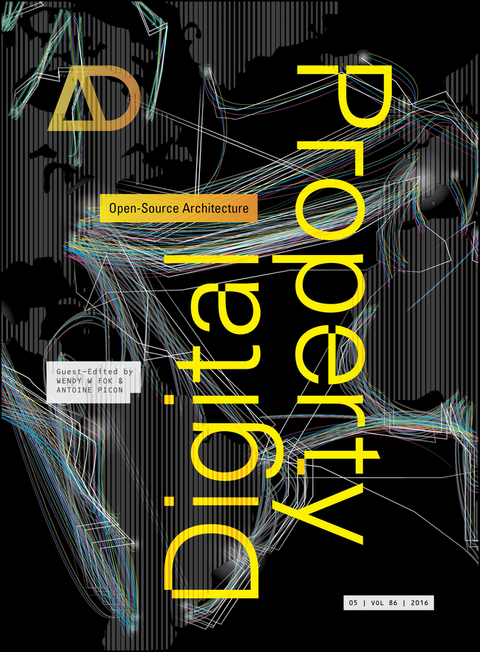
Digital Property (eBook)
John Wiley & Sons (Verlag)
978-1-118-95494-2 (ISBN)
Even more than authorship, ownership is challenged by the rise of digital and computational methods of design and production. These challenges are simultaneously legal, ethical and economic. How are new methods of fabrication and manufacture going to irreversibly change not only ways of working, but also designers' ethics and their stance on ownership? In his 2013 second-term State of the Union address, President Obama stated that 3D printing 'has the potential to revolutionize the way we make almost everything'. Nowhere will the impact of 3D printing be felt greater than in the architectural and design communities. When anyone can print out an object or structure from a digital file, will designers still exert the same creative rights or will they need to develop new practice and payment models? As architecture becomes more collaborative with open-source processes, will the emphasis on signature as the basis of ownership remain relevant? How will wider teams working globally be accredited and compensated? This issue of AD explores this subject; it features the work of designers who are developing wholly new approaches to practice by exploring means of commercialising process-based products rather than objects.
Contributors: Phil Bernstein, Mark Garcia, Antoine Picon, Carlo Ratti and David Ruy
Featured architects: Francis Bitonti, Marjan Colletti, Wendy W Fok, Panagiotis Michalatos, Jose Sanchez, Thibault Schwartz, Aaron Sprecher, Feng Xu and Philip Yuan
Antoine Picon is the G Ware Travelstead Professor of the History of Architecture and Technology at Harvard GSD. He works on the history of architectural and urban technologies from the 18th century to the present. In his book La Ville territoire des cyborgs (Editions de l'lmprimeur, 1998), he began to investigate the changes brought to cities and architecture by the development of digital tools and digital culture. His three most recent books - Digital Culture in Architecture: An Introduction for the Design Profession (Birkhauser, 2010); Ornament:The Politics of Architecture and Subjectivity (John Wiley & Sons,2013); and Smart Cities: A Spatialised Intelligence (Wiley, 2015) - deal extensively with this question. He received science and engineering degrees from the Ecole Polytechnique and Ecole Nationale des Ponts et Chaussees, an architecture degree from the Ecole d'Architecture de Paris-Villemin, and a PhD in history from the Ecole des Hautes Etudes en Sciences Sociales.
Wendy W Fok is the creative director/ founder of WE DESIGNS, which provides creative strategies for the built environment, as well as Resilient Modular Systems, a socially missioned venture and public-benefit corporation that focuses on innovative modular components using hybridised composite materials for the building industry. Her awards include the Autodesk® Pier 9 AiR (2016), Young CAADRIA Award (2015), Digital Kluge Fellowship awarded by the Library of Congress (2014- 15), the Art Directors Club of New York's ADC Young Guns 11 Award (2013), and the American Institute of Architects (AIA) Dallas 'Express Yourself' Women in Architecture Award (2013). She has a Master of Architecture from Princeton University, and a Bachelor of Arts in Architecture from Barnard College, Columbia University. She is an Assistant Professor of Integrated Design at Parsons, and completed her Doctor of Design at the Harvard GSD. Her doctoral research investigates computational innovation, the ethical/equitable application of technical methods of digital fabrication, and issues of intellectual property law within ownership and authorship property rights for the built environment.
Even more than authorship, ownership is challenged by the rise of digital and computational methods of design and production. These challenges are simultaneously legal, ethical and economic. How are new methods of fabrication and manufacture going to irreversibly change not only ways of working, but also designers ethics and their stance on ownership? In his 2013 second-term State of the Union address, President Obama stated that 3D printing has the potential to revolutionize the way we make almost everything . Nowhere will the impact of 3D printing be felt greater than in the architectural and design communities. When anyone can print out an object or structure from a digital file, will designers still exert the same creative rights or will they need to develop new practice and payment models? As architecture becomes more collaborative with open-source processes, will the emphasis on signature as the basis of ownership remain relevant? How will wider teams working globally be accredited and compensated? This issue of AD explores this subject; it features the work of designers who are developing wholly new approaches to practice by exploring means of commercialising process-based products rather than objects. Contributors: Phil Bernstein, Mark Garcia, Antoine Picon, Carlo Ratti and David Ruy Featured architects: Francis Bitonti, Marjan Colletti, Wendy W Fok, Panagiotis Michalatos, Jose Sanchez, Thibault Schwartz, Aaron Sprecher, Feng Xu and Philip Yuan
Antoine Picon is the G Ware Travelstead Professor of the History of Architecture and Technology at Harvard GSD. He works on the history of architectural and urban technologies from the 18th century to the present. In his book La Ville territoire des cyborgs (Editions de l'lmprimeur, 1998), he began to investigate the changes brought to cities and architecture by the development of digital tools and digital culture. His three most recent books - Digital Culture in Architecture: An Introduction for the Design Profession (Birkhauser, 2010); Ornament:The Politics of Architecture and Subjectivity (John Wiley & Sons,2013); and Smart Cities: A Spatialised Intelligence (Wiley, 2015) - deal extensively with this question. He received science and engineering degrees from the Ecole Polytechnique and Ecole Nationale des Ponts et Chaussees, an architecture degree from the Ecole d'Architecture de Paris-Villemin, and a PhD in history from the Ecole des Hautes Etudes en Sciences Sociales. Wendy W Fok is the creative director/ founder of WE DESIGNS, which provides creative strategies for the built environment, as well as Resilient Modular Systems, a socially missioned venture and public-benefit corporation that focuses on innovative modular components using hybridised composite materials for the building industry. Her awards include the Autodesk® Pier 9 AiR (2016), Young CAADRIA Award (2015), Digital Kluge Fellowship awarded by the Library of Congress (2014- 15), the Art Directors Club of New York's ADC Young Guns 11 Award (2013), and the American Institute of Architects (AIA) Dallas 'Express Yourself' Women in Architecture Award (2013). She has a Master of Architecture from Princeton University, and a Bachelor of Arts in Architecture from Barnard College, Columbia University. She is an Assistant Professor of Integrated Design at Parsons, and completed her Doctor of Design at the Harvard GSD. Her doctoral research investigates computational innovation, the ethical/equitable application of technical methods of digital fabrication, and issues of intellectual property law within ownership and authorship property rights for the built environment.
Cover 1
Title Page 3
Contents 4
Copyright Page 6
About the Guest-Editors 7
Introduction The Ownership Revolution 8
Serving, Owning, Authoring 18
Notes 27
Adaptive Knowledge in Architecture: A Few Notes on the Nature of Transdisciplinarity 28
Intensity 30
Extensity 32
Potentiality 35
Adaptive Knowledge 37
Notes 37
From Authorship to Ownership: A Historical Perspective 38
An Imperious Sense of Change 39
Cooperation and Competition 40
Notes 43
A/B Architecture: Publicly Augmented Design 44
User Participation 46
Feedback in Design 47
Implementation 48
The Case of the Expo 49
Notes 49
Massive Re-Patterning of the Urban Landscape 50
The Power of the Crowd 51
Block’hood 52
Notes 53
Fab-Union: A Collective Online to Offline Robotic Design Platform 54
An Online Design Platform 58
From Online Network to Offline Collective Design Space 59
A Multidisciplinary Robotic Factory 60
Future Challenges 61
Notes 61
Design Instruments of Service in the Era of Connection 62
Products Versus Services 64
Digital Transformations and Changing Obligations 65
New Processes and Procedures 65
New Roles, New Obligations 67
Creating New Value 67
Notes 69
An Art of Connectivity 70
Sensor Fusion and Multidisciplinarity 75
The Portable Plug-and-Play Library: an Extension of the Prescribed 75
A Planned Technological Schism 77
Notes 77
Post-Digital Transdisciplinarity 78
Notes 85
VULCAN: Closing the Loop in 3D-Printed Architectural Design 86
Architectural Patents and Open-Source Architectures: The Globalisation of Spatial Design Innovations (or Learning from ‘E99’) 94
Patents Per Se 97
Patents, Patent Systems and Architecture 99
Anti-Futures of Patents and Open-Source Architectures 101
Notes 101
When Matter Becomes Media: How Our New Tools Are Reinventing Physicality 102
Multiple Materials: Gradient Matter 104
Products Designed for Individuals: Mutatio Shoes 106
Social Manufacturing: The Cloud Collection 107
The Materials Revolution: The Real Agents of Change 109
Design Signals: The Role of Software Architecture and Paradigms in Design Thinking and Practice 110
Granular Authorship/Ownership 115
Architecture as a Signal: the Biomedical Paradigm 116
Signals as Property 117
Notes 117
Opening Up the Future of Open Source: From Open Innovation to the Internet of Things for the Built Environment 118
Notes 127
Counterpoint The Culture of the Copy 128
Mimetic Cultures 131
Swarm Behaviours 132
Against Authenticity 135
Notes 135
Contributors 136
What is Architectural Design? 138
Forthcoming Titles 139
Back Cover 140
EULA 141
| Erscheint lt. Verlag | 9.3.2017 |
|---|---|
| Reihe/Serie | Architectural Design | Architectural Design |
| Sprache | englisch |
| Themenwelt | Informatik ► Grafik / Design ► Digitale Bildverarbeitung |
| Technik ► Architektur | |
| Schlagworte | Address • architectural theory • Architecture • Architektur • Architekturtheorie • Architektur / Theorie • authorship • Computational • Design • Design, Drawing & Presentation • Designers • Entwurf • Entwurf, Zeichnung u. Präsentation • everything • Fabrication • Manufacture • Methods • New • Ownership • Potential • President Obama • Production • Rise • secondterm • simultaneously legal • stance • State • Union • Way • Ways |
| ISBN-10 | 1-118-95494-7 / 1118954947 |
| ISBN-13 | 978-1-118-95494-2 / 9781118954942 |
| Informationen gemäß Produktsicherheitsverordnung (GPSR) | |
| Haben Sie eine Frage zum Produkt? |
 PDF (Adobe DRM)
Kopierschutz: Adobe-DRM
Adobe-DRM ist ein Kopierschutz, der das eBook vor Mißbrauch schützen soll. Dabei wird das eBook bereits beim Download auf Ihre persönliche Adobe-ID autorisiert. Lesen können Sie das eBook dann nur auf den Geräten, welche ebenfalls auf Ihre Adobe-ID registriert sind.
Details zum Adobe-DRM
Dateiformat: PDF (Portable Document Format)
Mit einem festen Seitenlayout eignet sich die PDF besonders für Fachbücher mit Spalten, Tabellen und Abbildungen. Eine PDF kann auf fast allen Geräten angezeigt werden, ist aber für kleine Displays (Smartphone, eReader) nur eingeschränkt geeignet.
Systemvoraussetzungen:
PC/Mac: Mit einem PC oder Mac können Sie dieses eBook lesen. Sie benötigen eine
eReader: Dieses eBook kann mit (fast) allen eBook-Readern gelesen werden. Mit dem amazon-Kindle ist es aber nicht kompatibel.
Smartphone/Tablet: Egal ob Apple oder Android, dieses eBook können Sie lesen. Sie benötigen eine
Geräteliste und zusätzliche Hinweise
Buying eBooks from abroad
For tax law reasons we can sell eBooks just within Germany and Switzerland. Regrettably we cannot fulfill eBook-orders from other countries.
aus dem Bereich