


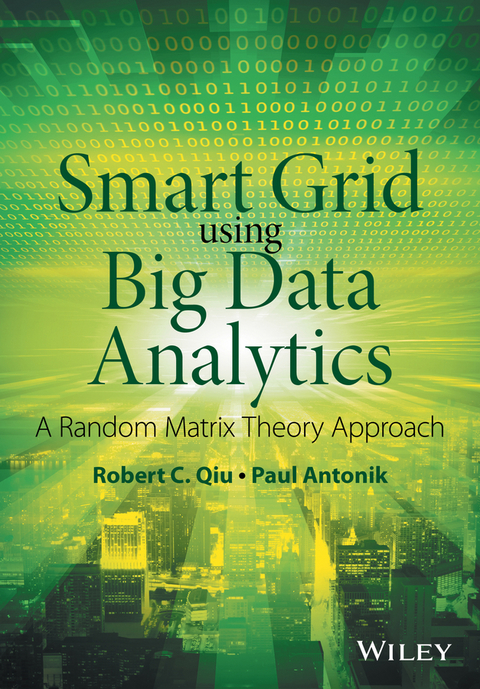
Smart Grid using Big Data Analytics (eBook)
John Wiley & Sons (Verlag)
978-1-118-71679-3 (ISBN)
Robert Caiming Qiu, Professor, Dept. of ECE, Tennessee Technological University, Cookeville, TN, USA. Professor Qiu was Founder-CEO and President of Wiscom Technologies, Inc., manufacturing and marketing WCDMA chipsets. Wiscom was acquired by Intel in 2003. Prior to Wiscom, he worked for GTE Labs, Inc. (now Verizon), Waltham, MA, and Bell Labs, Lucent, Whippany, NJ. He holds 5 U.S. patents (another two pending) in WCDMA. Professor Qiu has contributed to 3GPP and IEEE standards bodies, and delivered invited seminars to institutions including Princeton University and the U.S. Army Research Lab. Dr. Qiu was made an IEEE Fellow in 2014.
Dr. Paul Antonik, Chief Scientist, Information Directorate, Air Force Research Laboratory, Rome, N.Y., USA. Dr. Antonik serves as the directorate's principal scientific and technical adviser and primary authority for the technical content of the science and technology portfolio, providing principal technical oversight of a broad spectrum of information technologies.
Robert Caiming Qiu, Professor, Dept. of ECE, Tennessee Technological University, Cookeville, TN, USA. Professor Qiu was Founder-CEO and President of Wiscom Technologies, Inc., manufacturing and marketing WCDMA chipsets. Wiscom was acquired by Intel in 2003. Prior to Wiscom, he worked for GTE Labs, Inc. (now Verizon), Waltham, MA, and Bell Labs, Lucent, Whippany, NJ. He holds 5 U.S. patents (another two pending) in WCDMA. Professor Qiu has contributed to 3GPP and IEEE standards bodies, and delivered invited seminars to institutions including Princeton University and the U.S. Army Research Lab. Dr. Qiu was made an IEEE Fellow in 2014. Dr. Paul Antonik, Chief Scientist, Information Directorate, Air Force Research Laboratory, Rome, N.Y., USA. Dr. Antonik serves as the directorate's principal scientific and technical adviser and primary authority for the technical content of the science and technology portfolio, providing principal technical oversight of a broad spectrum of information technologies.
1
Introduction
1.1 Big Data: Basic Concepts
Data is “unreasonably effective” [2]. Nobel laureate Eugene Wigner referred to the unreasonable effectiveness of mathematics in the natural sciences [3]. What is big data? According to [4], its sizes are in the order of terabytes or petabytes; it is often online, and it is not available from a central source. It is diverse, may be loosely structured with a large percentage of data missing.It is heterogeneous.
The promise of data‐driven decision‐making is now broadly recognized [5–16]. There is no clear consensus about what big data is. In fact, there have been many controversial statements about big data, such as “Size is the only thing that matters.”
Big data is a big deal [17]. The Big Data Research and Development Initiative has been launched by the US Federal government. “By improving our ability to extract knowledge and insights from large and complex collections of digital data, the initiative promises to help accelerate the pace of discovery in science and engineering, strengthen our national security, and transform teaching and learning” [17]. Universities are beginning to create new courses to prepare the next generation of “data scientists.”
The age of big data has already arrived with global data doubling every two years. The utility industry is not the only one facing this issue (Wal‐Mart has a million customer transactions a day) but utilities have been slower to respond to the data deluge. Scaling up the algorithms to massive datasets is a big challenge.
According to [18]:
A key tenet of big data is that the world and the data that describe it are constantly changing and organizations that can recognize the changes and react quickly and intelligently will have the upper hand … As the volume of data explodes, organizations will need analytic tools that are reliable, robust and capable of being automated. At the same time, the analytics, algorithms, and user interfaces they employ will need to facilitate interactions with the people who work with the tools.
1.1.1 Big Data—Big Picture
Data is a strategic resource, together with natural resources and human resources. Data is king! “Big data” refers to a technology phenomenon that has arisen since the late 1980s [19]. As computers have improved, their growing storage and processing capacities have provided new and powerful ways to gain insight into the world by sifting through enormous quantities of data available. But this insight, discoverable in previously unseen patterns and trends within these phenomenally large data sets, can be hard to detect without new analytic tools that can comb through the information and highlight points of interest.
Sources such as online or mobile financial transactions, social media traffic, and GPS coordinates, now generate over 2.5 quintillion bytes of so‐called “big data” every day. The growth of mobile data traffic from subscribers in emerging markets exceeded 100% annually through 2015. There are new possibilities for international development (see Figure 1.1).
Figure 1.1 Big data, big impact: new possibilities for international development.
Source: Reproduced from [6] with permission from the World Economic Forum.
Big data at the societal level provides a powerful microscope, together with social mining—the ability to discover knowledge from these data. Scientific research is being revolutionized by this, and policy making is next in line, because big data and social mining are providing novel means for measuring and monitoring wellbeing in our society more realistically, beyond the GDP, more precisely, continuously, everywhere [20].
Most scientific disciplines are finding the data deluge to be extremely challenging, and tremendous opportunities can be realized if we can better organize and access the data [16].
Chris Anderson believed that the data deluge makes the scientific method obsolete [21]. Petabytes data tell us to say correlation is enough. There is no need to find the models. Correction replaces causality. It remains open to see whether the data growth will lead to a fundamental change in scientific methods.
In the computing industry we are now focussing on how to process big data [22].
A fundamental question is “What is the unifying theory for big data?” This book adopts the viewpoint that big data is a new science of combining data science and information science. Specialists in different fields deal with big data on their own, while information experts play a secondary role as assistants. In other words, most scientific problems are in the hands of specialists whereas only few problems—common to all fields—are refined by computing experts. When more and more problems are open, some unifying challenges common to all fields will arise. Big data from the Internet may receive more attention first. Big data from physical systems will become more and more important.
Big data will form a unique discipline that requires expertise from mathematics, statistics and computing algorithms.
Following the excellent review in [22], we highlight some challenges for big data:
- Processing unstructured and semistructured data. Presently 85% of the data are unstructured or semistructured. Traditional relational databases cannot handle these massive datasets. High scalability is the most important requirement for big‐data analysis. MapReduce and Hadoop are two nonrelational data analysis technologies.
- Novel approaches for data representation. Current data representation cannot visually express the true essence of the data. If the raw data are labeled, the problem is much easier but customers do not approve of the labeling.
- Data fusion. The true value of big data cannot exhibit itself without data fusion. The data deluge on the Internet has something to do with data formats. One critical challenge is whether we can conveniently fuse the data from individuals, industry and government. It is preferable that data formats be platform free.
- Redundancy reduction and high‐efficiency, low‐cost data storage. Redundancy reduction is important for cost reduction.
- Analytical tools and development environments that are suitable for a variety of fields. Computing algorithm researchers and people from different disciplines are encouraged to work together closely as a team. There are enormous barriers for people from different disciplines to share data. Data collection, especially simultaneous collection for relational data, is still very challenging.
- Novel approaches to save energy for data processing, data storage, and communication.
1.1.2 DARPA’s XDATA Program
The Defense Advanced Research Projects Agency’s (DARPA’s) XDATA program seeks to develop computational techniques and software tools for analyzing large volumes of data, both semistructured (e.g., tabular, relational, categorical, metadata) and unstructured (e.g., text documents, message traffic). Central challenges to be addressed include (i) developing scalable algorithms for processing imperfect data in distributed data stores, and (ii) creating effective human–computer interaction tools to facilitate rapidly customizable visual reasoning for diverse missions.
Data continues to be generated and digitally archived at increasing rates, resulting in vast databases available for search and analysis. Access to these databases has generated new insights through data‐driven methods in the commercial, science, and computing sectors [23]. The defense section is “swimming in sensors and drowning in data.” Big data arises from the Internet and the monitoring of industrial equipment. Sensor networks and the Internet of Things (IoT) are another two drivers.
There is a trend for data to be used that can sometimes be seen only once, for milliseconds, or can only be stored for a short time before being deleted, especially in some defense applications. This trend is accelerated by the proliferation of various digital devices and the Internet. It is important to develop fast, scalable, and efficient methods for processing and visualizing data.
The XDATA program’s technology development is approached through four technical areas (TAs):
- TA1: Scalable analytics and data‐processing technology;
- TA2: Visual user interface technology;
- TA3: Research software integration;
- TA4: Evaluation.
It is useful to consider distributed computing via architectures like MapReduce, and its open source implementation, Hadoop. Data collected by the Department of Defense (DoD) are particularly difficult to deal with, including missing data, missing connections between data, incomplete data, corrupted data, data of variable size and type, and so forth [23]. We need to develop analytical principles and implementations scalable to data volume and distributed computer architectures. The challenge for Technical Area 1 is how to enable systematic use of big data in the following list of topic areas:
- Methods for leveraging the problem structure to create new algorithms to achieve optimal tradeoffs among time complexity, space complexity, and stream complexity (i.e., how many passes over the data are needed).
- Methods for the propagation of uncertainty (i.e., every query should have an answer and an error bar), with performance guarantees...
| Erscheint lt. Verlag | 8.2.2017 |
|---|---|
| Sprache | englisch |
| Themenwelt | Mathematik / Informatik ► Informatik ► Datenbanken |
| Technik ► Elektrotechnik / Energietechnik | |
| Technik ► Nachrichtentechnik | |
| Schlagworte | Big Data • Electrical & Electronics Engineering • Elektrotechnik u. Elektronik • Energie • Energy • Numerical Methods & Algorithms • Numerische Methoden u. Algorithmen • Smart Grid • smart grid, big data analytics, electrical engineering, algorithms • Systems Engineering & Management • Systemtechnik • Systemtechnik u. -management |
| ISBN-10 | 1-118-71679-5 / 1118716795 |
| ISBN-13 | 978-1-118-71679-3 / 9781118716793 |
| Informationen gemäß Produktsicherheitsverordnung (GPSR) | |
| Haben Sie eine Frage zum Produkt? |
 EPUB (Adobe DRM)
Kopierschutz: Adobe-DRM
Adobe-DRM ist ein Kopierschutz, der das eBook vor Mißbrauch schützen soll. Dabei wird das eBook bereits beim Download auf Ihre persönliche Adobe-ID autorisiert. Lesen können Sie das eBook dann nur auf den Geräten, welche ebenfalls auf Ihre Adobe-ID registriert sind.
Details zum Adobe-DRM
Dateiformat: EPUB (Electronic Publication)
EPUB ist ein offener Standard für eBooks und eignet sich besonders zur Darstellung von Belletristik und Sachbüchern. Der Fließtext wird dynamisch an die Display- und Schriftgröße angepasst. Auch für mobile Lesegeräte ist EPUB daher gut geeignet.
Systemvoraussetzungen:
PC/Mac: Mit einem PC oder Mac können Sie dieses eBook lesen. Sie benötigen eine
eReader: Dieses eBook kann mit (fast) allen eBook-Readern gelesen werden. Mit dem amazon-Kindle ist es aber nicht kompatibel.
Smartphone/Tablet: Egal ob Apple oder Android, dieses eBook können Sie lesen. Sie benötigen eine
Geräteliste und zusätzliche Hinweise
Buying eBooks from abroad
For tax law reasons we can sell eBooks just within Germany and Switzerland. Regrettably we cannot fulfill eBook-orders from other countries.
aus dem Bereich


