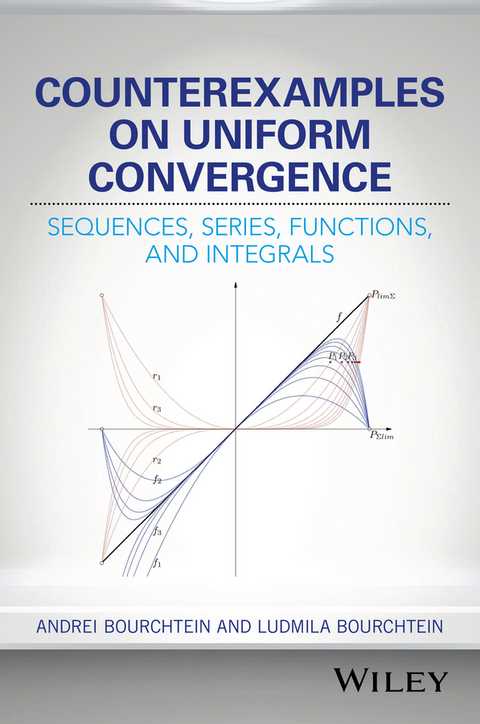
Counterexamples on Uniform Convergence (eBook)
John Wiley & Sons (Verlag)
978-1-119-30342-8 (ISBN)
ANDREI BOURCHTEIN, PhD, is Professor in the Department of Mathematics at Pelotas State University in Brazil. The author of more than 100 referred articles and five books, his research interests include numerical analysis, computational fluid dynamics, numerical weather prediction, and real analysis. Dr. Andrei Bourchtein received his PhD in Mathematics and Physics from the Hydrometeorological Center of Russia.
LUDMILA BOURCHTEIN, PhD, is Senior Research Scientist at the Institute of Physics and Mathematics at Pelotas State University in Brazil. The author of more than 80 referred articles and three books, her research interests include real and complex analysis, conformal mappings, and numerical analysis. Dr. Ludmila Bourchtein received her PhD in Mathematics from Saint Petersburg State University in Russia.
A comprehensive and thorough analysis of concepts and results on uniform convergence Counterexamples on Uniform Convergence: Sequences, Series, Functions, and Integrals presents counterexamples to false statements typically found within the study of mathematical analysis and calculus, all of which are related to uniform convergence. The book includes the convergence of sequences, series and families of functions, and proper and improper integrals depending on a parameter. The exposition is restricted to the main definitions and theorems in order to explore different versions (wrong and correct) of the fundamental concepts and results. The goal of the book is threefold. First, the authors provide a brief survey and discussion of principal results of the theory of uniform convergence in real analysis. Second, the book aims to help readers master the presented concepts and theorems, which are traditionally challenging and are sources of misunderstanding and confusion. Finally, this book illustrates how important mathematical tools such as counterexamples can be used in different situations. The features of the book include: An overview of important concepts and theorems on uniform convergence Well-organized coverage of the majority of the topics on uniform convergence studied in analysis courses An original approach to the analysis of important results on uniform convergence based/ on counterexamples Additional exercises at varying levels of complexity for each topic covered in the book A supplementary Instructor s Solutions Manual containing complete solutions to all exercises, which is available via a companion website Counterexamples on Uniform Convergence: Sequences, Series, Functions, and Integrals is an appropriate reference and/or supplementary reading for upper-undergraduate and graduate-level courses in mathematical analysis and advanced calculus for students majoring in mathematics, engineering, and other sciences. The book is also a valuable resource for instructors teaching mathematical analysis and calculus. ANDREI BOURCHTEIN, PhD, is Professor in the Department of Mathematics at Pelotas State University in Brazil. The author of more than 100 referred articles and five books, his research interests include numerical analysis, computational fluid dynamics, numerical weather prediction, and real analysis. Dr. Andrei Bourchtein received his PhD in Mathematics and Physics from the Hydrometeorological Center of Russia. LUDMILA BOURCHTEIN, PhD, is Senior Research Scientist at the Institute of Physics and Mathematics at Pelotas State University in Brazil. The author of more than 80 referred articles and three books, her research interests include real and complex analysis, conformal mappings, and numerical analysis. Dr. Ludmila Bourchtein received her PhD in Mathematics from Saint Petersburg State University in Russia.
ANDREI BOURCHTEIN, PhD, is Professor in the Department of Mathematics at Pelotas State University in Brazil. The author of more than 100 referred articles and five books, his research interests include numerical analysis, computational fluid dynamics, numerical weather prediction, and real analysis. Dr. Andrei Bourchtein received his PhD in Mathematics and Physics from the Hydrometeorological Center of Russia. LUDMILA BOURCHTEIN, PhD, is Senior Research Scientist at the Institute of Physics and Mathematics at Pelotas State University in Brazil. The author of more than 80 referred articles and three books, her research interests include real and complex analysis, conformal mappings, and numerical analysis. Dr. Ludmila Bourchtein received her PhD in Mathematics from Saint Petersburg State University in Russia.
Preface ix
List of Examples xi
List of Figures xxix
About the Companion Website xxxiii
Introduction xxxv
I.1 Comments xxxv
I.1.1 On the Structure of This Book xxxv
I.1.2 On Mathematical Language and Notation xxxvii
I.2 Background (Elements of Theory) xxxviii
I.2.1 Sequences of Functions xxxviii
I.2.2 Series of Functions xli
I.2.3 Families of Functions xliv
1 Conditions of Uniform Convergence 1
1.1 Pointwise, Absolute, and Uniform Convergence. Convergence on a Set and Subset 1
1.2 Uniform Convergence of Sequences and Series of Squares and Products 15
1.3 Dirichlet's and Abel's Theorems 31
Exercises 39
Further Reading 42
2 Properties of the Limit Function: Boundedness, Limits, Continuity 45
2.1 Convergence and Boundedness 45
2.2 Limits and Continuity of Limit Functions 51
2.3 Conditions of Uniform Convergence. Dini's Theorem 68
2.4 Convergence and Uniform Continuity 79
Exercises 88
Further Reading 93
3 Properties of the Limit Function: Differentiability and Integrability 95
3.1 Differentiability of the Limit Function 95
3.2 Integrability of the Limit Function 117
Exercises 128
Further Reading 131
4 Integrals Depending on a Parameter 133
4.1 Existence of the Limit and Continuity 133
4.2 Differentiability 144
4.3 Integrability 154
Exercises 162
Further Reading 166
5 Improper Integrals Depending on a Parameter 167
5.1 Pointwise, Absolute, and Uniform Convergence 167
5.2 Convergence of the Sum and Product 176
5.3 Dirichlet's and Abel's Theorems 185
5.4 Existence of the Limit and Continuity 192
5.5 Differentiability 198
5.6 Integrability 202
Exercises 210
Further Reading 214
Bibliography 215
Index 217
"The features of the book include An overview of important concepts and theorems on uniform convergence, Well-organized coverage of the majority of the topics on uniform convergence studied in analysis courses, An original approach to the analysis of important results on uniform convergence
based on counterexamples, Additional exercises at varying levels of complexity for each topic covered in the book & A supplementary Instructor's Solutions Manual containing complete solutions to
all exercises, which is available via a companion website" Mathematical Reviews, Sept 2017
List of Examples
Chapter 1. Conditions of Uniform Convergence
Example 1. A function f(x, y) defined on converges pointwise on X as y approaches y0, but this convergence is nonuniform on X
A sequence of functions converges (pointwise) on a set, but this convergence is nonuniform.
A series of functions converges (pointwise) on a set, but this convergence is nonuniform.
Example 2. A series of functions converges on X and a general term of the series converges to zero uniformly on X, but the series converges nonuniformly on X.
Example 3. A sequence of functions converges on X and there exists its subsequence that converges uniformly on X, but the original sequence does not converge uniformly on X.
Example 4. A function f(x, y) defined on converges on (a, b) as y approaches y0 and this convergence is uniform on any interval , but the convergence is nonuniform on (a, b).
A sequence of functions defined on (a, b) converges uniformly on any interval , but the convergence is nonuniform on (a, b)
A series of functions converges uniformly on any interval , but the convergence is nonuniform on (a, b).
Example 5. A sequence converges on X, but this convergence is nonuniform on a closed interval .
A series converges on X, but this series does not converge uniformly on a closed subinterval .
A function f(x, y) defined on has a limit for , but f(x, y) converges nonuniformly on a subinterval .
Example 6. A sequence converges on a set X, but it does not converge uniformly on any subinterval of X.
A series converges on X, but it does not converge uniformly on any subinterval of X.
Example 7. A series converges uniformly on an interval, but it does not converge absolutely on the same interval.
Example 8. A series converges absolutely on an interval, but it does not converge uniformly on the same interval.
Example 9. A series converges absolutely and uniformly on [a, b], but the series does not converge uniformly on [a, b].
Example 10. A series converges absolutely and uniformly on X, but there is no bound of the general term un(x) on X in the form , such that the series converges.
Example 11. A sequence fn(x) converges uniformly on X to a function f(x), but does not converge uniformly on X to f2(x).
Sequences fn(x) and gn(x) converge uniformly on X, but fn(x)gn(x) does not converge uniformly on X.
Example 12. Sequences fn(x) and gn(x) converge nonuniformly on X to f(x) and g(x), respectively, but converges to uniformly on X.
Example 13. A sequence converges uniformly on X, but fn(x) diverges on X.
A sequence converges uniformly on X, but fn(x) diverges on X.
A sequence converges uniformly on X and fn(x) converges on X, but the convergence of fn(x) is nonuniform.
Example 14. A sequence converges uniformly on X to 0, but neither fn(x) nor gn(x) converges to 0 on X.
Example 15. A sequence fn(x) converges uniformly on X to a function f(x), , , , but does not converge uniformly on X to .
Example 16. A sequence fn(x) is bounded uniformly on ℝ and converges uniformly on , , to a function f(x), but the numerical sequence does not converge to .
Example 17. Suppose each function fn(x) maps X on Y and function g(y) is continuous on Y; the sequence fn(x) converges uniformly on X, but the sequence does not converge uniformly on X.
Suppose functions fn(x) map X on Y and function g(y) is continuous on Y; the sequence fn(x) converges nonuniformly on X, but the sequence converges uniformly on X
Example 18. A series converges uniformly on X, but the series does not converge uniformly on X.
Example 19. A series converges uniformly on X, but the series does not converge (even pointwise) on X.
Example 20. A series converges uniformly on X, but at least one of the series or does not converge uniformly on X.
Example 21. A series converges uniformly on X, but neither nor converges (even pointwise) on X.
Example 22. Series and converge nonuniformly on X, but converges uniformly on X.
Example 23. A series converges uniformly on X, but does not converge uniformly on X.
Both series and converge uniformly on X, but the series does not converge uniformly on X.
Example 24. A series converges uniformly on X, but does not converge (even pointwise) on X.
Both series and converge uniformly on X, but the series does not converge (even pointwise) on X.
Example 25. Both series and are nonnegative for , and one of these series converges uniformly on X, but another series does not converge uniformly on X.
Example 26. The partial sums of are bounded for , and the sequence vn(x) is monotone in n for each fixed and converges uniformly on X to 0, but the series does not converge uniformly on X.
Example 27. The partial sums of are uniformly bounded on X and the sequence vn(x) converges uniformly on X to 0, but the series does not converge uniformly on X.
Example 28. The partial sums of are uniformly bounded on X, and the sequence vn(x) is monotone in n for each fixed and converges on X to 0, but the series does not converge uniformly on X.
Example 29. The partial sums of are not uniformly bounded on X, and the sequence vn(x) is not monotone in n and does not converge uniformly on X to 0, but still the series converges uniformly on X.
A series diverges at each point of X, and a sequence vn(x) is not monotone in n and diverges on X, but still the series converges uniformly on X.
Example 30. A series converges on X, and a sequence vn(x) is monotone in n for each fixed and uniformly bounded on X, but the series does not converge uniformly on X.
Example 31. A series converges uniformly on X, and a sequence vn(x) is uniformly bounded on X, but the series does not converge uniformly on X.
Example 32. A series converges uniformly on X, and a sequence vn(x) is monotone in n for each fixed , but the series does not converge uniformly on X.
A series converges uniformly on X, and a sequence vn(x) is monotone and bounded in n for each fixed , but the series does not converge uniformly on X.
Example 33. A series does not converge uniformly on X, and a sequence vn(x) is not monotone in n and is not uniformly bounded on X, but still the series converges uniformly on X.
A series diverges at each point of X, and a sequence vn(x) is not monotone in n and is not bounded at each point of X, but still the series converges uniformly on X.
Chapter 2. Properties of the Limit Function: Boundedness, Limits, Continuity
Example 1. A sequence of bounded on X functions converges on X to a function, which is unbounded on X.
Example 2. A sequence of functions is not uniformly bounded on X, but it converges on X to a function, which is bounded on X.
Example 3. A sequence of unbounded and discontinuous on X functions converges on X to a function, which is bounded and continuous on X.
Example 4. A sequence of unbounded and discontinuous on X functions converges on X to an unbounded and discontinuous function, but the convergence is nonuniform on X.
A sequence of unbounded and continuous on X functions converges on X to an unbounded and continuous function, but the convergence is nonuniform on X.
Example 5. A sequence of unbounded and discontinuous on X functions converges on X to an unbounded and discontinuous function, but this convergence is uniform on X.
Example 6. A sequence of uniformly bounded on...
| Erscheint lt. Verlag | 23.1.2017 |
|---|---|
| Sprache | englisch |
| Themenwelt | Mathematik / Informatik ► Mathematik ► Analysis |
| Technik | |
| Schlagworte | Analysis • Calculus • counterexamples, mathematical analysis, calculus, proper and improper integrals, real analysis, uniform convergence • gegenbeispiel • Mathematical Analysis • Mathematics • Mathematik • Mathematische Analyse • Real analysis • reelle Analysis • Reelle Zahl |
| ISBN-10 | 1-119-30342-7 / 1119303427 |
| ISBN-13 | 978-1-119-30342-8 / 9781119303428 |
| Informationen gemäß Produktsicherheitsverordnung (GPSR) | |
| Haben Sie eine Frage zum Produkt? |
 EPUB (Adobe DRM)
Kopierschutz: Adobe-DRM
Adobe-DRM ist ein Kopierschutz, der das eBook vor Mißbrauch schützen soll. Dabei wird das eBook bereits beim Download auf Ihre persönliche Adobe-ID autorisiert. Lesen können Sie das eBook dann nur auf den Geräten, welche ebenfalls auf Ihre Adobe-ID registriert sind.
Details zum Adobe-DRM
Dateiformat: EPUB (Electronic Publication)
EPUB ist ein offener Standard für eBooks und eignet sich besonders zur Darstellung von Belletristik und Sachbüchern. Der Fließtext wird dynamisch an die Display- und Schriftgröße angepasst. Auch für mobile Lesegeräte ist EPUB daher gut geeignet.
Systemvoraussetzungen:
PC/Mac: Mit einem PC oder Mac können Sie dieses eBook lesen. Sie benötigen eine
eReader: Dieses eBook kann mit (fast) allen eBook-Readern gelesen werden. Mit dem amazon-Kindle ist es aber nicht kompatibel.
Smartphone/Tablet: Egal ob Apple oder Android, dieses eBook können Sie lesen. Sie benötigen eine
Geräteliste und zusätzliche Hinweise
Buying eBooks from abroad
For tax law reasons we can sell eBooks just within Germany and Switzerland. Regrettably we cannot fulfill eBook-orders from other countries.
aus dem Bereich