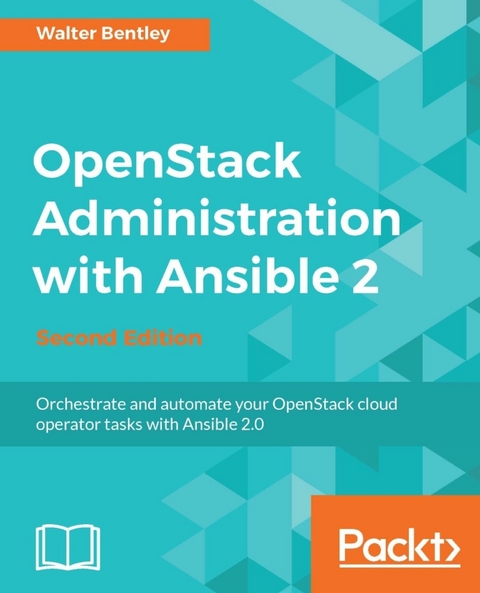
OpenStack Administration with Ansible 2 - Second Edition (eBook)
230 Seiten
Packt Publishing (Verlag)
978-1-78712-013-6 (ISBN)
Most organizations are seeking methods to improve business agility because they have realized just having a cloud is not enough. Being able to improve application deployments, reduce infrastructure downtime, and eliminate daily manual tasks can only be accomplished through some sort of automation.
We start with a brief overview of OpenStack and Ansible 2 and highlight some best practices. Each chapter will provide an introduction to handling various Cloud Operator administration tasks such as managing containers within your cloud; setting up/utilizing open source packages for monitoring; creating multiple users/tenants; taking instance snapshots; and customizing your cloud to run multiple active regions. Each chapter will also supply a step-by-step tutorial on how to automate these tasks with Ansible 2.
Packed with real-world OpenStack administrative tasks, this book will walk you through working examples and explain how these tasks can be automated using one of the most popular open source automation tools on the market today.
Orchestrate and automate your OpenStack cloud operator tasks with Ansible 2.0About This BookAutomate real-world OpenStack cloud operator administrative tasksConstruct a collection of the latest automation code to save time on managing your OpenStack cloudManage containers on your cloud and check the health of your cloud using NagiosWho This Book Is ForThis book is aimed at OpenStack-based cloud operators and infrastructure and sys administrators who have some knowledge of OpenStack and are seeking to automate taxing and manual tasks. This book is also for people new to automating cloud operations in general and the DevOps practice in particular.What You Will LearnEfficiently execute OpenStack administrative tasksFamiliarize yourself with how Ansible 2 works and assess the defined best practicesCreate Ansible 2 playbooks and rolesAutomate tasks to customize your OpenStack cloudReview OpenStack automation considerations when automating administrative tasksExamine and automate advanced OpenStack tasks and designated use casesGet a high-level overview of OpenStack and current production-ready projectsExplore OpenStack CLI tools and learn how to use themIn DetailMost organizations are seeking methods to improve business agility because they have realized just having a cloud is not enough. Being able to improve application deployments, reduce infrastructure downtime, and eliminate daily manual tasks can only be accomplished through some sort of automation.We start with a brief overview of OpenStack and Ansible 2 and highlight some best practices. Each chapter will provide an introduction to handling various Cloud Operator administration tasks such as managing containers within your cloud; setting up/utilizing open source packages for monitoring; creating multiple users/tenants; taking instance snapshots; and customizing your cloud to run multiple active regions. Each chapter will also supply a step-by-step tutorial on how to automate these tasks with Ansible 2.Packed with real-world OpenStack administrative tasks, this book will walk you through working examples and explain how these tasks can be automated using one of the most popular open source automation tools on the market today.Style and approachThis book is a concise, fast-paced guide filled with real-world scenarios that will execute OpenStack administrative tasks efficiently. It serves as a quick reference guide for not just OpenStack functions, but also for creating future Ansible code.
| Erscheint lt. Verlag | 26.12.2016 |
|---|---|
| Sprache | englisch |
| Themenwelt | Mathematik / Informatik ► Informatik ► Netzwerke |
| ISBN-10 | 1-78712-013-9 / 1787120139 |
| ISBN-13 | 978-1-78712-013-6 / 9781787120136 |
| Informationen gemäß Produktsicherheitsverordnung (GPSR) | |
| Haben Sie eine Frage zum Produkt? |
 EPUB (Ohne DRM)
Digital Rights Management: ohne DRM
Dieses eBook enthält kein DRM oder Kopierschutz. Eine Weitergabe an Dritte ist jedoch rechtlich nicht zulässig, weil Sie beim Kauf nur die Rechte an der persönlichen Nutzung erwerben.
Dateiformat: EPUB (Electronic Publication)
EPUB ist ein offener Standard für eBooks und eignet sich besonders zur Darstellung von Belletristik und Sachbüchern. Der Fließtext wird dynamisch an die Display- und Schriftgröße angepasst. Auch für mobile Lesegeräte ist EPUB daher gut geeignet.
Systemvoraussetzungen:
PC/Mac: Mit einem PC oder Mac können Sie dieses eBook lesen. Sie benötigen dafür die kostenlose Software Adobe Digital Editions.
eReader: Dieses eBook kann mit (fast) allen eBook-Readern gelesen werden. Mit dem amazon-Kindle ist es aber nicht kompatibel.
Smartphone/Tablet: Egal ob Apple oder Android, dieses eBook können Sie lesen. Sie benötigen dafür eine kostenlose App.
Geräteliste und zusätzliche Hinweise
Buying eBooks from abroad
For tax law reasons we can sell eBooks just within Germany and Switzerland. Regrettably we cannot fulfill eBook-orders from other countries.
aus dem Bereich