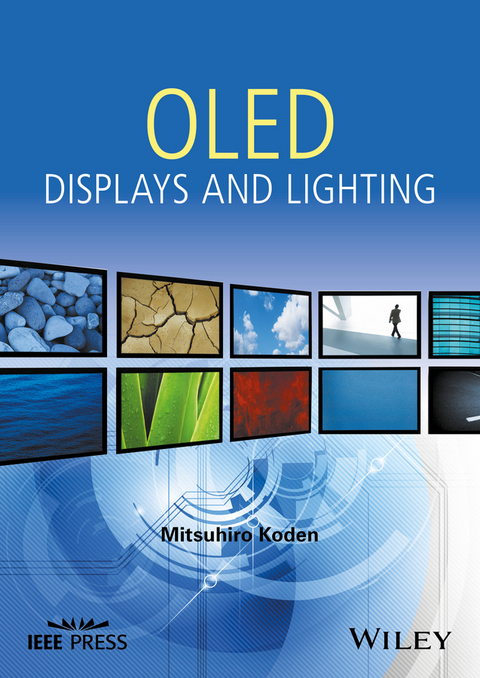
OLED Displays and Lighting (eBook)
John Wiley & Sons (Verlag)
978-1-119-04050-7 (ISBN)
Explains the fundamentals and practical applications of flat and flexible OLEDs for displays and lighting
Organic light-emitting diodes (OLEDs) have emerged as the leading technology for the new display and lighting market. OLEDs are solid-state devices composed of thin films of organic molecules that create light with the application of electricity. OLEDs can provide brighter, crisper displays on electronic devices and use less power than conventional light-emitting diodes (LEDs) or liquid crystal displays (LCDs) used today. This book covers both the fundamentals and practical applications of flat and flexible OLEDs.
Key features:
- Covers all of the aspects necessary to the design and manufacturing of OLED displays and lighting.
- Explains the fundamental basic technologies and also related technologies which might contribute to the next innovation in the industry.
- Provides several indications for future innovation in the OLED industry.
- Includes coverage of OLED vacuum deposition type and solution type materials.
The book is essential reading for early career engineers developing OLED devices and OLED related technologies in industrial companies, such as OLED device fabrication companies.
Dr. Koden is currently a Professor at the Innovation Center for Organic Electronics (INOEL) at Yamagata University, Japan. He is the author/ co-author of more than 70 papers and articles, and is the inventor of more than 150 patents. Prof. Koden has extensive R&D industrial experience from his 30 year career at Sharp Corporation.
Explains the fundamentals and practical applications of flat and flexible OLEDs for displays and lighting Organic light-emitting diodes (OLEDs) have emerged as the leading technology for the new display and lighting market. OLEDs are solid-state devices composed of thin films of organic molecules that create light with the application of electricity. OLEDs can provide brighter, crisper displays on electronic devices and use less power than conventional light-emitting diodes (LEDs) or liquid crystal displays (LCDs) used today. This book covers both the fundamentals and practical applications of flat and flexible OLEDs. Key features: Covers all of the aspects necessary to the design and manufacturing of OLED displays and lighting. Explains the fundamental basic technologies and also related technologies which might contribute to the next innovation in the industry. Provides several indications for future innovation in the OLED industry. Includes coverage of OLED vacuum deposition type and solution type materials. The book is essential reading for early career engineers developing OLED devices and OLED related technologies in industrial companies, such as OLED device fabrication companies.
Dr. Koden is currently a Professor at the Innovation Center for Organic Electronics (INOEL) at Yamagata University, Japan. He is the author/ co-author of more than 70 papers and articles, and is the inventor of more than 150 patents. Prof. Koden has extensive R&D industrial experience from his 30 year career at Sharp Corporation.
Title Page 5
Copyright Page 6
Contents 7
Preface 11
Chapter 1 History of OLEDs 13
References 22
Chapter 2 Fundamentals of OLEDs 24
2.1 Principle of the OLED 24
2.2 Fundamental Structure of the OLED 26
2.3 Features of the OLED 27
Chapter 3 Light Emission Mechanism 29
3.1 Fluorescent OLEDs 29
3.2 Phosphorescent OLEDs 31
3.3 Thermally Activated Delayed Fluorescent OLEDs 33
3.4 Energy Diagram 33
3.5 Light Emission Efficiency 35
References 36
Chapter 4 OLED Materials 37
4.1 Types of OLED Materials 38
4.2 Anode Materials 39
4.3 Evaporated Organic Materials (Small Molecular Materials) 41
4.3.1 Hole Injection Materials 41
4.3.2 Hole Transport Materials 44
4.3.3 Emitting Materials and Host Materials in Fluorescent Emission Layer 45
4.3.4 Emitting Materials and Host Materials in Phosphorescent Emission Layer 46
4.3.5 Emitting Materials and Host Materials in TADF Emission Layers 54
4.3.6 Electron Transport Materials 55
4.3.7 Electron Injection Materials and Cathodes 57
4.3.8 Charge-Carrier and Exciton Blocking Materials 58
4.3.9 N-Dope and P-Dope Materials 61
4.4 Solution Materials 62
4.4.1 Polymer Materials 62
4.4.2 Dendrimers 73
4.4.3 Small Molecules 81
4.5 Molecular Orientation of Organic Materials 82
References 83
Chapter 5 OLED Devices 87
5.1 Bottom Emission, Top Emission, and Transparent Types 87
5.2 Normal and Inverted Structures 91
5.3 White OLEDs 93
5.4 Full-Color Technology 96
5.4.1 RGB-Side-by-Side 99
5.4.2 White + CF 99
5.4.3 Blue Emission with Color Changing Medium (CCM) 100
5.5 Micro-Cavity Structure 101
5.6 Multi-Photon OLED 103
5.7 Encapsulation 106
5.7.1 Thin Film Encapsulation 111
5.7.2 Desiccant Technologies 112
References 112
Chapter 6 OLED Fabrication Process 115
6.1 Vacuum Evaporation Process 115
6.1.1 Mask Deposition 116
6.1.2 Three Types of Evaporation Methods 116
6.1.3 Ultra-High Vacuum 117
6.2 Wet Processes 119
6.3 Laser Processes 126
References 127
Chapter 7 Performance of OLEDs 129
7.1 Characteristics of OLEDs 129
7.2 Lifetime 132
7.2.1 Storage Lifetime 133
7.2.2 Driving Lifetime 133
7.3 Temperature Measurement of OLED Devices 136
References 138
Chapter 8 OLED Display 139
8.1 Features of OLED Displays 140
8.2 Types of OLED Displays 140
8.3 Passive-Matrix OLED Display 142
8.4 Active-Matrix OLED Display 144
8.4.1 TFT Circuit Technologies 145
8.4.2 TFT Device Technologies 149
8.4.3 Commercialized and Prototype AM-OLED Displays 151
References 156
Chapter 9 OLED Lighting 159
9.1 Appearance of OLED Lighting 159
9.2 Features of OLED Lighting 160
9.3 Fundamental Technologies of OLED Lighting 164
9.4 Light Extraction Enhancement Technologies 166
9.5 Performance of OLED Lighting 171
9.6 Color Tunable OLED Lighting 171
9.7 Application of OLED Lighting – Products and Prototypes 173
References 176
Chapter 10 Flexible OLEDs 178
10.1 Early Studies of Flexible OLEDs 178
10.2 Flexible Substrates 179
10.2.1 Ultra-Thin Glass 180
10.2.2 Stainless Steel Foil 183
10.2.3 Plastic Films 184
10.3 Flexible OLED Displays 186
10.3.1 Flexible OLED Displays on Ultra-Thin Glass 188
10.3.2 Flexible OLED Displays on Stainless Steel Foil 188
10.3.3 Flexible OLED Displays on Plastic Film 189
10.4 Flexible OLED Lighting 193
10.4.1 Flexible OLED Lighting on Ultra-Thin Glass 194
10.4.2 Flexible OLED Lighting on Stainless Steel Foil 196
10.4.3 Flexible OLED Lighting on Plastic Films 196
10.5 Toward the Flexible 198
References 198
Chapter 11 New Technologies 201
11.1 Non-ITO Transparent Electrodes 201
11.1.1 Conducting Polymer 202
11.1.2 Stacked Layer Using Ag 206
11.1.3 Silver Nanowire (AgNW) 207
11.1.4 Carbon Nanotube (CNT) 208
11.2 Organic TFT 209
11.3 Wet-Processed TFT 210
11.4 Novel Wet-Processed or Printed OLED 213
11.5 Roll-to-Roll Equipment Technologies 215
11.6 Quantum Dot 216
References 218
Index 221
EULA 235
| Erscheint lt. Verlag | 15.11.2016 |
|---|---|
| Reihe/Serie | IEEE Press |
| Sprache | englisch |
| Themenwelt | Informatik ► Weitere Themen ► Hardware |
| Technik ► Elektrotechnik / Energietechnik | |
| Schlagworte | application • Applications • brighter • Conventional • Create • Crystal • Dünne Schichten, Oberflächen u. Grenzflächen • devices • diodes • Displays • Dünne Schichten, Oberflächen u. Grenzflächen • Electrical & Electronics Engineering • Electrical Engineering - Displays • electricity • Electronic • Elektronische Displays • Elektrotechnik u. Elektronik • Films • Flat • Flexible • LESS • light • lightemitting • Materials Science • Materialwissenschaften • Molecules • OLED • OLEDs • organic • Organic electronics • Organische Elektronik • Practical • solidstate • thin • Thin Films, Surfaces & Interfaces |
| ISBN-10 | 1-119-04050-7 / 1119040507 |
| ISBN-13 | 978-1-119-04050-7 / 9781119040507 |
| Informationen gemäß Produktsicherheitsverordnung (GPSR) | |
| Haben Sie eine Frage zum Produkt? |
 PDF (Adobe DRM)
Kopierschutz: Adobe-DRM
Adobe-DRM ist ein Kopierschutz, der das eBook vor Mißbrauch schützen soll. Dabei wird das eBook bereits beim Download auf Ihre persönliche Adobe-ID autorisiert. Lesen können Sie das eBook dann nur auf den Geräten, welche ebenfalls auf Ihre Adobe-ID registriert sind.
Details zum Adobe-DRM
Dateiformat: PDF (Portable Document Format)
Mit einem festen Seitenlayout eignet sich die PDF besonders für Fachbücher mit Spalten, Tabellen und Abbildungen. Eine PDF kann auf fast allen Geräten angezeigt werden, ist aber für kleine Displays (Smartphone, eReader) nur eingeschränkt geeignet.
Systemvoraussetzungen:
PC/Mac: Mit einem PC oder Mac können Sie dieses eBook lesen. Sie benötigen eine
eReader: Dieses eBook kann mit (fast) allen eBook-Readern gelesen werden. Mit dem amazon-Kindle ist es aber nicht kompatibel.
Smartphone/Tablet: Egal ob Apple oder Android, dieses eBook können Sie lesen. Sie benötigen eine
Geräteliste und zusätzliche Hinweise
Buying eBooks from abroad
For tax law reasons we can sell eBooks just within Germany and Switzerland. Regrettably we cannot fulfill eBook-orders from other countries.
aus dem Bereich