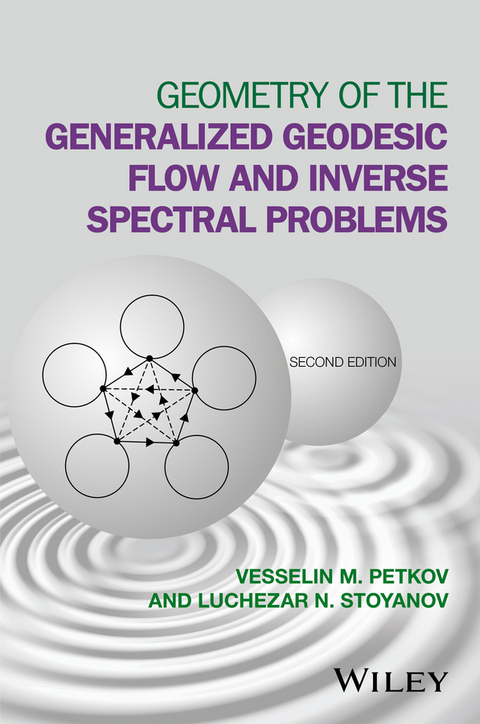
Geometry of the Generalized Geodesic Flow and Inverse Spectral Problems (eBook)
John Wiley & Sons (Verlag)
978-1-119-10769-9 (ISBN)
This book is a new edition of a title originally published in1992. No other book has been published that treats inverse spectral and inverse scattering results by using the so called Poisson summation formula and the related study of singularities. This book presents these in a closed and comprehensive form, and the exposition is based on a combination of different tools and results from dynamical systems, microlocal analysis, spectral and scattering theory.
The content of the first edition is still relevant, however the new edition will include several new results established after 1992; new text will comprise about a third of the content of the new edition. The main chapters in the first edition in combination with the new chapters will provide a better and more comprehensive presentation of importance for the applications inverse results. These results are obtained by modern mathematical techniques which will be presented together in order to give the readers the opportunity to completely understand them. Moreover, some basic generic properties established by the authors after the publication of the first edition establishing the wide range of applicability of the Poison relation will be presented for first time in the new edition of the book.
This book is a new edition of a title originally published in1992. No other book has been published that treats inverse spectral and inverse scattering results by using the so called Poisson summation formula and the related study of singularities. This book presents these in a closed and comprehensive form, and the exposition is based on a combination of different tools and results from dynamical systems, microlocal analysis, spectral and scattering theory.The content of the first edition is still relevant, however the new edition will include several new results established after 1992; new text will comprise about a third of the content of the new edition. The main chapters in the first edition in combination with the new chapters will provide a better and more comprehensive presentation of importance for the applications inverse results. These results are obtained by modern mathematical techniques which will be presented together in order to give the readers the opportunity to completely understand them. Moreover, some basic generic properties established by the authors after the publication of the first edition establishing the wide range of applicability of the Poison relation will be presented for first time in the new edition of the book.
Vesselin Petkov, Professor Emeritus, IMB, Unversité de Bordeaux, France. Luchezar Stoyanov, Professor, School of Mathematics and Statistics, University of Western Australia.
"Thus, while solving the usual inverse problems is the rst main concern, a second
one is the study of generic properties, supported by the bumpy surfaces theorem.
Understanding scattering and sojourn times is the third main topic, and the fourth is
obtaining inverse scattering results. The material added for this edition focuses on the
latter two" Boris Hasselblatt on behalf of Mathematical Reviews, October 2017
Preface
This monograph is devoted to the analysis of some inverse problems concerning the spectrum of the Laplace operator in a bounded domain , and of the scattering length spectrum (SLS) (the set of sojourn times of reflecting rays) of the scattering kernel associated with scattering in the exterior of a bounded obstacle . In both cases our aim is to obtain some geometric information about (resp. K from spectral (resp. scattering) data. We treat both inverse problems by using similar techniques based on properties of the generalized geodesic flow in and on microlocal analysis of the corresponding mixed problems.
Let , be a closed bounded domain with C∞ smooth boundary , and let A be the self-adjoint operator in related to the Laplacian
in with Dirichlet boundary condition on . The spectrum of A is given by a sequence
of eigenvalues for which the problem
has a non-trivial solution . The counting function
where every eigenvalue is counted with its multiplicity, admits a polynomial bound
Moreover, it is known (see [Se] [H4] [SaV]) that N(λ) has a Weyl type asymptotic
as λ → ∞. Thus, from the spectrum (0.1) we can recover the volume of . In 1911, Weyl [W] conjectured that for every bounded domain in with smooth boundary we have
as λ → ∞. Ivrii [Ivl] proved that if the points for which there exists a periodic billiard trajectory in issued from x in direction v form a subset of Lebesgue measure zero in the space , then the asymptotic (0.4) holds. Therefore, for such domain becomes another spectral invariant. It is not known so far if the assumption in Ivrii's result is alwayssatisfied.
To obtain more information from the knowledge of the spectrum , it is convenient to examine some distributions determined by the sequence (0.1). The distribution
has the asymptotic
and the constants cj are spectral invariants. Moreover, one can recover and from c0 and c1.
In his classical work Kac [Kac] posed the problem of recovering the shape of a strictly convex domain from the spectrum (0.1). This article has had a big influence on the investigations of various inverse spectral problems for manifolds with and without boundary as well as on the analysis of the so-called isospectral manifolds, that is manifolds for which the spectra of the corresponding Laplace–Beltrami operators coincide.
To determine a strictly convex planar domain , modulo Euclidean transformations, it suffices to know the curvature of at each point . In general, the spectral data , given by (0.5), is not sufficient to determine the function . Let us mention that the distribution τ(t) is singular only at t = 0. A distribution related to having a larger singular set is
This distribution is singular at 0 and
(see [Me3] [Iv2]). The constants dj provide other spectral invariants, and the first two determine again and .
It turns out that the set of singularities of σ(t) is related to the so-called length spectrum of . By definition, is the set of periods (lengths) of all periodic generalized geodesics in . Let us mention that the generalized geodesics are the projections in of the generalized bicharacteristics of the wave operator in defined by Melrose and Sjöstrand ([MS1] [MS2]). We refer to Chapter 1 for the precise definitions. The so-called Poisson relation for manifolds with boundary has the form
For strictly convex (concave) domains this relation has been established by Anderson and Melrose [AM]. Its proof for general domains is based on the results in [MS2] on the propagation of C∞ singularities. A relation similar to (0.6) was first established for Riemannian manifolds without boundary. This was achieved independently by Chazarain [Ch2] and Duistermaat and Guillemin [DG]. Moreover, under certain assumptions on the periodic geodesics with period T, the leading singularity at T was examined in [DG].
It is natural to investigate the inverse inclusion in (0.7), however in the general case, very little is known so far. For certain strictly convex planar domains Marvizi and Melrose [MM] found a sequence of closed billiard trajectories in whose lengths belong to sing supp σ(t). It was expected ([Cl] [GM3]) that for generic strictly convex domains in the inclusion (0.7) could become an equality. Such a result was established in [PS2] (see also [PSl]) for all generic domains (not necessarily convex). Its analogue in the case n > 2 is proved only for strictly convex domains [S3]. The results, just mentioned, form one of the main topics in this book.
If the equality
holds for some domain , then the lengths of the periodic geodesics in can be considered as spectral invariants. From them one can determine various spectral invariants. The reader may consult [MM] [Cl] [Pol] [Po2] [Po3] [PoT] [HeZ] and [Z] for more information and further results in this direction.
Let be the set of all periodic geodesics in . For we denote by c01-math10}}}}} the period (length) of γ. There are three types of elements of : periodic reflecting rays (i.e. closed billiard trajectories in ), closed geodesics on and periodic geodesics of mixed type, containing both linear segments in and geodesic segments on . Amongst the periodic reflecting rays we will distinguish those without segments tangent to the boundary ; such rays will be called ordinary. Similarly to the case of closed geodesics on , for each ordinary periodic reflecting ray γ one can naturally define a Poincaré map
| Erscheint lt. Verlag | 16.11.2016 |
|---|---|
| Sprache | englisch |
| Themenwelt | Mathematik / Informatik ► Mathematik ► Geometrie / Topologie |
| Technik | |
| Schlagworte | Applied Mathematics in Science • generalized geodesics • generic properties of periodic geodesics • Geodätischer Fluss • Geometrie • Geometrie u. Topologie • Geometry & Topology • inverse scattering problems • inverse spectral problems • length spectrum • Mathematics • Mathematics Special Topics • Mathematik • Mathematik in den Naturwissenschaften • periodic geodesics • Poisson relation • reflecting rays • scattering amplitude • scattering rays • Spezialthemen Mathematik |
| ISBN-10 | 1-119-10769-5 / 1119107695 |
| ISBN-13 | 978-1-119-10769-9 / 9781119107699 |
| Informationen gemäß Produktsicherheitsverordnung (GPSR) | |
| Haben Sie eine Frage zum Produkt? |
 EPUB (Adobe DRM)
Kopierschutz: Adobe-DRM
Adobe-DRM ist ein Kopierschutz, der das eBook vor Mißbrauch schützen soll. Dabei wird das eBook bereits beim Download auf Ihre persönliche Adobe-ID autorisiert. Lesen können Sie das eBook dann nur auf den Geräten, welche ebenfalls auf Ihre Adobe-ID registriert sind.
Details zum Adobe-DRM
Dateiformat: EPUB (Electronic Publication)
EPUB ist ein offener Standard für eBooks und eignet sich besonders zur Darstellung von Belletristik und Sachbüchern. Der Fließtext wird dynamisch an die Display- und Schriftgröße angepasst. Auch für mobile Lesegeräte ist EPUB daher gut geeignet.
Systemvoraussetzungen:
PC/Mac: Mit einem PC oder Mac können Sie dieses eBook lesen. Sie benötigen eine
eReader: Dieses eBook kann mit (fast) allen eBook-Readern gelesen werden. Mit dem amazon-Kindle ist es aber nicht kompatibel.
Smartphone/Tablet: Egal ob Apple oder Android, dieses eBook können Sie lesen. Sie benötigen eine
Geräteliste und zusätzliche Hinweise
Buying eBooks from abroad
For tax law reasons we can sell eBooks just within Germany and Switzerland. Regrettably we cannot fulfill eBook-orders from other countries.
aus dem Bereich