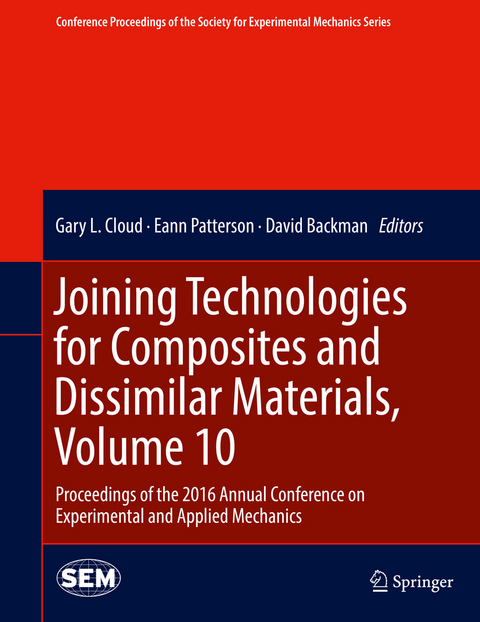
Joining Technologies for Composites and Dissimilar Materials, Volume 10 (eBook)
VII, 123 Seiten
Springer International Publishing (Verlag)
978-3-319-42426-2 (ISBN)
Joining Technologies for Composites and Dissimilar Materials, Volume 10 of the Proceedings of the 2016 SEM Annual Conference & Exposition on Experimental and Applied Mechanics, the tenth volume of ten from the Conference, brings together contributions to this important area of research and engineering. The collection presents early findings and case studies on a wide range of areas, including:
- Composite Joints
- Non-Adhesive Bonding
- Adhesive Bonding
- Joining of Ceramic & Other Materials
Gary Cloud-Michigan State University, USA; Eann Patterson - University of Liverpool, UK; David Backman-National Research Council Canada, Canada.
Gary Cloud-Michigan State University, USA; Eann Patterson – University of Liverpool, UK; David Backman-National Research Council Canada, Canada.
Preface 5
Contents 6
Chapter 1: How to Join Fiber-Reinforced Composite Parts: An Experimental Investigation 7
1.1 Introduction 7
1.2 Designed Experiment for Joining Socket to Pultrusion 10
1.2.1 Parameter Selection Stage 1: Screening 10
1.2.2 Parameter Selection Stage 2: Groove Design 12
1.2.3 Parameter Selection Stage 3: Final Design 13
1.3 Conclusions 14
References 15
Chapter 2: Analysis of a Composite Pi/T-Joint Using an FE Model and DIC 16
2.1 Introduction 16
2.2 Experimental Method 17
2.2.1 Manufacture of the Pi-joints 17
2.2.2 Pull-Out and Damage Resistance (DIC) 19
2.3 Numerical Simulations 19
2.3.1 Mesh, Gap Creation and Material Models 20
2.3.2 Boundary Conditions and Loading 20
2.4 Results and Discussion 21
2.4.1 Experimental Pull-Out Results 21
2.4.2 Digital Image Correlation Results 21
2.4.3 Numerical Simulation Results 21
2.4.4 Comparison of DIC and FE Using Image Decomposition 22
2.5 Conclusions 23
References 24
Chapter 3: 5xxx Aluminum Sensitization and Application of Laminated Composite Patch Repairs 25
3.1 Background 25
3.2 Sensitization and Detection 27
3.3 Mitigation and Repair of Sensitized Aluminum 28
3.3.1 Weld Repair 28
3.3.2 Cold Worked Welded Repair 28
3.3.3 Un-Weldable Material 29
3.4 Alternative Repair Methods 29
3.4.1 Bonded Aluminum Repair 29
3.4.2 Composite Patch Repair 30
3.5 Composite Patch Strength and Durability 30
3.6 Summary 34
References 35
Chapter 4: Investigation and Improvement of Composite T-Joints with Metallic Arrow-Pin Reinforcement 37
4.1 Introduction 37
4.2 T-Joint Design Specification 38
4.3 Experimental Characterization 39
4.4 Modeling and Simulation 42
4.5 Conclusion 44
References 44
Chapter 5: Review of Natural Joints and Bio-Inspired CFRP to Steel joints 45
5.1 Introduction 45
5.2 Review of Natural Joint Systems 46
5.2.1 Joining Method—Network Structures 46
5.2.2 Joining Method: Transitional Zone of Stiffness 47
5.2.3 Options to Increase the Strength of Engineering Joining Systems 47
5.3 Bio-Inspired CFRP to Perforated Steel Joints 48
5.3.1 Numerical Modelling 48
5.3.2 Specimen Manufacture and Tensile Testing 48
5.4 Results and Discussion of Bio-Inspired CFRP to Perforated Steel Joints 49
5.4.1 Load-Displacement Response 49
5.4.2 Maximum Load 49
5.4.3 Failure Observation Using High Speed Camera 49
5.5 Conclusions 51
References 51
Chapter 6: Fabrication of 3D Thermoplastic Sandwich Structures Utilizing Ultrasonic Spot Welding 53
6.1 Introduction 53
6.2 Characterization of Ultrasonic Spot Welds in Polycarbonate 55
6.3 Fabrication of Sandwich Structures 57
6.4 Mechanical Characterization of Sandwich Structures 58
6.4.1 3-Point Bend Testing 58
6.4.2 Impact Testing 60
6.5 Conclusions 61
References 61
Chapter 7: Impact and Lap Shear Properties of Ultrasonically Spot Welded Composite Lap Joints 63
7.1 Introduction 63
7.2 Ultrasonic Spot Welding of a Composite Material 64
7.3 Characterization of Ultrasonically Spot Welded Tecanat GF 20 66
7.3.1 Ultrasonically Spot Welded Lap Joints 66
7.3.2 Adhesively Joined Lap Joints 68
7.3.3 Comparison of Adhesively Joined and USSW Joints 69
7.4 Finite Element Analysis 70
7.5 Microscopy of Welds 71
7.6 Conclusions 71
References 72
Chapter 8: Numerical and Experimental Characterization of Hybrid Fastening System in Composite Joints 74
8.1 Introduction 74
8.2 Materials 75
8.3 Fabrication of Bolted Joints 75
8.4 Experimental Setup 76
8.5 FEM Modeling 76
8.5.1 Modeling and Meshing 76
8.5.2 Material Modeling 77
8.6 Results and Discussion 78
8.7 Conclusions 82
References 83
Chapter 9: Application of Digital Image Correlation to the Thick Adherend Shear Test 84
1 Introduction 84
2 Experimental 85
2.1 KGR-1 Extensometer 85
2.2 Digital Image Correlation 85
2.3 Manufacturing 87
2.4 Testing 87
3 Data Processing 87
3.1 Correcting DIC Displacement Measurements for Rigid Body Rotation 88
4 Results 89
4.1 Shear Stress-Shear Strain Curves 89
4.2 Statistical Testing 89
5 Discussion 91
6 Conclusions 92
References 93
Chapter 10: Interfacial Strength of Thin Film Measurement by Laser-Spallation 94
10.1 Introduction 94
10.2 Material and Experimental Setup 95
10.2.1 SnO2 Thin Film Deposition 95
10.2.2 Aluminum Thin Film Back Layer 95
10.2.3 Laser Spallation 95
10.2.4 Thin Film Characterization 96
10.3 Result and Discussion 97
10.4 Residual Stress Measurement After Laser Spallation Using Two Dimensional ?XRD Data 98
10.5 Peak Selection for Residual Stress Measurement 98
10.6 Conclusion 101
References 101
Chapter 11: Joining of UHTC Composites Using Metallic Interlayer 102
11.1 Introduction 102
11.2 Materials and Experimental Procedures 103
11.2.1 HfB2- and ZrB2-Based Composites 103
11.2.2 Transient Liquid Phase (TLP) Bonding Using Ni–Nb–Ni Interlayer 103
11.2.3 Reactive Bonding Using Ti or Zr Interlayer 105
11.2.4 Transient Liquid Phase (TLP) Bonding Using ZrB2-Ni Powder-Based Interlayer 105
11.2.5 Four-Point Bending Test of the Joints 105
11.3 Results and Discussion 105
11.3.1 Transient Liquid Phase (TLP) Bonding Using Ni-Nb Interlayer 105
11.3.2 Reactive Bonding Using Ti or Zr Interlayer 106
11.3.3 Transient Liquid Phase (TLP) Bonding Using ZrB2-Ni Powder-Based Interlayer 107
11.4 Summary 107
References 108
Chapter 12: Metal-to-Composite Structural Joining for Drivetrain Applications 110
12.1 Introduction 110
12.2 Shear Strength 111
12.2.1 Shear Strength Samples 111
12.2.2 Shear Strength Verification 112
12.2.3 Shear Strength with Metal Surface Preparation 112
12.3 Adhesive Bonding 112
12.3.1 Adhesive Bond Samples 112
12.3.2 Adhesive Bond Verification 113
12.3.3 Adhesive Bond of Rotational Parts 114
12.4 Thermal Range 114
12.4.1 Thermal Range Samples 114
12.4.2 Thermal Range Verification 114
12.4.3 Thermal Capability of Composite to Metal Interfaces 115
12.5 Structural Behavior 116
12.5.1 Structural Behavior Samples 116
12.5.2 Structural Behavior Verification 116
12.5.3 Full Prototype Dynamometer Duty Cycles 116
12.6 Conclusion: Utility of Composite-and-Metal Components for Use in Drivetrains 117
References 117
Chapter 13: Short-Term Preload Relaxation in Composite Bolted Joints Monitored with Reusable Optical Sensors 118
1 Introduction 118
2 Specimen Preparation 119
2.1 Bolt Tension Monitor Fabrication 119
2.2 Bolted Joints Assembly 120
3 Experimental Results and Discussion 121
3.1 Bolt Tension Monitor Features and Calibration 121
3.2 Data Analysis Using a Single-Parameter Model for Preload Relaxation 121
3.3 Short-Term Preload Relaxation Measurements by Hot Melt Adhesive-Based Bolt Tension Monitor for 4500 N Initial Preload 122
3.4 Short-Term Preload Relaxation Measurements by PLA-Based Bolt Tension Monitor for 4500 N Initial Preload 123
3.5 Short-Term Preload Relaxation Measurements by PLA-Based Bolt Tension Monitor for 8000 N Initial Preload 124
3.6 Evaluation of Thru-Hole Load Cell for Preload Relaxation Measurements 125
4 Conclusions 125
References 126
| Erscheint lt. Verlag | 8.10.2016 |
|---|---|
| Reihe/Serie | Conference Proceedings of the Society for Experimental Mechanics Series | Conference Proceedings of the Society for Experimental Mechanics Series |
| Zusatzinfo | VII, 123 p. 111 illus., 91 illus. in color. |
| Verlagsort | Cham |
| Sprache | englisch |
| Themenwelt | Mathematik / Informatik ► Mathematik ► Wahrscheinlichkeit / Kombinatorik |
| Technik ► Bauwesen | |
| Technik ► Maschinenbau | |
| Schlagworte | composite materials • Conference Proceedings of the Society for Experimental Mechanics • Joining Dissimilar Materials • Joining Technologies • Structural Mechanics |
| ISBN-10 | 3-319-42426-2 / 3319424262 |
| ISBN-13 | 978-3-319-42426-2 / 9783319424262 |
| Informationen gemäß Produktsicherheitsverordnung (GPSR) | |
| Haben Sie eine Frage zum Produkt? |
 PDF (Wasserzeichen)
DRM: Digitales Wasserzeichen
Dieses eBook enthält ein digitales Wasserzeichen und ist damit für Sie personalisiert. Bei einer missbräuchlichen Weitergabe des eBooks an Dritte ist eine Rückverfolgung an die Quelle möglich.
Dateiformat: PDF (Portable Document Format)
Mit einem festen Seitenlayout eignet sich die PDF besonders für Fachbücher mit Spalten, Tabellen und Abbildungen. Eine PDF kann auf fast allen Geräten angezeigt werden, ist aber für kleine Displays (Smartphone, eReader) nur eingeschränkt geeignet.
Systemvoraussetzungen:
PC/Mac: Mit einem PC oder Mac können Sie dieses eBook lesen. Sie benötigen dafür einen PDF-Viewer - z.B. den Adobe Reader oder Adobe Digital Editions.
eReader: Dieses eBook kann mit (fast) allen eBook-Readern gelesen werden. Mit dem amazon-Kindle ist es aber nicht kompatibel.
Smartphone/Tablet: Egal ob Apple oder Android, dieses eBook können Sie lesen. Sie benötigen dafür einen PDF-Viewer - z.B. die kostenlose Adobe Digital Editions-App.
Buying eBooks from abroad
For tax law reasons we can sell eBooks just within Germany and Switzerland. Regrettably we cannot fulfill eBook-orders from other countries.
aus dem Bereich