


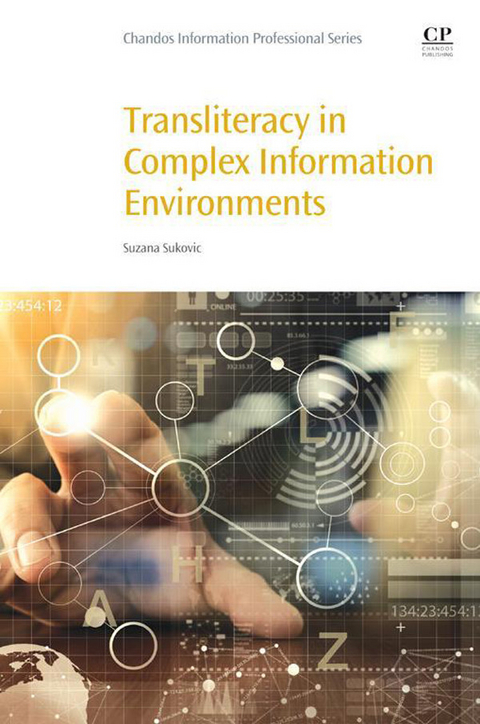
Transliteracy in Complex Information Environments (eBook)
174 Seiten
Elsevier Science (Verlag)
978-0-08-100901-7 (ISBN)
Suzana Sukovic is a librarian, researcher and educator with extensive professional experience in the information industry, mainly in the academic sector. She has also worked in academic teaching and research roles. She has completed a number of innovative projects, including applications of technology in research, teaching and learning. Suzana has published papers on issues related to technology in scholarly research, and on innovation and creativity in libraries. Her doctoral thesis explored roles of electronic texts in research projects in the human ities. Transliteracy, learning and knowledge creation, and library innovation are her main professional and research interests. She is currently Executive Director Educational Research & Evidence Based Practice, HETI (Health Education & Training Institute). She actively promotes research in the library and information profession through ALIA. She is Co-Chair of the ALIA Research Advisory Committee, and the founder and leader of ALIA LARK (Library Applied Research Kollektive).
Transliteracy in Complex Information Environments considers this relatively new concept, which has attracted a great deal of interest in the library and information field, particularly among practitioners. The notion of transliteracy arises in the context of increasingly complex information and communication environments characterised by multimodality and new roles of creators and consumers. Transliteracy concerns the ability to apply and transfer a range of skills and contextual insights to a variety of settings. Rather than focusing on any one skillset or technology, transliteracy is about fluidity of movement across a range of contexts. This book is concerned with processes of learning and knowledge creation. An understanding of transliteracy emergesfrom research data gathered in university and high school settings. Transliteracy is considered in relation to other literacies as an overarching framework. Applications in education and lifelong learning are discussed. Social aspects of transliteracy are considered in relation to academic cultures and broader social trends, particularly hybrid cultures- Provides an overarching model of transliteracy based on the well-established information literacy- Relates to a number of professional and academic fields, such as library and information, education, communication, media, and cultural studies- Integrates both professional and academic perspectives
| Erscheint lt. Verlag | 24.10.2016 |
|---|---|
| Sprache | englisch |
| Themenwelt | Geisteswissenschaften ► Sprach- / Literaturwissenschaft ► Sprachwissenschaft |
| Mathematik / Informatik ► Informatik | |
| Sozialwissenschaften ► Kommunikation / Medien ► Buchhandel / Bibliothekswesen | |
| Sozialwissenschaften ► Pädagogik | |
| Sozialwissenschaften ► Soziologie | |
| ISBN-10 | 0-08-100901-1 / 0081009011 |
| ISBN-13 | 978-0-08-100901-7 / 9780081009017 |
| Informationen gemäß Produktsicherheitsverordnung (GPSR) | |
| Haben Sie eine Frage zum Produkt? |
 EPUB (Adobe DRM)
Kopierschutz: Adobe-DRM
Adobe-DRM ist ein Kopierschutz, der das eBook vor Mißbrauch schützen soll. Dabei wird das eBook bereits beim Download auf Ihre persönliche Adobe-ID autorisiert. Lesen können Sie das eBook dann nur auf den Geräten, welche ebenfalls auf Ihre Adobe-ID registriert sind.
Details zum Adobe-DRM
Dateiformat: EPUB (Electronic Publication)
EPUB ist ein offener Standard für eBooks und eignet sich besonders zur Darstellung von Belletristik und Sachbüchern. Der Fließtext wird dynamisch an die Display- und Schriftgröße angepasst. Auch für mobile Lesegeräte ist EPUB daher gut geeignet.
Systemvoraussetzungen:
PC/Mac: Mit einem PC oder Mac können Sie dieses eBook lesen. Sie benötigen eine
eReader: Dieses eBook kann mit (fast) allen eBook-Readern gelesen werden. Mit dem amazon-Kindle ist es aber nicht kompatibel.
Smartphone/Tablet: Egal ob Apple oder Android, dieses eBook können Sie lesen. Sie benötigen eine
Geräteliste und zusätzliche Hinweise
Buying eBooks from abroad
For tax law reasons we can sell eBooks just within Germany and Switzerland. Regrettably we cannot fulfill eBook-orders from other countries.
aus dem Bereich


