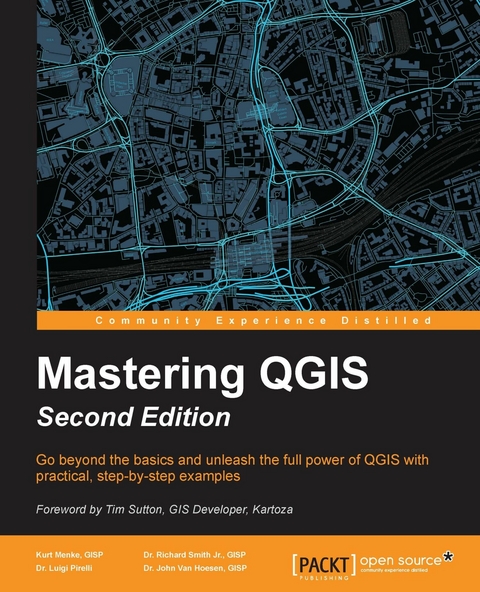
Mastering QGIS - Second Edition (eBook)
486 Seiten
Packt Publishing (Verlag)
978-1-78646-362-3 (ISBN)
Go beyond the basics and unleash the full power of QGIS with practical, step-by-step examples
About This Book
- This book is your one-stop solution to all of your GIS needs using the open source QGIS
- Master QGIS by learning about database integration, geoprocessing tools, Python scripts, advanced cartography, and custom plugins
- This example-rich, practical guide will help you create sophisticated analyses and maps
Who This Book Is For
If you are a GIS professional, a consultant, a student, or perhaps a fast learner who wants to go beyond the basics of QGIS, then this book is for you. It will prepare you to realize the full potential of QGIS.
What You Will Learn
- Create and manage a spatial database
- Get to know advanced techniques to style GIS data
- Prepare both vector and raster data for processing
- Add heat maps, live layer effects, and labels to your maps
- Master LAStools and GRASS integration with the Processing Toolbox
- Edit and repair topological data errors
- Automate workflows with batch processing and the QGIS Graphical Modeler
- Integrate Python scripting into your data processing workflows
- Develop your own QGIS plugin
In Detail
QGIS is an open source solution to GIS. It is widely used by GIS professionals all over the world. It is the leading alternative to the proprietary GIS software. Although QGIS is described as intuitive, it is also by default complex. Knowing which tools to use and how to apply them is essential to producing valuable deliverables on time.
Starting with a refresher on the QGIS basics, this book will take you all the way through to creating your first custom QGIS plugin. From the refresher, we will recap how to create, populate, and manage a spatial database. You'll also walk through styling GIS data, from creating custom symbols and color ramps to using blending modes. In the next section, you will discover how to prepare vector, heat maps, and create live layer effects, labeling, and raster data for processing. You'll also discover advanced data creation and editing techniques.
The last third of the book covers the more technical aspects of QGIS such as using LAStools and GRASS GIS's integration with the Processing Toolbox, how to automate workflows with batch processing, and how to create graphical models. Finally, you will see how to create and run Python data processing scripts and write your own QGIS plugin with pyqgis.
By the end of the book, you will understand how to work with all the aspects of QGIS, and will be ready to use it for any type of GIS work.
Style and approach
This step-by-step comprehensive guide will let you dig your teeth into working with spatial databases, creating your own QGIS plugins, and creating your own custom graphical models.
Go beyond the basics and unleash the full power of QGIS with practical, step-by-step examplesAbout This BookThis book is your one-stop solution to all of your GIS needs using the open source QGISMaster QGIS by learning about database integration, geoprocessing tools, Python scripts, advanced cartography, and custom pluginsThis example-rich, practical guide will help you create sophisticated analyses and mapsWho This Book Is ForIf you are a GIS professional, a consultant, a student, or perhaps a fast learner who wants to go beyond the basics of QGIS, then this book is for you. It will prepare you to realize the full potential of QGIS.What You Will LearnCreate and manage a spatial databaseGet to know advanced techniques to style GIS dataPrepare both vector and raster data for processingAdd heat maps, live layer effects, and labels to your mapsMaster LAStools and GRASS integration with the Processing ToolboxEdit and repair topological data errorsAutomate workflows with batch processing and the QGIS Graphical ModelerIntegrate Python scripting into your data processing workflowsDevelop your own QGIS pluginIn DetailQGIS is an open source solution to GIS. It is widely used by GIS professionals all over the world. It is the leading alternative to the proprietary GIS software. Although QGIS is described as intuitive, it is also by default complex. Knowing which tools to use and how to apply them is essential to producing valuable deliverables on time.Starting with a refresher on the QGIS basics, this book will take you all the way through to creating your first custom QGIS plugin. From the refresher, we will recap how to create, populate, and manage a spatial database. You'll also walk through styling GIS data, from creating custom symbols and color ramps to using blending modes. In the next section, you will discover how to prepare vector, heat maps, and create live layer effects, labeling, and raster data for processing. You'll also discover advanced data creation and editing techniques.The last third of the book covers the more technical aspects of QGIS such as using LAStools and GRASS GIS's integration with the Processing Toolbox, how to automate workflows with batch processing, and how to create graphical models. Finally, you will see how to create and run Python data processing scripts and write your own QGIS plugin with pyqgis.By the end of the book, you will understand how to work with all the aspects of QGIS, and will be ready to use it for any type of GIS work.Style and approachThis step-by-step comprehensive guide will let you dig your teeth into working with spatial databases, creating your own QGIS plugins, and creating your own custom graphical models.
| Erscheint lt. Verlag | 30.9.2016 |
|---|---|
| Sprache | englisch |
| Themenwelt | Mathematik / Informatik ► Informatik |
| ISBN-10 | 1-78646-362-8 / 1786463628 |
| ISBN-13 | 978-1-78646-362-3 / 9781786463623 |
| Informationen gemäß Produktsicherheitsverordnung (GPSR) | |
| Haben Sie eine Frage zum Produkt? |
 EPUB (Adobe DRM)
Kopierschutz: Adobe-DRM
Adobe-DRM ist ein Kopierschutz, der das eBook vor Mißbrauch schützen soll. Dabei wird das eBook bereits beim Download auf Ihre persönliche Adobe-ID autorisiert. Lesen können Sie das eBook dann nur auf den Geräten, welche ebenfalls auf Ihre Adobe-ID registriert sind.
Details zum Adobe-DRM
Dateiformat: EPUB (Electronic Publication)
EPUB ist ein offener Standard für eBooks und eignet sich besonders zur Darstellung von Belletristik und Sachbüchern. Der Fließtext wird dynamisch an die Display- und Schriftgröße angepasst. Auch für mobile Lesegeräte ist EPUB daher gut geeignet.
Systemvoraussetzungen:
PC/Mac: Mit einem PC oder Mac können Sie dieses eBook lesen. Sie benötigen eine
eReader: Dieses eBook kann mit (fast) allen eBook-Readern gelesen werden. Mit dem amazon-Kindle ist es aber nicht kompatibel.
Smartphone/Tablet: Egal ob Apple oder Android, dieses eBook können Sie lesen. Sie benötigen eine
Geräteliste und zusätzliche Hinweise
Buying eBooks from abroad
For tax law reasons we can sell eBooks just within Germany and Switzerland. Regrettably we cannot fulfill eBook-orders from other countries.
aus dem Bereich