


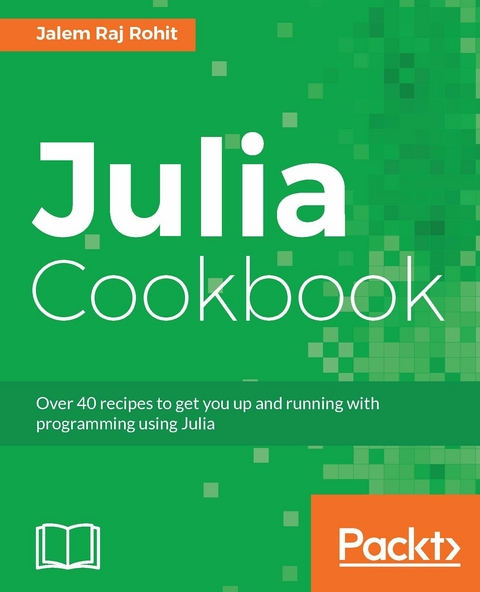
Julia Cookbook (eBook)
172 Seiten
Packt Publishing (Verlag)
978-1-78588-363-7 (ISBN)
Over 40 recipes to get you up and running with programming using Julia
About This Book
- Follow a practical approach to learn Julia programming the easy way
- Get an extensive coverage of Julia's packages for statistical analysis
- This recipe-based approach will help you get familiar with the key concepts in Juli
Who This Book Is For
This book is for data scientists and data analysts who are familiar with the basics of the Julia language. Prior experience of working with high-level languages such as MATLAB, Python, R, or Ruby is expected.
What You Will Learn
- Extract and handle your data with Julia
- Uncover the concepts of metaprogramming in Julia
- Conduct statistical analysis with StatsBase.jl and Distributions.jl
- Build your data science models
- Find out how to visualize your data with Gadfly
- Explore big data concepts in Julia
In Detail
Want to handle everything that Julia can throw at you and get the most of it every day? This practical guide to programming with Julia for performing numerical computation will make you more productive and able work with data more efficiently. The book starts with the main features of Julia to help you quickly refresh your knowledge of functions, modules, and arrays. We'll also show you how to utilize the Julia language to identify, retrieve, and transform data sets so you can perform data analysis and data manipulation.
Later on, you'll see how to optimize data science programs with parallel computing and memory allocation. You'll get familiar with the concepts of package development and networking to solve numerical problems using the Julia platform.
This book includes recipes on identifying and classifying data science problems, data modelling, data analysis, data manipulation, meta-programming, multidimensional arrays, and parallel computing. By the end of the book, you will acquire the skills to work more effectively with your data.
Style and approach
This book has a recipe-based approach to help you grasp the concepts of Julia programming.
Over 40 recipes to get you up and running with programming using JuliaAbout This BookFollow a practical approach to learn Julia programming the easy wayGet an extensive coverage of Julia's packages for statistical analysisThis recipe-based approach will help you get familiar with the key concepts in JuliWho This Book Is ForThis book is for data scientists and data analysts who are familiar with the basics of the Julia language. Prior experience of working with high-level languages such as MATLAB, Python, R, or Ruby is expected.What You Will LearnExtract and handle your data with JuliaUncover the concepts of metaprogramming in JuliaConduct statistical analysis with StatsBase.jl and Distributions.jlBuild your data science modelsFind out how to visualize your data with GadflyExplore big data concepts in JuliaIn DetailWant to handle everything that Julia can throw at you and get the most of it every day? This practical guide to programming with Julia for performing numerical computation will make you more productive and able work with data more efficiently. The book starts with the main features of Julia to help you quickly refresh your knowledge of functions, modules, and arrays. We'll also show you how to utilize the Julia language to identify, retrieve, and transform data sets so you can perform data analysis and data manipulation.Later on, you'll see how to optimize data science programs with parallel computing and memory allocation. You'll get familiar with the concepts of package development and networking to solve numerical problems using the Julia platform.This book includes recipes on identifying and classifying data science problems, data modelling, data analysis, data manipulation, meta-programming, multidimensional arrays, and parallel computing. By the end of the book, you will acquire the skills to work more effectively with your data.Style and approachThis book has a recipe-based approach to help you grasp the concepts of Julia programming.
| Erscheint lt. Verlag | 30.9.2016 |
|---|---|
| Sprache | englisch |
| Themenwelt | Mathematik / Informatik ► Informatik ► Programmiersprachen / -werkzeuge |
| ISBN-10 | 1-78588-363-1 / 1785883631 |
| ISBN-13 | 978-1-78588-363-7 / 9781785883637 |
| Informationen gemäß Produktsicherheitsverordnung (GPSR) | |
| Haben Sie eine Frage zum Produkt? |
 EPUB (Adobe DRM)
Kopierschutz: Adobe-DRM
Adobe-DRM ist ein Kopierschutz, der das eBook vor Mißbrauch schützen soll. Dabei wird das eBook bereits beim Download auf Ihre persönliche Adobe-ID autorisiert. Lesen können Sie das eBook dann nur auf den Geräten, welche ebenfalls auf Ihre Adobe-ID registriert sind.
Details zum Adobe-DRM
Dateiformat: EPUB (Electronic Publication)
EPUB ist ein offener Standard für eBooks und eignet sich besonders zur Darstellung von Belletristik und Sachbüchern. Der Fließtext wird dynamisch an die Display- und Schriftgröße angepasst. Auch für mobile Lesegeräte ist EPUB daher gut geeignet.
Systemvoraussetzungen:
PC/Mac: Mit einem PC oder Mac können Sie dieses eBook lesen. Sie benötigen eine
eReader: Dieses eBook kann mit (fast) allen eBook-Readern gelesen werden. Mit dem amazon-Kindle ist es aber nicht kompatibel.
Smartphone/Tablet: Egal ob Apple oder Android, dieses eBook können Sie lesen. Sie benötigen eine
Geräteliste und zusätzliche Hinweise
Buying eBooks from abroad
For tax law reasons we can sell eBooks just within Germany and Switzerland. Regrettably we cannot fulfill eBook-orders from other countries.
aus dem Bereich


