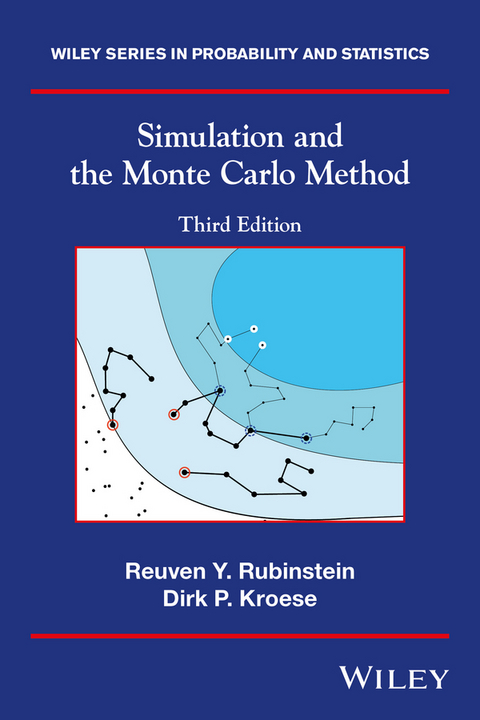
Simulation and the Monte Carlo Method (eBook)
John Wiley & Sons (Verlag)
978-1-118-63238-3 (ISBN)
This accessible new edition explores the major topics in Monte Carlo simulation that have arisen over the past 30 years and presents a sound foundation for problem solving
Simulation and the Monte Carlo Method, Third Edition reflects the latest developments in the field and presents a fully updated and comprehensive account of the state-of-the-art theory, methods and applications that have emerged in Monte Carlo simulation since the publication of the classic First Edition over more than a quarter of a century ago. While maintaining its accessible and intuitive approach, this revised edition features a wealth of up-to-date information that facilitates a deeper understanding of problem solving across a wide array of subject areas, such as engineering, statistics, computer science, mathematics, and the physical and life sciences. The book begins with a modernized introduction that addresses the basic concepts of probability, Markov processes, and convex optimization. Subsequent chapters discuss the dramatic changes that have occurred in the field of the Monte Carlo method, with coverage of many modern topics including: Markov Chain Monte Carlo, variance reduction techniques such as importance (re-)sampling, and the transform likelihood ratio method, the score function method for sensitivity analysis, the stochastic approximation method and the stochastic counter-part method for Monte Carlo optimization, the cross-entropy method for rare events estimation and combinatorial optimization, and application of Monte Carlo techniques for counting problems. An extensive range of exercises is provided at the end of each chapter, as well as a generous sampling of applied examples.
The Third Edition features a new chapter on the highly versatile splitting method, with applications to rare-event estimation, counting, sampling, and optimization. A second new chapter introduces the stochastic enumeration method, which is a new fast sequential Monte Carlo method for tree search. In addition, the Third Edition features new material on:
• Random number generation, including multiple-recursive generators and the Mersenne Twister
• Simulation of Gaussian processes, Brownian motion, and diffusion processes
• Multilevel Monte Carlo method
• New enhancements of the cross-entropy (CE) method, including the 'improved' CE method, which uses sampling from the zero-variance distribution to find the optimal importance sampling parameters
• Over 100 algorithms in modern pseudo code with flow control
• Over 25 new exercises
Simulation and the Monte Carlo Method, Third Edition is an excellent text for upper-undergraduate and beginning graduate courses in stochastic simulation and Monte Carlo techniques. The book also serves as a valuable reference for professionals who would like to achieve a more formal understanding of the Monte Carlo method.
Reuven Y. Rubinstein, DSc, was Professor Emeritus in the Faculty of Industrial Engineering and Management at Technion-Israel Institute of Technology. He served as a consultant at numerous large-scale organizations, such as IBM, Motorola, and NEC. The author of over 100 articles and six books, Dr. Rubinstein was also the inventor of the popular score-function method in simulation analysis and generic cross-entropy methods for combinatorial optimization and counting.
Dirk P. Kroese, PhD, is a Professor of Mathematics and Statistics in the School of Mathematics and Physics of The University of Queensland, Australia. He has published over 100 articles and four books in a wide range of areas in applied probability and statistics, including Monte Carlo methods, cross-entropy, randomized algorithms, tele-traffic c theory, reliability, computational statistics, applied probability, and stochastic modeling.
Reuven Y. Rubinstein, DSc, was Professor Emeritus in the Faculty of Industrial Engineering and Management at Technion-Israel Institute of Technology. He served as a consultant at numerous large-scale organizations, such as IBM, Motorola, and NEC. The author of over 100 articles and six books, Dr. Rubinstein was also the inventor of the popular score-function method in simulation analysis and generic cross-entropy methods for combinatorial optimization and counting.
Dirk P. Kroese, PhD, is a Professor of Mathematics and Statistics in the School of Mathematics and Physics of The University of Queensland, Australia. He has published over 100 articles and four books in a wide range of areas in applied probability and statistics, including Monte Carlo methods, cross-entropy, randomized algorithms, tele-traffic c theory, reliability, computational statistics, applied probability, and stochastic modeling.
This accessible new edition explores the major topics in Monte Carlo simulation that have arisen over the past 30 years and presents a sound foundation for problem solving Simulation and the Monte Carlo Method, Third Edition reflects the latest developments in the field and presents a fully updated and comprehensive account of the state-of-the-art theory, methods and applications that have emerged in Monte Carlo simulation since the publication of the classic First Edition over more than a quarter of a century ago. While maintaining its accessible and intuitive approach, this revised edition features a wealth of up-to-date information that facilitates a deeper understanding of problem solving across a wide array of subject areas, such as engineering, statistics, computer science, mathematics, and the physical and life sciences. The book begins with a modernized introduction that addresses the basic concepts of probability, Markov processes, and convex optimization. Subsequent chapters discuss the dramatic changes that have occurred in the field of the Monte Carlo method, with coverage of many modern topics including: Markov Chain Monte Carlo, variance reduction techniques such as importance (re-)sampling, and the transform likelihood ratio method, the score function method for sensitivity analysis, the stochastic approximation method and the stochastic counter-part method for Monte Carlo optimization, the cross-entropy method for rare events estimation and combinatorial optimization, and application of Monte Carlo techniques for counting problems. An extensive range of exercises is provided at the end of each chapter, as well as a generous sampling of applied examples. The Third Edition features a new chapter on the highly versatile splitting method, with applications to rare-event estimation, counting, sampling, and optimization. A second new chapter introduces the stochastic enumeration method, which is a new fast sequential Monte Carlo method for tree search. In addition, the Third Edition features new material on: Random number generation, including multiple-recursive generators and the Mersenne Twister Simulation of Gaussian processes, Brownian motion, and diffusion processes Multilevel Monte Carlo method New enhancements of the cross-entropy (CE) method, including the improved CE method, which uses sampling from the zero-variance distribution to find the optimal importance sampling parameters Over 100 algorithms in modern pseudo code with flow control Over 25 new exercises Simulation and the Monte Carlo Method, Third Edition is an excellent text for upper-undergraduate and beginning graduate courses in stochastic simulation and Monte Carlo techniques. The book also serves as a valuable reference for professionals who would like to achieve a more formal understanding of the Monte Carlo method. Reuven Y. Rubinstein, DSc, was Professor Emeritus in the Faculty of Industrial Engineering and Management at Technion-Israel Institute of Technology. He served as a consultant at numerous large-scale organizations, such as IBM, Motorola, and NEC. The author of over 100 articles and six books, Dr. Rubinstein was also the inventor of the popular score-function method in simulation analysis and generic cross-entropy methods for combinatorial optimization and counting. Dirk P. Kroese, PhD, is a Professor of Mathematics and Statistics in the School of Mathematics and Physics of The University of Queensland, Australia. He has published over 100 articles and four books in a wide range of areas in applied probability and statistics, including Monte Carlo methods, cross-entropy, randomized algorithms, tele-traffic c theory, reliability, computational statistics, applied probability, and stochastic modeling.
Reuven Y. Rubinstein, DSc, was Professor Emeritus in the Faculty of Industrial Engineering and Management at Technion-Israel Institute of Technology. He served as a consultant at numerous large-scale organizations, such as IBM, Motorola, and NEC. The author of over 100 articles and six books, Dr. Rubinstein was also the inventor of the popular score-function method in simulation analysis and generic cross-entropy methods for combinatorial optimization and counting. Dirk P. Kroese, PhD, is a Professor of Mathematics and Statistics in the School of Mathematics and Physics of The University of Queensland, Australia. He has published over 100 articles and four books in a wide range of areas in applied probability and statistics, including Monte Carlo methods, cross-entropy, randomized algorithms, tele-traffic c theory, reliability, computational statistics, applied probability, and stochastic modeling.
PREFACE
Since the publication in 2008 of the second edition of Simulation and the Monte Carlo Method, significant changes have taken place in the field of Monte Carlo simulation. This third edition gives a fully updated and comprehensive account of the major topics in Monte Carlo simulation.
The book is based on an undergraduate course on Monte Carlo methods given at the Israel Institute of Technology (Technion) and the University of Queensland for the last five years. It is aimed at a broad audience of students in engineering, physical and life sciences, statistics, computer science, mathematics, and simply anyone interested in using Monte Carlo simulation in their study or work. Our aim is to provide an accessible introduction to modern Monte Carlo methods, focusing on the main concepts, while providing a sound foundation for problem solving. For this reason most ideas are introduced and explained via concrete examples, algorithms, and experiments.
Although we assume that the reader has some basic mathematical background, such as an elementary course in probability and statistics, we nevertheless review the basic concepts of probability, stochastic processes, information theory, and convex optimization in Chapter 1.
In a typical stochastic simulation, randomness is introduced into simulation models via independent uniformly distributed random variables. These random variables are then used as building blocks to simulate more general stochastic systems. Chapter 2 deals with the generation of such random numbers, random variables, and stochastic processes.
Many real-world complex systems can be modeled as discrete-event systems. Examples of discrete-event systems include traffic systems, flexible manufacturing systems, computer-communications systems, inventory systems, production lines, coherent lifetime systems, PERT networks, and flow networks. The behavior of such systems is identified via a sequence of discrete “events” that causes the system to change from one “state” to another. We discuss how to model such systems on a computer in Chapter 3.
Chapter 4 treats the statistical analysis of the output data from static and dynamic simulation models. The main difference is that the former do not evolve in time whereas the latter do. For dynamic models, we distinguish between finite-horizon and steady-state simulations. Two popular methods for estimating steady-state performance measures — the batch means and regenerative methods — are discussed as well.
Chapter 5 deals with variance reduction techniques in Monte Carlo simulation, such as antithetic and common random numbers, control random variables, conditional Monte Carlo, stratified sampling, and importance sampling. Using importance sampling, one can often achieve substantial (sometimes dramatic) variance reduction, in particular when estimating rare-event probabilities. While dealing with importance sampling, we present two alternative approaches, called the variance minimization and the cross-entropy methods. Special attention is paid to importance sampling algorithms in which paths are generated in a sequential manner. Further improvements of such algorithms are obtained by resampling successful paths, giving rise to sequential importance resampling algorithms. We illustrate their use via a nonlinear filtering example. In addition, this chapter contains two new importance sampling based methods, called the transform likelihood ratio method and the screening method for variance reduction. The former presents a simple, convenient and unifying way of constructing efficient importance sampling estimators, whereas the latter ensures lowering of the dimensionality of the importance sampling density. This is accomplished by identifying (screening out) the most important (bottleneck) parameters to be used in the importance sampling distribution. As results, the accuracy of the importance sampling estimator increases substantially.
Chapter 6 gives a concise treatment of the generic Markov chain Monte Carlo (MCMC) method for approximately generating samples from an arbitrary distribution. We discuss the classic Metropolis–Hastings algorithm and the Gibbs sampler. In the former, one simulates a Markov chain such that its stationary distribution coincides with the target distribution, while in the latter the underlying Markov chain is constructed on the basis of a sequence of conditional distributions. We also deal with applications of MCMC in Bayesian statistics, and explain how MCMC is used to sample from the Boltzmann distribution for the Ising and Potts models, which are extensively used in statistical mechanics. Moreover, we show how MCMC is used in the simulated annealing method to find the global minimum of a multi-extremal function. We also show that both the Metropolis–Hastings and Gibbs samplers can be viewed as special cases of a general MCMC algorithm and then present two more modifications, namely the slice and the reversible jump samplers.
Chapter 7 is on sensitivity analysis and Monte Carlo optimization of simulated systems. Because of their complexity, the performance evaluation of discrete-event systems is usually studied by simulation, and the simulation is often associated with the estimation of the performance function with respect to some controllable parameters. Sensitivity analysis is concerned with evaluating sensitivities (gradients, Hessians, etc.) of the performance function with respect to system parameters. This provides guidance to operational decisions and to selecting system parameters that optimize the performance measures. Monte Carlo optimization deals with solving stochastic programs, that is, optimization problems where the objective function and some of the constraints are unknown and need to be obtained via simulation. We deal with sensitivity analysis and optimization of both static and dynamic models. We introduce the celebrated score function method for sensitivity analysis, and two alternative methods for Monte Carlo optimization, the so-called stochastic approximation and stochastic counterpart methods. In particular, in the latter method, we show how using a single simulation experiment one can approximate quite accurately the true unknown optimal solution of the original deterministic program.
Chapter 8 deals with the cross-entropy (CE) method, which was introduced by the first author in 1997 as an adaptive algorithm for rare-event estimation using a cross-entropy minimization technique. It was soon realized that the underlying ideas had a much wider range of application than just in rare-event simulation: they could be readily adapted to tackle quite general combinatorial and multi-extremal optimization problems, including many problems associated with learning algorithms and neural computation. We provide a gradual introduction to the CE method, and show its elegance and versatility. In particular, we present a general CE algorithm for the estimation of rare-event probabilities and then slightly modify it for solving combinatorial optimization problems. We discuss applications of the CE method to several combinatorial optimization problems, such as the max-cut problem and the traveling salesman problem, and provide supportive numerical results on its effectiveness. Due to its versatility, tractability, and simplicity, the CE method has potentially a diverse range of applications, for example, in computational biology, DNA sequence alignment, graph theory, and scheduling. Over the last 10 years many hundreds of papers have been written on the theory and applications of CE. For more details see the site www.cemethod.org, our book The Cross-Entropy Method: A Unified Approach to Combinatorial Optimization, Monte-Carlo Simulation and Machine Learning (Springer, 2004), and search in the wikipedia under “cross-entropy method”. The chapter concludes with a discussion of the minimum cross-entropy (MinxEnt) optimization program.
Chapter 9 introduces the splitting method, which uses a sequential sampling plan to decompose a “difficult” problem into a sequence of “easy” problems. The method was originally designed for rare-event simulation, but it has developed into a highly versatile “particle MCMC” algorithm that can be used for rare-event estimation, optimization, and sampling. The chapter presents various splitting algorithms for dynamic and static simulation models, and demonstrates how they can be used to (1) estimate rare-event probabilities, (2) solve hard counting problems, (3) find solutions to challenging optimization problems, and (4) sample from complicated probability distributions. The chapter features a wide variety of case studies and numerical experiments, demonstrating the effectiveness of the method.
Many combinatorial problems can be formulated in terms of searching or counting the total cost of a tree. Chapter 10 presents a new Monte Carlo called stochastic enumeration (SE) that is well suited to solve such problems by generating random paths through the tree in a parallel fashion. The SE algorithm can be viewed as a sequential importance sampling method on a “hyper-tree” whose vertices are sets of vertices of the original tree. By combining SE with fast polynomial decision algorithms, we show how it can be used for counting #P-complete problems, such as the number of satisfiability assignments, number of paths in a general network, and the number of perfect matchings in a graph. The usefulness...
| Erscheint lt. Verlag | 21.10.2016 |
|---|---|
| Reihe/Serie | Wiley Series in Probability and Statistics |
| Wiley Series in Probability and Statistics | Wiley Series in Probability and Statistics |
| Sprache | englisch |
| Themenwelt | Mathematik / Informatik ► Mathematik ► Analysis |
| Mathematik / Informatik ► Mathematik ► Statistik | |
| Mathematik / Informatik ► Mathematik ► Wahrscheinlichkeit / Kombinatorik | |
| Technik | |
| Schlagworte | and convex optimization • Angewandte Wahrscheinlichkeitsrechnung u. Statistik • Angew. Wahrscheinlichkeitsrechn. u. Statistik / Modelle • application of Monte Carlo techniques for counting problems • Applied Probability & Statistics • Applied Probability & Statistics - Models • cross-entropy method for rare events estimation and combinatorial optimization • importance (re-)sampling • Markov Processes • Monte Carlo Methode • Monte Carlo simulation • ?probability • score function method for sensitivity analysis • Simulation • Spezialthemen Statistik • Statistics • Statistics Special Topics • Statistik • stochastic approximation method • stochastic counter-part method for Monte Carlo optimization • transform likelihood ratio method • variance reduction techniques |
| ISBN-10 | 1-118-63238-9 / 1118632389 |
| ISBN-13 | 978-1-118-63238-3 / 9781118632383 |
| Informationen gemäß Produktsicherheitsverordnung (GPSR) | |
| Haben Sie eine Frage zum Produkt? |
 EPUB (Adobe DRM)
Kopierschutz: Adobe-DRM
Adobe-DRM ist ein Kopierschutz, der das eBook vor Mißbrauch schützen soll. Dabei wird das eBook bereits beim Download auf Ihre persönliche Adobe-ID autorisiert. Lesen können Sie das eBook dann nur auf den Geräten, welche ebenfalls auf Ihre Adobe-ID registriert sind.
Details zum Adobe-DRM
Dateiformat: EPUB (Electronic Publication)
EPUB ist ein offener Standard für eBooks und eignet sich besonders zur Darstellung von Belletristik und Sachbüchern. Der Fließtext wird dynamisch an die Display- und Schriftgröße angepasst. Auch für mobile Lesegeräte ist EPUB daher gut geeignet.
Systemvoraussetzungen:
PC/Mac: Mit einem PC oder Mac können Sie dieses eBook lesen. Sie benötigen eine
eReader: Dieses eBook kann mit (fast) allen eBook-Readern gelesen werden. Mit dem amazon-Kindle ist es aber nicht kompatibel.
Smartphone/Tablet: Egal ob Apple oder Android, dieses eBook können Sie lesen. Sie benötigen eine
Geräteliste und zusätzliche Hinweise
Buying eBooks from abroad
For tax law reasons we can sell eBooks just within Germany and Switzerland. Regrettably we cannot fulfill eBook-orders from other countries.
aus dem Bereich