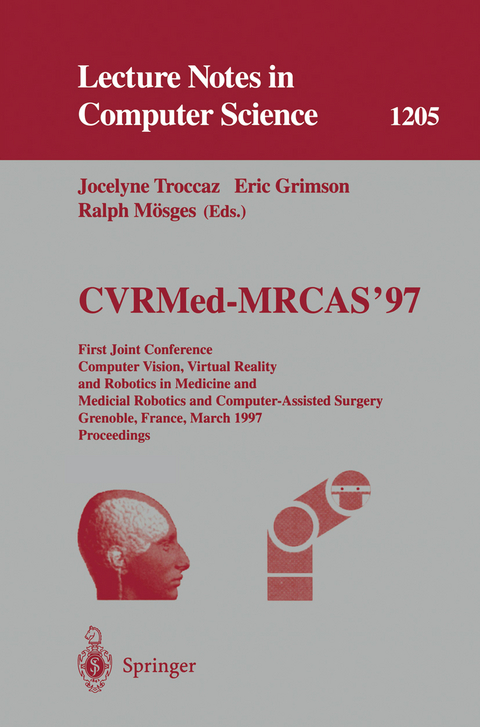
CVRMed-MRCAS'97
Springer Berlin (Verlag)
978-3-540-62734-0 (ISBN)
The volume presents 76 regular revised papers and 16 clinical papers selected from a total of 161 submitted full papers. The volume offers highly innovative and promising research results in computer-assisted medicine and medical informatics. Among the areas covered are medical imaging, virtual reality, medical robotics, and computer-integrated therapy and surgery. The book is of relevance to clinicians, medical engineers, and computer scientists.
Non-rigid image registration using bone growth model.- Volumetric medical images segmentation using shape constrained deformable models.- Medical image segmentation using topologically adaptable surfaces.- Definition of a 4D continuous polar transformation for the tracking and the analysis of LV motion.- Shape-based segmentation and tracking in 4D cardiac MR images.- Segmentation using deformable models with affinity-based localization.- Advances in elastic matching theory and its implementation.- Automatic detection of articular surfaces in 3-D image through minimal subset random sampling.- Decimation of isosurfaces with deformable models.- Comparative estimation of orbital three dimensional CT measurements utilizing analyze(TM).- Surgical instrument guidance using synthesized anatomical structures.- Kinematic study of lumbar spine using functional radiographies and 3D / 2D registration.- An approach to 2D/3D registration of a vertebra in 2D x-ray fluoroscopies with 3D CT images.- Matching 3D MR angiography data and 2D X-ray angiograms.- A method for evaluating CT-based surgical registration.- Retrospective intermodality registration techniques: Surface-based versus volume-based.- Anatomical landmark image registration: Validation and comparison.- Rigid registration of CT, MR and cryosection images using a GLCM framework.- Geometric constraint analysis and synthesis: Methods for improving shape-based registration accuracy.- Unwrapping phase in 3D MR phase contrast angiograms.- Image registration: Convex weighting functions for histogram-based similarity measures.- 3D multi-scale line filter for segmentation and visualization of curvilinear structures in medical images.- A new model for the recovery of cylindrical structures from medical image data.- Multi-scale line segmentation with automatic estimation of width, contrast and tangential direction in 2D and 3D medical images.- Geometrical modelling of abdominal aortic aneurysms.- Augmented reality for diagnosis basedon ultrasound images.- Parametric two-dimensional B-spline representation of vein and artery from 2.5D echography used to aid virtual echography.- CT-based simulation of fluoroscopy and DSA for endovascular surgery training.- Computer ASsisted PERicardial punctures: Animal feasability study.- An efficient needle injection technique and radiological guidance method for percutaneous procedures.- An automated system for precise percutaneous access of the renal collecting system.- 3D-visualisation for image guided surgery.- Virtual endoscopy for planning and simulation of minimally invasive neurosurgery.- Robot-assisted minimally invasive neurosurgical procedures: First experimental experience.- Real and simulated endoscopy of neurosurgical approaches in an anatomical model.- Non-invasive 3d patient registration for image-guided intranasal surgery - Experimental and clinical results.- Toward an active three dimensional navigation system in medical imaging.- A low-cost training simulator for initial formation in gynecologic laparoscopy.- Automatic tracking of laparoscopic instruments by color coding.- Simulating arthroscopic knee surgery using volumetric object representations, real-time volume rendering and haptic feedback.- Physically-based model for simulating the human trunk respiration movements.- A 3D virtual environment for modeling mechanical cardiopulmonary interactions.- Design considerations for a computer-vision-enabled ophthalmic augmented reality environment.- Clinical assessment of a training simulator for retinal photocoagulation.- Freeflight: A virtual endoscopy system.- A fast morphology-based registration.- Interactive virtualized display system for intravascular neurosurgery.- Differential features of cortical folds.- Estimation of intraoperative brain surface movement.- The correction of stereotactic inaccuracy caused by brain shift using an intraoperative ultrasound device.- A path-planning algorithm for image-guided neurosurgery.- Experimentation
| Erscheint lt. Verlag | 5.3.1997 |
|---|---|
| Reihe/Serie | Lecture Notes in Computer Science |
| Zusatzinfo | XIX, 836 p. 397 illus., 17 illus. in color. |
| Verlagsort | Berlin |
| Sprache | englisch |
| Maße | 155 x 235 mm |
| Gewicht | 1270 g |
| Themenwelt | Mathematik / Informatik ► Informatik ► Betriebssysteme / Server |
| Informatik ► Software Entwicklung ► User Interfaces (HCI) | |
| Schlagworte | Computer-Assisted Surgery • Computergestützte Chirurgie • Computerunterstütztes Verfahren • computer vision • Hardcover, Softcover / Informatik, EDV/Informatik • HC/Informatik, EDV/Informatik • Maschinelles Sehen • Medical Imaging • Medical Robotics • Medizinische Bildverarbeitung • Medizinische Informatik • Medizinische Robotik • Neuro-Chirurgie • neuro-surgery • robot • Robotics • Virtual Reality • Virtuelle Realität |
| ISBN-10 | 3-540-62734-0 / 3540627340 |
| ISBN-13 | 978-3-540-62734-0 / 9783540627340 |
| Zustand | Neuware |
| Informationen gemäß Produktsicherheitsverordnung (GPSR) | |
| Haben Sie eine Frage zum Produkt? |
aus dem Bereich