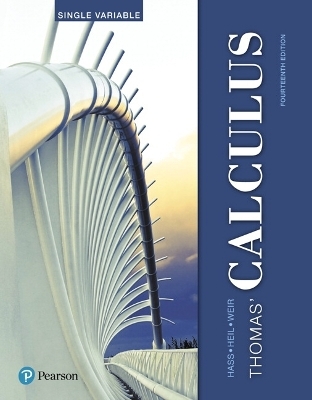
Thomas' Calculus, Single Variable
Pearson (Verlag)
978-0-13-443924-2 (ISBN)
Clarity and precision
Thomas' Calculus, Single Variable helps students reach the level of mathematical proficiency and maturity you require, but with support for students who need it through its balance of clear and intuitive explanations, current applications, and generalized concepts. In the 14th Edition, new co-author Christopher Heil (Georgia Institute of Technology) partners with author Joel Hass to preserve what is best about Thomas' time-tested text while reconsidering every word and every piece of art with today's students in mind. The result is a text that goes beyond memorizing formulas and routine procedures to help students generalize key concepts and develop deeper understanding.
Also available with MyLab Math
MyLab™ Math is an online homework, tutorial, and assessment program designed to work with this text to engage students and improve results. Within its structured environment, students practice what they learn, test their understanding, and pursue a personalized study plan that helps them absorb course material and understand difficult concepts. A full suite of Interactive Figures have been added to the accompanying MyLab Math course to further support teaching and learning. Enhanced Sample Assignments include just-in-time prerequisite review, help keep skills fresh with distributed practice of key concepts, and provide opportunities to work exercises without learning aids to help students develop confidence in their ability to solve problems independently.
Note: You are purchasing a standalone product; MyLab Math does not come packaged with this content. Students, if interested in purchasing this title with MyLab Math, ask your instructor for the correct package ISBN and Course ID. Instructors, contact your Pearson representative for more information.
If you would like to purchase both the physical text and MyLab Math, search for:
0134768523 / 9780134768526 Thomas' Calculus, Single Variable plus MyLab Math with Pearson eText -- Title-Specific Access Card package 14/e
Package consists of:
0134439244 / 9780134439242 Thomas' Calculus, Single Variable
0134764552 / 9780134764559 MyLab Math with Pearson eText - Standalone Access Card - Thomas's Calculus
Joel Hass received his PhD from the University of California Berkeley. He is currently a professor of mathematics at the University of California Davis. He has coauthored widely used calculus texts as well as calculus study guides. He is currently on the editorial board of several publications, including the Notices of the American Mathematical Society. He has been a member of the Institute for Advanced Study at Princeton University and of the Mathematical Sciences Research Institute, and he was a Sloan Research Fellow. Hass’s current areas of research include the geometry of proteins, three dimensional manifolds, applied math, and computational complexity. In his free time, Hass enjoys kayaking. Christopher Heil received his PhD from the University of Maryland. He is currently a professor of mathematics at the Georgia Institute of Technology. He is the author of a graduate text on analysis and a number of highly cited research survey articles. He serves on the editorial boards of Applied and Computational Harmonic Analysis and The Journal of Fourier Analysis and Its Applications. Heil's current areas of research include redundant representations, operator theory, and applied harmonic analysis. In his spare time, Heil pursues his hobby of astronomy. Maurice D. Weir (late) of the the Naval Postgraduate School in Monterey, California was Professor Emeritus as a member of the Department of Applied Mathematics. He held a DA and MS from Carnegie-Mellon University and received his BS at Whitman College. Weir was awarded the Outstanding Civilian Service Medal, the Superior Civilian Service Award, and the Schieffelin Award for Excellence in Teaching. He co-authored eight books, including University Calculus and Thomas’ Calculus.
Table of Contents
Functions
1.1 Functions and Their Graphs
1.2 Combining Functions; Shifting and Scaling Graphs
1.3 Trigonometric Functions
1.4 Graphing with Software
Limits and Continuity
2.1 Rates of Change and Tangent Lines to Curves
2.2 Limit of a Function and Limit Laws
2.3 The Precise Definition of a Limit
2.4 One-Sided Limits
2.5 Continuity
2.6 Limits Involving Infinity; Asymptotes of Graphs
Derivatives
3.1 Tangent Lines and the Derivative at a Point
3.2 The Derivative as a Function
3.3 Differentiation Rules
3.4 The Derivative as a Rate of Change
3.5 Derivatives of Trigonometric Functions
3.6 The Chain Rule
3.7 Implicit Differentiation
3.8 Related Rates
3.9 Linearization and Differentials
Applications of Derivatives
4.1 Extreme Values of Functions on Closed Intervals
4.2 The Mean Value Theorem
4.3 Monotonic Functions and the First Derivative Test
4.4 Concavity and Curve Sketching
4.5 Applied Optimization
4.6 Newton’S Method
4.7 Antiderivatives
Integrals
5.1 Area and Estimating with Finite Sums
5.2 Sigma Notation and Limits of Finite Sums
5.3 The Definite Integral
5.4 The Fundamental Theorem of Calculus
5.5 Indefinite Integrals and the Substitution Method
5.6 Definite Integral Substitutions and the Area Between Curves
Applications of Definite Integrals
6.1 Volumes Using Cross-Sections
6.2 Volumes Using Cylindrical Shells
6.3 Arc Length
6.4 Areas of Surfaces of Revolution
6.5 Work and Fluid Forces
6.6 Moments and Centers of Mass
Transcendental Functions
7.1 Inverse Functions and Their Derivatives
7.2 Natural Logarithms
7.3 Exponential Functions
7.4 Exponential Change and Separable Differential Equations
7.5 Indeterminate Forms and L’Hôpital's Rule
7.6 Inverse Trigonometric Functions
7.7 Hyperbolic Functions
7.8 Relative Rates of Growth
Techniques of Integration
8.1 Using Basic Integration Formulas
8.2 Integration by Parts
8.3 Trigonometric Integrals
8.4 Trigonometric Substitutions
8.5 Integration of Rational Functions by Partial Fractions
8.6 Integral Tables and Computer Algebra Systems
8.7 Numerical Integration
8.8 Improper Integrals
8.9 Probability
First-Order Differential Equations
9.1 Solutions, Slope Fields, and Euler’s Method
9.2 First-Order Linear Equations
9.3 Applications
9.4 Graphical Solutions of Autonomous Equations
9.5 Systems of Equations and Phase Planes
Infinite Sequences and Series
10.1 Sequences
10.2 Infinite Series
10.3 The Integral Test
10.4 Comparison Tests
10.5 Absolute Convergence; The Ratio and Root Tests
10.6 Alternating Series and Conditional Convergence
10.7 Power Series
10.8 Taylor and Maclaurin Series
10.9 Convergence of Taylor Series
10.10 Applications of Taylor Series
Parametric Equations and Polar Coordinates
11.1 Parametrizations of Plane Curves
11.2 Calculus with Parametric Curves
11.3 Polar Coordinates
11.4 Graphing Polar Coordinate Equations
11.5 Areas and Lengths in Polar Coordinates
11.6 Conic Sections
11.7 Conics in Polar Coordinates
Vectors and the Geometry of Space
12.1 Three-Dimensional Coordinate Systems
12.2 Vectors
12.3 The Dot Product
12.4 The Cross Product
12.5 Lines and Planes in Space
12.6 Cylinders and Quadric Surfaces
Vector-Valued Functions and Motion in Space
13.1 Curves in Space and Their Tangents
13.2 Integrals of Vector Functions; Projectile Motion
13.3 Arc Length in Space
13.4 Curvature and Normal Vectors of a Curve
13.5 Tangential and Normal Components of Acceleration
13.6 Velocity and Acceleration in Polar Coordinates
Partial Derivatives
14.1 Functions of Several Variables
14.2 Limits and Continuity in Higher Dimensions
14.3 Partial Derivatives
14.4 The Chain Rule
14.5 Directional Derivatives and Gradient Vectors
14.6 Tangent Planes and Differentials
14.7 Extreme Values and Saddle Points
14.8 Lagrange Multipliers
14.9 Taylor’s Formula for Two Variables
14.10 Partial Derivatives with Constrained Variables
Multiple Integrals
15.1 Double and Iterated Integrals over Rectangles
15.2 Double Integrals over General Regions
15.3 Area by Double Integration
15.4 Double Integrals in Polar Form
15.5 Triple Integrals in Rectangular Coordinates
15.6 Applications
15.7 Triple Integrals in Cylindrical and Spherical Coordinates
15.8 Substitutions in Multiple Integrals
Integrals and Vector Fields
16.1 Line Integrals of Scalar Functions
16.2 Vector Fields and Line Integrals: Work, Circulation, and Flux
16.3 Path Independence, Conservative Fields, and Potential Functions
16.4 Green’s Theorem in the Plane
16.5 Surfaces and Area
16.6 Surface Integrals
16.7 Stokes' Theorem
16.8 The Divergence Theorem and a Unified Theory
Second-Order Differential Equations (Online at www.goo.gl/MgDXPY)
17.1 Second-Order Linear Equations
17.2 Nonhomogeneous Linear Equations
17.3 Applications
17.4 Euler Equations
17.5 Power-Series Solutions
Appendices
Real Numbers and the Real Line
Mathematical Induction
Lines, Circles, and Parabolas
Proofs of Limit Theorems
Commonly Occurring Limits
Theory of the Real Numbers
Complex Numbers
The Distributive Law for Vector Cross Products
The Mixed Derivative Theorem and the Increment Theorem
| Erscheinungsdatum | 29.04.2017 |
|---|---|
| Sprache | englisch |
| Themenwelt | Mathematik / Informatik ► Mathematik ► Analysis |
| ISBN-10 | 0-13-443924-4 / 0134439244 |
| ISBN-13 | 978-0-13-443924-2 / 9780134439242 |
| Zustand | Neuware |
| Informationen gemäß Produktsicherheitsverordnung (GPSR) | |
| Haben Sie eine Frage zum Produkt? |
aus dem Bereich