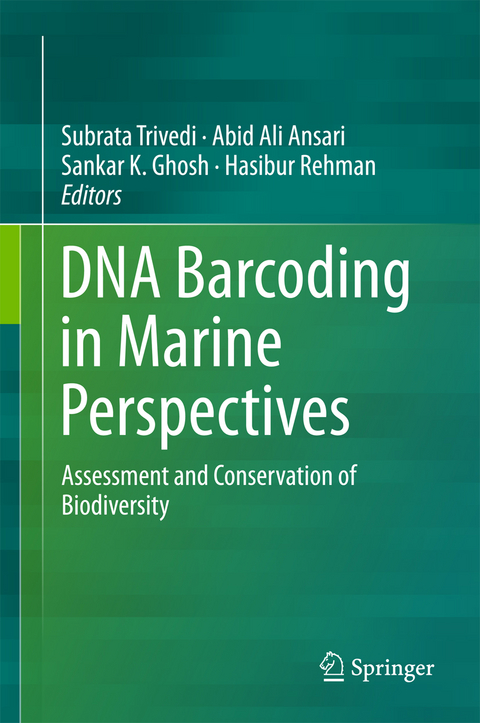
DNA Barcoding in Marine Perspectives (eBook)
330 Seiten
Springer International Publishing (Verlag)
978-3-319-41840-7 (ISBN)
More than two third of the surface area of our planet is covered by oceans and assessment of the marine biodiversity is a challenging task. With the increasing global population, there is a tendency to exploit marine recourses for food, energy and other requirements. This puts pressure on the fragile marine environment and needs sustainable conservation efforts. Marine species identification using traditional taxonomical methods are often burdened with taxonomic controversies. Here in this book we will discuss the comparatively new concept of DNA barcoding and its significance in marine perspective. This molecular technique can be helpful in the assessment of crypticspecies which are widespread in marine environment, and can also be used to link the different life cycle stages to the adult which is difficult to accomplish in marine ecosystems. Other advantages of DNA barcoding include authentication and safety assessment of seafood, wildlife forensics, conservation genetics and detection of invasive alien species (IAS). Global DNA barcoding efforts in the marine habitat include MarBOL, CeDAMar, CMarZ, SHARK-BOL, etc. DNA barcoding of different marine groups ranging from the microbes to mammals is to be revealed. In conjugation with newer and faster techniques like high throughput sequencing, DNA barcoding is serving as an effective modern tool in marine biodiversity assessment and conservation.
Dr. Subrata Trivedi, Ph.DDepartment of BiologyFaculty of ScienceUniversity of TabukTabuk, Kingdom of Saudi Arabiastriverdi@ut.edu.satriverdi.subrata@gmail.comAbid A AnsariDepartment of BiologyFaculty of Science University of TabukTabuk-71491, Kingdom of Saudi Arabiaaansari@ut.edu.saaaansari40@gmail.comDr. Sankar K. Ghosh, Ph.D.Department of Biotechnology, Assam UniversitySilchar-788011Assam, IndiaSankar.kumar.ghosh@aus.ac.indrsankarghosh@gmail.comHasibur Rehman, Ph.D Department of Biology Faculty of Sciences University of Tabuk Tabuk, Kingdom of Saudi Arabia (KSA)hrehman@ut.edu.sa
1. DNA Barcoding in the Marine Habitat: An Overview.- 2. Measurement of a Barcode’s Accuracy in Identifying Species.- 3. DNA barcoding: a tool to assess and conserve marine biodiversity.- 4. Safety Assessment and authentication of seafood through DNA barcoding.- 5. Bioinformatics tools in Marine DNA Barcoding.- 6. Morphological and COI sequence based charactersation of Marine Polychaete Species from Great Nicobar Island, India.- 7. Revised Phylogeny of Extant Xiphosurans (Horseshoe Crabs).- 8. DNA Barcoding in marine nematodes: successes and pitfalls.- 9. DNA barcoding of calanoid copepods from the gulf of california.- 10. DNA Barciding of Primitive Species - Nemertine from Sundarbans Marine Bio-Resourse.- 11. Future Perspectives of DNA Barcoding in Marine Zooplanktons and Invertebrates.- 12. Molecular Positioning of Living Fossils (Horseshoe Crab) Using DNA Barcoding Approach.- 13. Mitochondrial DNA diversity of Wild and Hatchery Reared Strains of Indian Lates calcarifer (Bloch).- 14. Barcoding Antarctic fishes: species discrimination and contribution to elucidate ontogenetic changes in Nototheniidae.- 15. Barcoding of Indian marine fishes: For identification and conservation.- 16. DNA barcoding Identifies Brackish Water fishes from Nallavadu Lagoon, Puducherry, India.- 17. DNA Barcoding of Marine fish: Prospects and Challenges.- 18. DNA Barcoding in Phytoplankton and other algae in Marine Ecosystem: An Effective Tool for Biodiversity Assessment.- 19. A search for a single DNA barcode for seagrasses of the world.
| Erscheint lt. Verlag | 31.8.2016 |
|---|---|
| Zusatzinfo | X, 330 p. 54 illus., 38 illus. in color. |
| Verlagsort | Cham |
| Sprache | englisch |
| Themenwelt | Mathematik / Informatik ► Informatik |
| Naturwissenschaften ► Biologie ► Ökologie / Naturschutz | |
| Technik | |
| Schlagworte | Bioinformatics • CeDAMar • CMarZ • Coastal invertebrates • conservation • Diatoms • DNA barcoding • fish • high throughput sequencing • Mangrove ecosystems • MarBOL • marine algae • marine and freshwater sciences • Marine barcoding • Marine biodiversity • Marine plankton • Marine yeast • SHARK-BOL |
| ISBN-10 | 3-319-41840-8 / 3319418408 |
| ISBN-13 | 978-3-319-41840-7 / 9783319418407 |
| Informationen gemäß Produktsicherheitsverordnung (GPSR) | |
| Haben Sie eine Frage zum Produkt? |
 PDF (Wasserzeichen)
DRM: Digitales Wasserzeichen
Dieses eBook enthält ein digitales Wasserzeichen und ist damit für Sie personalisiert. Bei einer missbräuchlichen Weitergabe des eBooks an Dritte ist eine Rückverfolgung an die Quelle möglich.
Dateiformat: PDF (Portable Document Format)
Mit einem festen Seitenlayout eignet sich die PDF besonders für Fachbücher mit Spalten, Tabellen und Abbildungen. Eine PDF kann auf fast allen Geräten angezeigt werden, ist aber für kleine Displays (Smartphone, eReader) nur eingeschränkt geeignet.
Systemvoraussetzungen:
PC/Mac: Mit einem PC oder Mac können Sie dieses eBook lesen. Sie benötigen dafür einen PDF-Viewer - z.B. den Adobe Reader oder Adobe Digital Editions.
eReader: Dieses eBook kann mit (fast) allen eBook-Readern gelesen werden. Mit dem amazon-Kindle ist es aber nicht kompatibel.
Smartphone/Tablet: Egal ob Apple oder Android, dieses eBook können Sie lesen. Sie benötigen dafür einen PDF-Viewer - z.B. die kostenlose Adobe Digital Editions-App.
Buying eBooks from abroad
For tax law reasons we can sell eBooks just within Germany and Switzerland. Regrettably we cannot fulfill eBook-orders from other countries.
aus dem Bereich