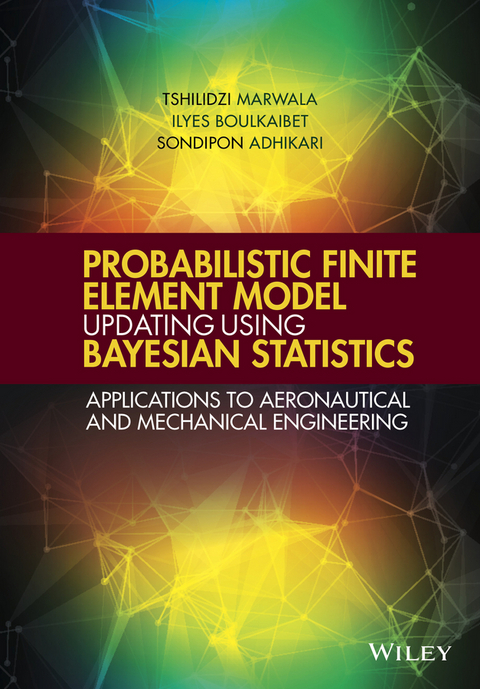
Probabilistic Finite Element Model Updating Using Bayesian Statistics (eBook)
Probabilistic Finite Element Model Updating Using Bayesian Statistics: Applications to Aeronautical and Mechanical Engineering
Tshilidzi Marwala and Ilyes Boulkaibet, University of Johannesburg, South Africa
Sondipon Adhikari, Swansea University, UK
Covers the probabilistic finite element model based on Bayesian statistics with applications to aeronautical and mechanical engineering
Finite element models are used widely to model the dynamic behaviour of many systems including in electrical, aerospace and mechanical engineering.
The book covers probabilistic finite element model updating, achieved using Bayesian statistics. The Bayesian framework is employed to estimate the probabilistic finite element models which take into account of the uncertainties in the measurements and the modelling procedure. The Bayesian formulation achieves this by formulating the finite element model as the posterior distribution of the model given the measured data within the context of computational statistics and applies these in aeronautical and mechanical engineering.
Probabilistic Finite Element Model Updating Using Bayesian Statistics contains simple explanations of computational statistical techniques such as Metropolis-Hastings Algorithm, Slice sampling, Markov Chain Monte Carlo method, hybrid Monte Carlo as well as Shadow Hybrid Monte Carlo and their relevance in engineering.
Key features:
- Contains several contributions in the area of model updating using Bayesian techniques which are useful for graduate students.
- Explains in detail the use of Bayesian techniques to quantify uncertainties in mechanical structures as well as the use of Markov Chain Monte Carlo techniques to evaluate the Bayesian formulations.
The book is essential reading for researchers, practitioners and students in mechanical and aerospace engineering.
Tshilidzi Marwala is a Professor of Mechanical and Electrical Engineering as well as Deputy Vice-Chancellor at the University of Johannesburg. He holds a Bachelor of Science in Mechanical Engineering from Case Western Reserve University, a Master of Mechanical Engineering from the University of Pretoria, a PhD in Engineering from Cambridge University and was a post-doctoral researcher at Imperial College (London). He is a Fellow of TWAS and a distinguished member of the ACM. His research interests are multi-disciplinary and include the applications of computational intelligence to engineering, computer science, finance, social science and medicine. He has supervised 45 Masters and 19 PhD students and has published 8 books and over 260 papers. He is an associate editor of the International Journal of Systems Science.
Dr. Ilyes Boulkaibet is currently a researcher at the University of Johannesburg. He received a PhD from the University of Johannesburg, a second MSc from Stellenbosch University, an MSc from the University of Constantine 1 Algeria, and a Bachelor of Engineering from University of Constantine 1 Algeria. Dr. Ilyes Boulkaibet has published papers in international journals and has participated in numerous conferences including the International Modal Analysis Conference. Dr. Boulkaibet's research areas are multidisciplinary in nature and include uncertainty quantification in computational mechanics, dynamics of complex systems, inverse problems for linear and non-linear dynamics and control systems.
Professor Adhikari is the chair of Aerospace Engineering in the College of Engineering of Swansea University. He received his MSc from the Indian Institute of Science and a PhD from the University of Cambridge. He was a lecturer at the Bristol University and a Junior Research Fellow in Fitzwilliam College, Cambridge. He has been a visiting Professor at the University of Johannesburg, Carleton University and the Los Alamos National Laboratory . Professor Adhikari's research areas are multidisciplinary in nature and include uncertainty quantification in computational mechanics, bio- and nano-mechanics (nanotubes, graphene, cell mechanics, nano-bio sensors), dynamics of complex systems, inverse problems for linear and non-linear dynamics and vibration energy harvesting.
Probabilistic Finite Element Model Updating Using Bayesian Statistics: Applications to Aeronautical and Mechanical Engineering Tshilidzi Marwala and Ilyes Boulkaibet, University of Johannesburg, South Africa Sondipon Adhikari, Swansea University, UK Covers the probabilistic finite element model based on Bayesian statistics with applications to aeronautical and mechanical engineering Finite element models are used widely to model the dynamic behaviour of many systems including in electrical, aerospace and mechanical engineering. The book covers probabilistic finite element model updating, achieved using Bayesian statistics. The Bayesian framework is employed to estimate the probabilistic finite element models which take into account of the uncertainties in the measurements and the modelling procedure. The Bayesian formulation achieves this by formulating the finite element model as the posterior distribution of the model given the measured data within the context of computational statistics and applies these in aeronautical and mechanical engineering. Probabilistic Finite Element Model Updating Using Bayesian Statistics contains simple explanations of computational statistical techniques such as Metropolis-Hastings Algorithm, Slice sampling, Markov Chain Monte Carlo method, hybrid Monte Carlo as well as Shadow Hybrid Monte Carlo and their relevance in engineering. Key features: Contains several contributions in the area of model updating using Bayesian techniques which are useful for graduate students. Explains in detail the use of Bayesian techniques to quantify uncertainties in mechanical structures as well as the use of Markov Chain Monte Carlo techniques to evaluate the Bayesian formulations. The book is essential reading for researchers, practitioners and students in mechanical and aerospace engineering.
Tshilidzi Marwala is a Professor of Mechanical and Electrical Engineering as well as Deputy Vice-Chancellor at the University of Johannesburg. He holds a Bachelor of Science in Mechanical Engineering from Case Western Reserve University, a Master of Mechanical Engineering from the University of Pretoria, a PhD in Engineering from Cambridge University and was a post-doctoral researcher at Imperial College (London). He is a Fellow of TWAS and a distinguished member of the ACM. His research interests are multi-disciplinary and include the applications of computational intelligence to engineering, computer science, finance, social science and medicine. He has supervised 45 Masters and 19 PhD students and has published 8 books and over 260 papers. He is an associate editor of the International Journal of Systems Science. Dr. Ilyes Boulkaibet is currently a researcher at the University of Johannesburg. He received a PhD from the University of Johannesburg, a second MSc from Stellenbosch University, an MSc from the University of Constantine 1 Algeria, and a Bachelor of Engineering from University of Constantine 1 Algeria. Dr. Ilyes Boulkaibet has published papers in international journals and has participated in numerous conferences including the International Modal Analysis Conference. Dr. Boulkaibet's research areas are multidisciplinary in nature and include uncertainty quantification in computational mechanics, dynamics of complex systems, inverse problems for linear and non-linear dynamics and control systems. Professor Adhikari is the chair of Aerospace Engineering in the College of Engineering of Swansea University. He received his MSc from the Indian Institute of Science and a PhD from the University of Cambridge. He was a lecturer at the Bristol University and a Junior Research Fellow in Fitzwilliam College, Cambridge. He has been a visiting Professor at the University of Johannesburg, Carleton University and the Los Alamos National Laboratory . Professor Adhikari's research areas are multidisciplinary in nature and include uncertainty quantification in computational mechanics, bio- and nano-mechanics (nanotubes, graphene, cell mechanics, nano-bio sensors), dynamics of complex systems, inverse problems for linear and non-linear dynamics and vibration energy harvesting.
Title Page 5
Copyright 6
Contents 7
Acknowledgements 12
Nomenclature 13
Chapter 1 Introduction to Finite Element Model Updating 17
1.1 Introduction 17
1.2 Finite Element Modelling 18
1.3 Vibration Analysis 20
1.3.1 Modal Domain Data 20
1.3.2 Frequency Domain Data 21
1.4 Finite Element Model Updating 21
1.5 Finite Element Model Updating and Bounded Rationality 22
1.6 Finite Element Model Updating Methods 23
1.6.1 Direct Methods 24
1.6.2 Iterative Methods 26
1.6.3 Artificial Intelligence Methods 27
1.6.4 Uncertainty Quantification Methods 27
1.7 Bayesian Approach versus Maximum Likelihood Method 30
1.8 Outline of the Book 31
References 33
Chapter 2 Model Selection in Finite Element Model Updating 40
2.1 Introduction 40
2.2 Model Selection in Finite Element Modelling 41
2.2.1 Akaike Information Criterion 41
2.2.2 Bayesian Information Criterion 41
2.2.3 Bayes Factor 42
2.2.4 Deviance Information Criterion 42
2.2.5 Particle Swarm Optimisation for Model Selection 43
2.2.6 Regularisation 44
2.2.7 Cross-Validation 44
2.2.8 Nested Sampling for Model Selection 46
2.3 Simulated Annealing 48
2.4 Asymmetrical H-Shaped Structure 51
2.4.1 Regularisation 51
2.4.2 Cross-Validation 52
2.4.3 Bayes Factor and Nested Sampling 52
2.5 Conclusion 53
References 53
Chapter 3 Bayesian Statistics in Structural Dynamics 58
3.1 Introduction 58
3.2 Bayes´ Rule 61
3.3 Maximum Likelihood Method 62
3.4 Maximum a Posteriori Parameter Estimates 62
3.5 Laplace´s Method 63
3.6 Prior, Likelihood and Posterior Function of a Simple Dynamic Example 63
3.6.1 Likelihood Function 65
3.6.2 Prior Function 65
3.6.3 Posterior Function 66
3.6.4 Gaussian Approximation 66
3.7 The Posterior Approximation 68
3.7.1 Objective Function 68
3.7.2 Optimisation Approach 68
3.7.3 Case Example 71
3.8 Sampling Approaches for Estimating Posterior Distribution 71
3.8.1 Monte Carlo Method 71
3.8.2 Markov Chain Monte Carlo Method 72
3.8.3 Simulated Annealing 73
3.8.4 Gibbs Sampling 74
3.9 Comparison between Approaches 74
3.9.1 Numerical Example 74
3.10 Conclusions 76
References 77
Chapter 4 Metropolis–Hastings and Slice Sampling for Finite Element Updating 81
4.1 Introduction 81
4.2 Likelihood, Prior and the Posterior Functions 82
4.3 The Metropolis–Hastings Algorithm 85
4.4 The Slice Sampling Algorithm 87
4.5 Statistical Measures 88
4.6 Application 1: Cantilevered Beam 90
4.7 Application 2: Asymmetrical H-Shaped Structure 94
4.8 Conclusions 97
References 97
Chapter 5 Dynamically Weighted Importance Sampling for Finite Element Updating 100
5.1 Introduction 100
5.2 Bayesian Modelling Approach 101
5.3 Metropolis–Hastings (M-H) Algorithm 103
5.4 Importance Sampling 104
5.5 Dynamically Weighted Importance Sampling 105
5.5.1 Markov Chain 106
5.5.2 Adaptive Pruned-Enriched Population Control Scheme 106
5.5.3 Monte Carlo Dynamically Weighted Importance Sampling 108
5.6 Application 1: Cantilevered Beam 109
5.7 Application 2: H-Shaped Structure 113
5.8 Conclusions 117
References 117
Chapter 6 Adaptive Metropolis–Hastings for Finite Element Updating 120
6.1 Introduction 120
6.2 Adaptive Metropolis–Hastings Algorithm 121
6.3 Application 1: Cantilevered Beam 124
6.4 Application 2: Asymmetrical H-Shaped Beam 127
6.5 Application 3: Aircraft GARTEUR Structure 129
6.6 Conclusion 135
References 135
Chapter 7 Hybrid Monte Carlo Technique for Finite Element Model Updating 138
7.1 Introduction 138
7.2 Hybrid Monte Carlo Method 139
7.3 Properties of the HMC Method 140
7.3.1 Time Reversibility 140
7.3.2 Volume Preservation 140
7.3.3 Energy Conservation 141
7.4 The Molecular Dynamics Algorithm 141
7.5 Improving the HMC 143
7.5.1 Choosing an Efficient Time Step 143
7.5.2 Suppressing the Random Walk in the Momentum 144
7.5.3 Gradient Computation 144
7.6 Application 1: Cantilever Beam 145
7.7 Application 2: Asymmetrical H-Shaped Structure 148
7.8 Conclusion 151
References 151
Chapter 8 Shadow Hybrid Monte Carlo Technique for Finite Element Model Updating 154
8.1 Introduction 154
8.2 Effect of Time Step in the Hybrid Monte Carlo Method 155
8.3 The Shadow Hybrid Monte Carlo Method 155
8.4 The Shadow Hamiltonian 158
8.5 Application: GARTEUR SM-AG19 Structure 159
8.6 Conclusion 168
References 169
Chapter 9 Separable Shadow Hybrid Monte Carlo in Finite Element Updating 171
9.1 Introduction 171
9.2 Separable Shadow Hybrid Monte Carlo 171
9.3 Theoretical Justifications of the S2HMC Method 174
9.4 Application 1: Asymmetrical H-Shaped Structure 176
9.5 Application 2: GARTEUR SM-AG19 Structure 181
9.6 Conclusions 187
References 188
Chapter 10 Evolutionary Approach to Finite Element Model Updating 190
10.1 Introduction 190
10.2 The Bayesian Formulation 191
10.3 The Evolutionary MCMC Algorithm 193
10.3.1 Mutation 194
10.3.2 Crossover 195
10.3.3 Exchange 197
10.4 Metropolis–Hastings Method 197
10.5 Application: Asymmetrical H-Shaped Structure 198
10.6 Conclusion 201
References 202
Chapter 11 Adaptive Markov Chain Monte Carlo Method for Finite Element Model Updating 205
11.1 Introduction 205
11.2 Bayesian Theory 207
11.3 Adaptive Hybrid Monte Carlo 208
11.4 Application 1: A Linear System with Three Degrees of Freedom 211
11.4.1 Updating the Stiffness Parameters 212
11.5 Application 2: Asymmetrical H-Shaped Structure 214
11.5.1 H-Shaped Structure Simulation 214
11.6 Conclusion 218
References 219
Chapter 12 Conclusions and Further Work 222
12.1 Introduction 222
12.2 Further Work 224
12.2.1 Reversible Jump Monte Carlo 224
12.2.2 Multiple-Try Metropolis–Hastings 224
12.2.3 Dynamic Programming 225
12.2.4 Sequential Monte Carlo 225
References 225
Appendix A: Experimental Examples 227
A.1 Cantilevered Beam 227
A.2 H-Shaped Structure Simulation 227
A.3 GARTEUR SM-AG19 Structure 230
References 234
Appendix B: Markov Chain Monte Carlo 235
B.1 Introduction 235
B.2 Basic Definition of the Markov Chain 235
B.3 Invariant Distribution 236
B.4 Reversibility and Ergodicity 236
References 237
Appendix C: Gaussian Distribution 238
C.1 Introduction 238
C.2 Gaussian Distribution 238
C.3 Properties of the Gaussian Distribution 240
References 241
Index 242
EULA 245
| Erscheint lt. Verlag | 23.9.2016 |
|---|---|
| Sprache | englisch |
| Themenwelt | Mathematik / Informatik ► Mathematik ► Statistik |
| Technik ► Bauwesen | |
| Technik ► Fahrzeugbau / Schiffbau | |
| Technik ► Luft- / Raumfahrttechnik | |
| Technik ► Maschinenbau | |
| Schlagworte | Bauingenieur- u. Bauwesen • Baustatik u. Baumechanik • Bayesian analysis • Bayesian theory • Bayes-Verfahren • Civil Engineering & Construction • Computational / Numerical Methods • Finite-Element-Methode • Finite Element Model • iterative methods • Markov Chain Monte Carlo • Maschinenbau • mechanical engineering • Model Selection • Model Updating • Optimization • Probabilistic model updating • Rechnergestützte / Numerische Verfahren im Maschinenbau • Rechnergestützte / Numerische Verfahren im Maschinenbau • Statistics • Statistik • structural dynamics • Structural Theory & Structural Mechanics • Uncertainty quantifications |
| ISBN-10 | 1-119-15300-X / 111915300X |
| ISBN-13 | 978-1-119-15300-9 / 9781119153009 |
| Informationen gemäß Produktsicherheitsverordnung (GPSR) | |
| Haben Sie eine Frage zum Produkt? |
 PDF (Adobe DRM)
Kopierschutz: Adobe-DRM
Adobe-DRM ist ein Kopierschutz, der das eBook vor Mißbrauch schützen soll. Dabei wird das eBook bereits beim Download auf Ihre persönliche Adobe-ID autorisiert. Lesen können Sie das eBook dann nur auf den Geräten, welche ebenfalls auf Ihre Adobe-ID registriert sind.
Details zum Adobe-DRM
Dateiformat: PDF (Portable Document Format)
Mit einem festen Seitenlayout eignet sich die PDF besonders für Fachbücher mit Spalten, Tabellen und Abbildungen. Eine PDF kann auf fast allen Geräten angezeigt werden, ist aber für kleine Displays (Smartphone, eReader) nur eingeschränkt geeignet.
Systemvoraussetzungen:
PC/Mac: Mit einem PC oder Mac können Sie dieses eBook lesen. Sie benötigen eine
eReader: Dieses eBook kann mit (fast) allen eBook-Readern gelesen werden. Mit dem amazon-Kindle ist es aber nicht kompatibel.
Smartphone/Tablet: Egal ob Apple oder Android, dieses eBook können Sie lesen. Sie benötigen eine
Geräteliste und zusätzliche Hinweise
Buying eBooks from abroad
For tax law reasons we can sell eBooks just within Germany and Switzerland. Regrettably we cannot fulfill eBook-orders from other countries.
aus dem Bereich