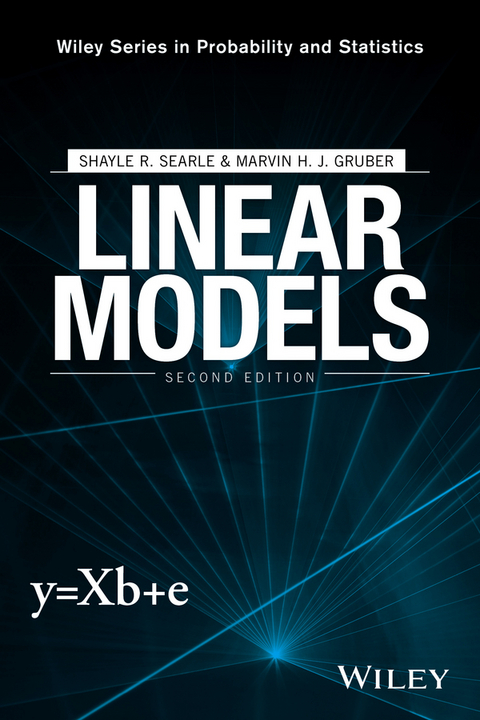
Linear Models (eBook)
John Wiley & Sons (Verlag)
978-1-118-95284-9 (ISBN)
Provides an easy-to-understand guide to statistical linear models and its uses in data analysis
This book defines a broad spectrum of statistical linear models that is useful in the analysis of data. Considerable rewriting was done to make the book more reader friendly than the first edition. Linear Models, Second Edition is written in such a way as to be self-contained for a person with a background in basic statistics, calculus and linear algebra. The text includes numerous applied illustrations, numerical examples, and exercises, now augmented with computer outputs in SAS and R. Also new to this edition is:
• A greatly improved internal design and format
• A short introductory chapter to ease understanding of the order in which topics are taken up
• Discussion of additional topics including multiple comparisons and shrinkage estimators
• Enhanced discussions of generalized inverses, the MINQUE, Bayes and Maximum Likelihood estimators for estimating variance components
Furthermore, in this edition, the second author adds many pedagogical elements throughout the book. These include numbered examples, end-of-example and end-of-proof symbols, selected hints and solutions to exercises available on the book's website, and references to 'big data' in everyday life. Featuring a thorough update, Linear Models, Second Edition includes:
• A new internal format, additional instructional pedagogy, selected hints and solutions to exercises, and several more real-life applications
• Many examples using SAS and R with timely data sets
• Over 400 examples and exercises throughout the book to reinforce understanding
Linear Models, Second Edition is a textbook and a reference for upper-level undergraduate and beginning graduate-level courses on linear models, statisticians, engineers, and scientists who use multiple regression or analysis of variance in their work.
SHAYLE R. SEARLE, PhD, was Professor Emeritus of Biometry at Cornell University. He was the author of the first edition of Linear Models, Linear Models for Unbalanced Data, and Generalized, Linear, and Mixed Models (with Charles E. McCulloch), all from Wiley. The first edition of Linear Models appears in the Wiley Classics Library.
MARVIN H. J. GRUBER, PhD, is Professor Emeritus at Rochester Institute of Technology, School of Mathematical Sciences. Dr. Gruber has written a number of papers and has given numerous presentations at professional meetings during his tenure as a professor at RIT. His fields of interest include regression estimators and the improvement of their efficiency using shrinkage estimators. He has written and published two books on this topic. Another of his books, Matrix Algebra for Linear Models, also published by Wiley, provides good preparation for studying Linear Models. He is a member of the American Mathematical Society, the Institute of Mathematical Statistics and the American Statistical Association.
The late SHAYLE R. SEARLE, PhD, was Professor Emeritus of Biometry at Cornell University. He was the author of the first edition of Linear Models, Linear Models for Unbalanced Data, and Generalized, Linear, and Mixed Models (with Charles E. McCulloch), all from Wiley. The first edition of Linear Models appears in the Wiley Classics Library.
MARVIN H. J. GRUBER, PhD, is Professor Emeritus at Rochester Institute of Technology, School of Mathematical Sciences. Dr. Gruber has written a number of papers and has given numerous presentations at professional meetings during his tenure as a professor at RIT. His fields of interest include regression estimators and the improvement of their efficiency using shrinkage estimators. He has written and published two books on this topic. Another of his books, Matrix Algebra for Linear Models, also published by Wiley, provides good preparation for studying Linear Models. He is a member of the American Mathematical Society, the Institute of Mathematical Statistics and the American Statistical Association.
Provides an easy-to-understand guide to statistical linear models and its uses in data analysis This book defines a broad spectrum of statistical linear models that is useful in the analysis of data. Considerable rewriting was done to make the book more reader friendly than the first edition. Linear Models, Second Edition is written in such a way as to be self-contained for a person with a background in basic statistics, calculus and linear algebra. The text includes numerous applied illustrations, numerical examples, and exercises, now augmented with computer outputs in SAS and R. Also new to this edition is: A greatly improved internal design and format A short introductory chapter to ease understanding of the order in which topics are taken up Discussion of additional topics including multiple comparisons and shrinkage estimators Enhanced discussions of generalized inverses, the MINQUE, Bayes and Maximum Likelihood estimators for estimating variance components Furthermore, in this edition, the second author adds many pedagogical elements throughout the book. These include numbered examples, end-of-example and end-of-proof symbols, selected hints and solutions to exercises available on the book s website, and references to big data in everyday life. Featuring a thorough update, Linear Models, Second Edition includes: A new internal format, additional instructional pedagogy, selected hints and solutions to exercises, and several more real-life applications Many examples using SAS and R with timely data sets Over 400 examples and exercises throughout the book to reinforce understanding Linear Models, Second Edition is a textbook and a reference for upper-level undergraduate and beginning graduate-level courses on linear models, statisticians, engineers, and scientists who use multiple regression or analysis of variance in their work. SHAYLE R. SEARLE, PhD, was Professor Emeritus of Biometry at Cornell University. He was the author of the first edition of Linear Models, Linear Models for Unbalanced Data, and Generalized, Linear, and Mixed Models (with Charles E. McCulloch), all from Wiley. The first edition of Linear Models appears in the Wiley Classics Library. MARVIN H. J. GRUBER, PhD, is Professor Emeritus at Rochester Institute of Technology, School of Mathematical Sciences. Dr. Gruber has written a number of papers and has given numerous presentations at professional meetings during his tenure as a professor at RIT. His fields of interest include regression estimators and the improvement of their efficiency using shrinkage estimators. He has written and published two books on this topic. Another of his books, Matrix Algebra for Linear Models, also published by Wiley, provides good preparation for studying Linear Models. He is a member of the American Mathematical Society, the Institute of Mathematical Statistics and the American Statistical Association.
The late SHAYLE R. SEARLE, PhD, was Professor Emeritus of Biometry at Cornell University. He was the author of the first edition of Linear Models, Linear Models for Unbalanced Data, and Generalized, Linear, and Mixed Models (with Charles E. McCulloch), all from Wiley. The first edition of Linear Models appears in the Wiley Classics Library. MARVIN H. J. GRUBER, PhD, is Professor Emeritus at Rochester Institute of Technology, School of Mathematical Sciences. Dr. Gruber has written a number of papers and has given numerous presentations at professional meetings during his tenure as a professor at RIT. His fields of interest include regression estimators and the improvement of their efficiency using shrinkage estimators. He has written and published two books on this topic. Another of his books, Matrix Algebra for Linear Models, also published by Wiley, provides good preparation for studying Linear Models. He is a member of the American Mathematical Society, the Institute of Mathematical Statistics and the American Statistical Association.
Linear Models 3
Contents 7
Preface 19
Preface to First Edition 23
About the Companion Website 27
Introduction and Overview 29
1 Generalized Inverse Matrices 35
1 Introduction 35
a Definition and Existence of a Generalized Inverse 36
b An Algorithm for Obtaining a Generalized Inverse 39
c Obtaining Generalized Inverses Using the Singular Value Decomposition (SVD) 42
2 Solving Linear Equations 45
a Consistent Equations 45
b Obtaining Solutions 46
c Properties of Solutions 48
3 The Penrose Inverse 54
4 Other Definitions 58
5 Symmetric Matrices 60
a Properties of a Generalized Inverse 60
b Two More Generalized Inverses of 63
6 Arbitrariness in a Generalized Inverse 65
7 Other Results 70
8 Exercises 72
2 Distributions and Quadratic Forms 77
1 Introduction 77
2 Symmetric Matrices 80
3 Positive Definiteness 81
4 Distributions 86
a Multivariate Density Functions 86
b Moments 87
c Linear Transformations 88
d Moment and Cumulative Generating Functions 90
e Univariate Normal 92
f Multivariate Normal 92
g Central 2, F, and t 97
h Non-central 2 99
i Non-central F 101
j The Non-central t Distribution 101
5 Distribution of Quadratic Forms 102
a Cumulants 103
b Distributions 106
c Independence 108
6 Bilinear Forms 115
7 Exercises 117
3 Regression for the Full-Rank Model 123
1 Introduction 123
a The Model 123
b Observations 125
c Estimation 126
d The General Case of k x Variables 128
e Intercept and No-Intercept Models 132
2 Deviations From Means 133
3 Some Methods of Estimation 137
a Ordinary Least Squares 137
b Generalized Least Squares 137
c Maximum Likelihood 138
d The Best Linear Unbiased Estimator (b.l.u.e.)(Gauss–Markov Theorem) 138
e Least-squares Theory When The Parameters are Random Variables 140
4 Consequences of Estimation 143
a Unbiasedness 143
b Variances 143
c Estimating E(y) 144
d Residual Error Sum of Squares 147
e Estimating the Residual Error Variance 148
f Partitioning the Total Sum of Squares 149
g Multiple Correlation 150
5 Distributional Properties 154
a The Vector of Observations y is Normal 154
b The Least-square Estimator ?b is Normal 155
c The Least-square Estimator ?b and the Estimator of the Variance ? ??????2 are Independent 155
d The Distribution of SSE/2 is a 2 Distribution 156
e Non-central ??????2? s 156
f F-distributions 157
g Analyses of Variance 157
h Tests of Hypotheses 159
i Confidence Intervals 161
j More Examples 164
k Pure Error 167
6 The General Linear Hypothesis 169
a Testing Linear Hypothesis 169
b Estimation Under the Null Hypothesis 171
c Four Common Hypotheses 173
d Reduced Models 176
e Stochastic Constraints 186
f Exact Quadratic Constraints (Ridge Regression) 188
7 Related Topics 190
a The Likelihood Ratio Test 191
b Type I and Type II Errors 192
c The Power of a Test 193
d Estimating Residuals 194
8 Summary of Regression Calculations 196
9 Exercises 197
4 Introducing Linear Models: Regression on Dummy Variables 203
1 Regression on Allocated Codes 203
a Allocated Codes 203
b Difficulties and Criticism 204
c Grouped Variables 205
d Unbalanced Data 206
2 Regression on Dummy (0, 1) Variables 208
a Factors and Levels 208
b The Regression 209
3 Describing Linear Models 212
a A One-Way Classification 212
b A Two-Way Classification 214
c A Three-Way Classification 216
d Main Effects and Interactions 216
e Nested and Crossed Classifications 222
4 The Normal Equations 226
5 Exercises 229
5 Models Not of Full Rank 233
1 The Normal Equations 233
a The Normal Equations 234
b Solutions to the Normal Equations 237
2 Consequences of a Solution 238
a Expected Value of 238
b Variance Covariance Matrices of b? (Variance Covariance Matrices) 239
c Estimating E(y) 240
d Residual Error Sum of Squares 240
e Estimating the Residual Error Variance 241
f Partitioning the Total Sum of Squares 242
g Coefficient of Determination 243
3 Distributional Properties 245
a The Observation Vector y is Normal 245
b The Solution to the Normal Equations b? is Normally Distributed 245
c The Solution to the Normal Equations b? and the Estimator of the Residual Error Variance ??????2 Are Independent 245
d The Error Sum of Squares Divided by the Population Variance SSE/??????2 is Chi-square ??????2 245
e Non-central ??????2? s 246
f Non-central F-distributions 247
g Analyses of Variance 248
h Tests of Hypotheses 249
4 Estimable Functions 251
a Definition 251
b Properties of Estimable Functions 252
c Confidence Intervals 255
d What Functions Are Estimable? 256
e Linearly Independent Estimable Functions 257
f Testing for Estimability 257
g General Expressions 261
5 The General Linear Hypothesis 264
a Testable Hypotheses 264
b Testing Testable Hypothesis 265
c The Hypothesis K?b = 0 268
d Non-testable Hypothesis 269
e Checking for Testability 271
f Some Examples of Testing Hypothesis 273
g Independent and Orthogonal Contrasts 276
h Examples of Orthogonal Contrasts 278
6 Restricted Models 283
a Restrictions Involving Estimable Functions 285
b Restrictions Involving Non-estimable Functions 287
c Stochastic Constraints 288
7 The “Usual Constraints” 292
a Limitations on Constraints 294
b Constraints of the Form b? = 0 294
c Procedure for Deriving b? and G 297
d Restrictions on the Model 298
e Illustrative Examples of Results in Subsections a–d 300
8 Generalizations 304
a Non-singular V 305
b Singular V 305
9 An Example 308
10 Summary 311
11 Exercises 311
6 Two Elementary Models 315
1 Summary of the General Results 316
2 The One-Way Classification 319
a The Model 319
b The Normal Equations 322
c Solving the Normal Equations 322
d Analysis of Variance 324
e Estimable Functions 327
f Tests of Linear Hypotheses 332
g Independent and Orthogonal Contrasts 336
h Models that Include Restrictions 338
i Balanced Data 340
3 Reductions in Sums of Squares 341
a The R() Notation 341
b Analyses of Variance 342
c Tests of Hypotheses 343
4 Multiple Comparisons 344
5 Robustness of Analysis of Variance to Assumptions 349
a Non-normality of the Error 349
b Unequal Variances 353
c Non-independent Observations 358
6 The Two-Way Nested Classification 359
a Model 360
b Normal Equations 360
c Solving the Normal Equations 361
d Analysis of Variance 362
e Estimable Functions 364
f Tests of Hypothesis 365
g Models that Include Restrictions 367
h Balanced Data 367
7 Normal Equations for Design Models 368
8 A Few Computer Outputs 369
9 Exercises 371
7 The Two-Way Crossed Classification 375
1 The Two-Way Classification Without Interaction 375
a Model 376
b Normal Equations 377
c Solving the Normal Equations 378
d Absorbing Equations 380
e Analyses of Variance 384
f Estimable Functions 396
g Tests of Hypotheses 398
h Models that Include Restrictions 401
i Balanced Data 402
2 The Two-Way Classification with Interaction 408
a Model 409
b Normal Equations 411
c Solving the Normal Equations 412
d Analysis of Variance 413
e Estimable Functions 426
f Tests of Hypotheses 431
g Models that Include Restrictions 441
h All Cells Filled 442
i Balanced Data 443
3 Interpretation of Hypotheses 448
4 Connectedness 450
5 THE ??????ij MODELS 455
6 Exercises 457
8 Some Other Analyses 465
1 LARGE-SCALE SURVEY-TYPE DATA 465
a Example 466
b Fitting a Linear Model 466
c Main-Effects-Only Models 468
d Stepwise Fitting 470
e Connectedness 470
f The ??????ij-models 471
2 COVARIANCE 473
a A General Formulation 474
b The One-Way Classification 482
c The Two-Way Classification (With Interaction) 498
3 Data Having All Cells Filled 502
a Estimating Missing Observations 503
b Setting Data Aside 506
c Analysis of Means 507
d Separate Analyses 515
4 Exercises 515
9 Introduction to Variance Components 521
1 Fixed and Random Models 521
a A Fixed-Effects Model 522
b A Random-Effects Model 522
c Other Examples 524
2 Mixed Models 525
3 Fixed or Random 527
4 Finite Populations 528
5 Introduction to Estimation 528
a Variance Matrix Structures 529
b Analyses of Variance 530
c Estimation 532
6 Rules for Balanced Data 535
a Establishing Analysis of Variance Tables 535
b Calculating Sums of Squares 538
c Expected Values of Mean Squares, E(MS) 538
7 The Two-Way Classification 540
a The Fixed Effects Model 543
b Random-Effects Model 546
c The Mixed Model 549
8 Estimating Variance Components From Balanced Data 554
a Unbiasedness and Minimum Variance 555
b Negative Estimates 556
9 Normality Assumptions 558
a Distribution of Mean Squares 558
b Distribution of Estimators 560
c Tests of Hypothesis 561
d Confidence Intervals 564
e Probability of Negative Estimates 566
f Sampling Variances of Estimators 567
10 Other Ways to Estimate Variance Components 570
a Maximum Likelihood Estimation 570
b The MINQUE 573
c Bayes Estimation 582
11 Exercises 585
10 Methods of Estimating Variance Components from Unbalanced Data 591
1 Expectations of Quadratic Forms 591
a Fixed-Effects Models 592
b Mixed Models 593
c Random-Effects Models 594
d Applications 594
2 Analysis of Variance Method (Henderson's Method 1) 595
a Model and Notation 595
b Analogous Sums of Squares 596
c Expectations 597
d Sampling Variances of Estimators 605
3 Adjusting for Bias in Mixed Models 616
a General Method 616
b A Simplification 616
c A Special Case: Henderson's Method 2 617
4 Fitting Constants Method (Henderson's Method 3) 618
a General Properties 618
b The Two-Way Classification 620
c Too Many Equations 623
d Mixed Models 625
e Sampling Variances of Estimators 625
5 Analysis of Means Methods 626
6 Symmetric Sums Methods 627
7 Infinitely Many Quadratics 630
8 Maximum Likelihood for Mixed Models 633
a Estimating Fixed Effects 634
b Fixed Effects and Variance Components 639
c Large Sample Variances 641
9 Mixed Models Having One Random Factor 642
10 Best Quadratic Unbiased Estimation 648
a The Method of Townsend and Searle (1971) for a Zero Mean 648
b The Method of Swallow and Searle (1978) for a Non-Zero Mean 650
11 Shrinkage Estimation of Regression Parameters and Variance Components 654
a Shrinkage Estimators 654
b The James–Stein Estimator 655
c Stein's Estimator of the Variance 655
d A Shrinkage Estimator of Variance Components 656
12 Exercises 658
References 661
Author Index 673
Subject Index 677
EULA 685
| Erscheint lt. Verlag | 23.9.2016 |
|---|---|
| Reihe/Serie | Wiley Series in Probability and Statistics |
| Wiley Series in Probability and Statistics | Wiley Series in Probability and Statistics |
| Sprache | englisch |
| Themenwelt | Mathematik / Informatik ► Mathematik ► Statistik |
| Mathematik / Informatik ► Mathematik ► Wahrscheinlichkeit / Kombinatorik | |
| Technik | |
| Schlagworte | Analysis of Data • Analysis of Variance • Angewandte Wahrscheinlichkeitsrechnung u. Statistik • Angew. Wahrscheinlichkeitsrechn. u. Statistik / Modelle • Applied Probability & Statistics • Applied Probability & Statistics - Models • linear models • multiple regression • R • SAS • statistical linear models • Statistics • Statistics - Text & Reference • Statistik • Statistik / Lehr- u. Nachschlagewerke |
| ISBN-10 | 1-118-95284-7 / 1118952847 |
| ISBN-13 | 978-1-118-95284-9 / 9781118952849 |
| Informationen gemäß Produktsicherheitsverordnung (GPSR) | |
| Haben Sie eine Frage zum Produkt? |
 PDF (Adobe DRM)
Kopierschutz: Adobe-DRM
Adobe-DRM ist ein Kopierschutz, der das eBook vor Mißbrauch schützen soll. Dabei wird das eBook bereits beim Download auf Ihre persönliche Adobe-ID autorisiert. Lesen können Sie das eBook dann nur auf den Geräten, welche ebenfalls auf Ihre Adobe-ID registriert sind.
Details zum Adobe-DRM
Dateiformat: PDF (Portable Document Format)
Mit einem festen Seitenlayout eignet sich die PDF besonders für Fachbücher mit Spalten, Tabellen und Abbildungen. Eine PDF kann auf fast allen Geräten angezeigt werden, ist aber für kleine Displays (Smartphone, eReader) nur eingeschränkt geeignet.
Systemvoraussetzungen:
PC/Mac: Mit einem PC oder Mac können Sie dieses eBook lesen. Sie benötigen eine
eReader: Dieses eBook kann mit (fast) allen eBook-Readern gelesen werden. Mit dem amazon-Kindle ist es aber nicht kompatibel.
Smartphone/Tablet: Egal ob Apple oder Android, dieses eBook können Sie lesen. Sie benötigen eine
Geräteliste und zusätzliche Hinweise
Buying eBooks from abroad
For tax law reasons we can sell eBooks just within Germany and Switzerland. Regrettably we cannot fulfill eBook-orders from other countries.
aus dem Bereich