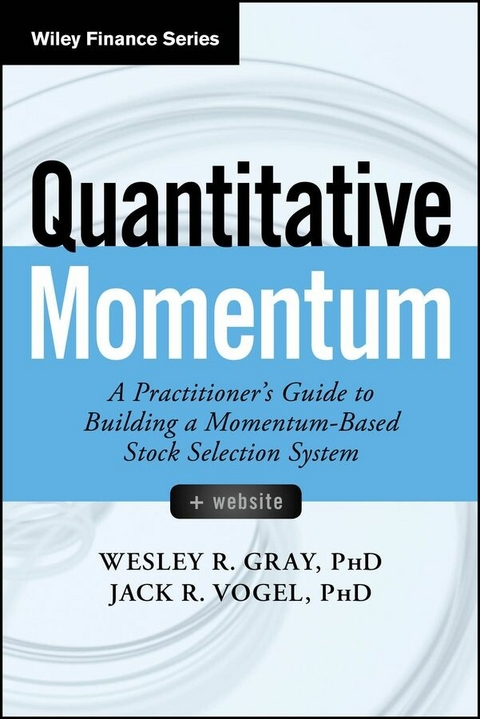
Quantitative Momentum (eBook)
John Wiley & Sons (Verlag)
978-1-119-23725-9 (ISBN)
Quantitative Momentum brings momentum investing out of Wall Street and into the hands of individual investors. In his last book, Quantitative Value, author Wes Gray brought systematic value strategy from the hedge funds to the masses; in this book, he does the same for momentum investing, the system that has been shown to beat the market and regularly enriches the coffers of Wall Street's most sophisticated investors. First, you'll learn what momentum investing is not: it's not 'growth' investing, nor is it an esoteric academic concept. You may have seen it used for asset allocation, but this book details the ways in which momentum stands on its own as a stock selection strategy, and gives you the expert insight you need to make it work for you. You'll dig into its behavioral psychology roots, and discover the key tactics that are bringing both institutional and individual investors flocking into the momentum fold.
Systematic investment strategies always seem to look good on paper, but many fall down in practice. Momentum investing is one of the few systematic strategies with legs, withstanding the test of time and the rigor of academic investigation. This book provides invaluable guidance on constructing your own momentum strategy from the ground up.
- Learn what momentum is and is not
- Discover how momentum can beat the market
- Take momentum beyond asset allocation into stock selection
- Access the tools that ease DIY implementation
The large Wall Street hedge funds tend to portray themselves as the sophisticated elite, but momentum investing allows you to 'borrow' one of their top strategies to enrich your own portfolio. Quantitative Momentum is the individual investor's guide to boosting market success with a robust momentum strategy.
The individual investor's comprehensive guide to momentum investing Quantitative Momentum brings momentum investing out of Wall Street and into the hands of individual investors. In his last book, Quantitative Value, author Wes Gray brought systematic value strategy from the hedge funds to the masses; in this book, he does the same for momentum investing, the system that has been shown to beat the market and regularly enriches the coffers of Wall Street's most sophisticated investors. First, you'll learn what momentum investing is not: it's not 'growth' investing, nor is it an esoteric academic concept. You may have seen it used for asset allocation, but this book details the ways in which momentum stands on its own as a stock selection strategy, and gives you the expert insight you need to make it work for you. You'll dig into its behavioral psychology roots, and discover the key tactics that are bringing both institutional and individual investors flocking into the momentum fold. Systematic investment strategies always seem to look good on paper, but many fall down in practice. Momentum investing is one of the few systematic strategies with legs, withstanding the test of time and the rigor of academic investigation. This book provides invaluable guidance on constructing your own momentum strategy from the ground up. Learn what momentum is and is not Discover how momentum can beat the market Take momentum beyond asset allocation into stock selection Access the tools that ease DIY implementation The large Wall Street hedge funds tend to portray themselves as the sophisticated elite, but momentum investing allows you to 'borrow' one of their top strategies to enrich your own portfolio. Quantitative Momentum is the individual investor's guide to boosting market success with a robust momentum strategy.
WESLEY R. GRAY, PhD, is founder and CEO/CIO of Alpha Architect, an asset management firm delivering affordable, active exposures for tax-sensitive investors. He is coauthor of Quantitative Value and DIY Financial Advisor, as well as author of Embedded: A Marine Corps Advisor Inside the Iraqi Army. JACK R. VOGEL, PhD, is CFO/CIO of Alpha Architect, an asset management firm delivering affordable, active exposures for tax-sensitive investors. He is coauthor of DIY Financial Advisor.
Preface ix
Acknowledgments xi
About the Authors xiii
Part One Understanding Momentum 1
Chapter 1 Less Religion; More Reason 3
Chapter 2 Why Can Active Investment Strategies Work? 14
Chapter 3 Momentum Investing is Not Growth Investing 43
Chapter 4 Why All Value Investors Need Momentum 62
Part Two Building a Momentum-Based Stock Selection Model 77
Chapter 5 The Basics of Building a Momentum Strategy 79
Chapter 6 Maximizing Momentum: The Path Matters 93
Chapter 7 Momentum Investors Need to Know Their Seasons 107
Chapter 8 Quantitative Momentum Beats the Market 120
Chapter 9 Making Momentum Work in Practice 144
Appendix A
Investigating Alternative Momentum Concepts 155
Appendix B
Performance Statistics Definitions 175
About the Companion Website 176
Index 177
"Systematic momentum investing, as opposed to its complementary cousin value, has not gotten the investor attention it deserves. Wes and Jack fix this problem. Anyone interested in systematic investing should read this book and add more tools to their repertoire."
- Cliff Asness, Managing and Founding Principal of AQR Capital Management
"Most investors would assume the 'premiere anomaly' is value, when in fact it is momentum. Let Wes and Jack take you through a MBA course on momentum that will have you saying by the end - 'the trend is your friend.'"
-Meb Faber, CIO of Cambria Investment Management
"Wes and Jack have looked under every rock for an edge and they've found it with momentum. Momentum is the 'premier anomaly', so no surprise this is their best book yet. Buy it and read it."
-Adam Butler, CEO of ReSolve Asset Management
CHAPTER 1
Less Religion; More Reason
Child: “Dad, are you sure Santa brought the presents?” Father: “Yes, Santa carried them on his sleigh.” Child: “I guess that makes sense. He did eat the cookies and milk we left by the fireplace.”
—Typical adult/child chat on Christmas Day
TECHNICAL ANALYSIS: THE MARKET'S OLDEST RELIGION
During the 1600s, the Dutch had a large merchant fleet and the port city of Amsterdam was a dominant commercial hub for trade from around the world. Based on the growing influence of the Dutch Republic, in 1602 the Dutch East India Company was founded, and its evolution into the first publicly traded global corporation drove a number of financial innovations to the Amsterdam Stock Exchange, including the subsequent listing of additional companies and even short selling.
In 1688, Joseph de la Vega, a successful Dutch merchant, wrote Confusion De Confusiones, one of the earliest known books to describe a stock exchange and stock trading. Some researchers today argue that he should be considered the father of behavioral finance. De la Vega vividly described excessive trading, overreaction, underreaction, and the disposition effect well before they were documented by modern finance journals.1
In his book, de la Vega describes the day-to-day business of the Exchange and alludes to how prices are set:
When a bull enters such a coffee-house during the Exchange hours, he is asked the price of the shares by the people present. He adds one to two per cent to the price of the day and he produces a notebook in which he pretends to put down orders. The desire to buy shares increases; and this enhances also the apprehension that there may be a further rise (for on this point we are all alike: when the prices rise, we think that they fly up high and, when they have risen high, that they will run away from us).2
De la Vega seems to be describing how rising prices themselves can beget continued price increases. Put another way, in the words of Wes's graduate school roommate who managed a market making desk at a large Wall Street bank, “High prices attract buyers, low prices attract sellers.”3
De la Vega continues:
The fall of prices need not have a limit, and there are also unlimited possibilities for the rise…Therefore the excessively high values need not alarm you…there will always be buyers who will free you from anxiety…the bulls are optimistic with joy over the state of business affairs, which is steadily favorable to them; and their attitude is so full of [unthinking] confidence that even less favorable news does not impress them and causes no anxiety…[It seems] incompatible with philosophy that bears should sell after the reason for their sales has ceased to exist, since the philosophers teach that when the cause ceases, the effect ceases also. But if the bears obstinately go on selling, there is an effect even after the cause had disappeared.4
Here de la Vega explicitly discusses how bulls can continue buying, and bears can continue selling, even when there is no direct reason or cause for them to do so, other than the price action itself. So here we see how, even in seventeenth-century Europe, price changes—independent of fundamentals—can affect future market prices.
While early technical analysis was evolving in stock trading in Europe, an even more fascinating financial experiment was taking place in Japan. During the 1600s, the peasant class, who made up the majority of the Japanese population, was forced into farming, thus supplying a tax base that could support the ruling military class, who, in turn, provided protection for agricultural land. Rice was the largest crop at that time, accounting for as much as 90 percent of government revenues, and became a staple of the Japanese economy.
The important role of rice in Japan led to the establishment of a formal exchange in 1697, and eventually to the emergence of what many believe to be the first futures market, the Dojima Rice Market. That market grew to include a network of warehouses, with established credit and clearing mechanisms.5
The rapidly evolving rice market in Japan was the fertile financial environment in which a young rice merchant, Munehisa Homma (1724–1803), found himself during the mid-1700s. Homma began trading rice futures and used a private communications network to trade advantageously. Homma also used the history of prices to make predictions about the direction of future prices. But his key insight involved the psychology of the markets.
In 1755, Homma wrote, The Fountain of Gold—The Three Monkey Record of Money, which described the role of emotions and how these could affect rice prices. Homma observed, “The psychological aspect of the market was critical to [one's] trading success,” and “studying the emotions of the market…could help in predicting prices.” Thus, Homma, like de la Vega, was perhaps one of the earliest documented practitioners of behavioral finance. His book was among the earliest writings covering markets and investor psychology.6
Homma invested on the long and the short side, and was thus an antecedent to today's hedge funds. He was so successful and became so wealthy that he inspired the adage: “I will never become a Homma, but I would settle to be a local lord.” He eventually became an adviser to the government, and to Japan's first sovereign wealth fund.7
On the other side of the globe, financial markets were also evolving. The late nineteenth and early twentieth centuries marked a time of increasing stock market participation in the United States. Among the most famous equity investors of that era was a man named Jesse Livermore. He began trading at the age of 14, and over his lifetime, he gained and lost several fortunes.
An American author named Edwin Lefevre wrote the biography Reminiscences of a Stock Operator. The biography is an account of Livermore's life and experiences in the early years of 1900s. The book describes Livermore's success using technical trading rules. Lefevre also described Livermore's overarching philosophy on the market:
You watch the market…with one object: to determine the direction—that is the price tendency…Nobody should be puzzled as to whether a market is a bull or a bear market after it fairly starts. The trend is evident to a man who has an open mind and reasonably clear sight…8
We gain more insight into Livermore's investment philosophy when we examine comments regarding his buy and sell decisions. We would recognize these decisions today as modern “momentum” strategies: “It is surprising how many experienced traders there are who look incredulous when I tell them that when I buy stocks for a rise I like to pay top prices and when I sell I must sell low or not at all.”
Clearly, the ideas that investors are not completely rational, and prices are related to future prices are not new ideas. Collectively, the investors discussed above—Joseph de la Vega, Munehisa Homma, and Jesse Livermore—highlight how great investors across history have recognized the role of psychology in the markets, and that historical prices can help predict future prices—in other words, technical analysis works. But fast forward to the early twentieth century, when some investors began to question whether technical analysis represented a sensible approach to investing. Many thought analysis of a company's fundamentals might be a more reasonable technique. Investors began to investigate fundamental analysis, involving a careful review of a company's financial statements, in hopes that such analysis might provide a better rationale for making investment decisions. In particular, a new investing philosophy began to gain notoriety: value investing, which involves buying stocks trading at a low price versus various fundamentals, such as earnings or cash flow.
A NEW RELIGION EMERGES: FUNDAMENTAL ANALYSIS
Benjamin Graham is commonly known as the father of the value investing movement. Graham believed that if investors bought stocks at prices consistently below their intrinsic value, as determined by fundamental analysis, those investors could earn superior risk-adjusted returns. Graham outlined his value-investing framework in two of the most famous investing books of all time, Security Analysis and The Intelligent Investor.
Graham realized that there were many adherents to the technical analysis approach, but he was clear in expressing what he thought of the discipline: bogus witchcraft. A quote from The Intelligent Investor summarizes his views:
The one principle that applies to nearly all these so-called “technical approaches” is that one should buy because a stock or the market has gone up and one should sell because it has declined. This is the exact opposite of sound business sense everywhere else, and it is most unlikely that it can lead to lasting success on Wall Street.9
Graham's early criticism of technical analysis has been reinforced over time by other adamant adherents of the fundamental analysis religion. Graham's most famous protégé, Warren Buffett, took the boxing gloves from Graham and continued to beat on the technical analysis crowd. A statement attributed to him demonstrates his views: “I realized technical analysis didn't work...
| Erscheint lt. Verlag | 13.9.2016 |
|---|---|
| Reihe/Serie | Wiley Finance |
| Wiley Finance Editions | Wiley Finance Editions |
| Sprache | englisch |
| Themenwelt | Mathematik / Informatik ► Mathematik |
| Recht / Steuern ► Wirtschaftsrecht | |
| Wirtschaft ► Betriebswirtschaft / Management ► Finanzierung | |
| Schlagworte | Alpha Architect • Business & Finance • David P. Foulke • Empirical Finance • Finance & Investments • Finanz- u. Anlagewesen • Finanzwesen • Investments & Securities • Jack R. Vogel • Kapitalanlagen u. Wertpapiere • Mathematics • Mathematik • Mathematik in Wirtschaft u. Finanzwesen • momentum investing • momentum investing basics • momentum investing guide • momentum investing how-to • momentum investing overview • momentum investing principles • momentum investing strategy • momentum investing techniques • momentum investing tips • momentum investing tools • momentum stock selection • Portfolio Management • Quantitative Investing • Quantitative Momentum: A Practitioner's Guide to Building a Momentum-Based Stock Selection System • systematic investing • Wesley R. Gray • what is momentum investing |
| ISBN-10 | 1-119-23725-4 / 1119237254 |
| ISBN-13 | 978-1-119-23725-9 / 9781119237259 |
| Informationen gemäß Produktsicherheitsverordnung (GPSR) | |
| Haben Sie eine Frage zum Produkt? |
 EPUB (Adobe DRM)
Kopierschutz: Adobe-DRM
Adobe-DRM ist ein Kopierschutz, der das eBook vor Mißbrauch schützen soll. Dabei wird das eBook bereits beim Download auf Ihre persönliche Adobe-ID autorisiert. Lesen können Sie das eBook dann nur auf den Geräten, welche ebenfalls auf Ihre Adobe-ID registriert sind.
Details zum Adobe-DRM
Dateiformat: EPUB (Electronic Publication)
EPUB ist ein offener Standard für eBooks und eignet sich besonders zur Darstellung von Belletristik und Sachbüchern. Der Fließtext wird dynamisch an die Display- und Schriftgröße angepasst. Auch für mobile Lesegeräte ist EPUB daher gut geeignet.
Systemvoraussetzungen:
PC/Mac: Mit einem PC oder Mac können Sie dieses eBook lesen. Sie benötigen eine
eReader: Dieses eBook kann mit (fast) allen eBook-Readern gelesen werden. Mit dem amazon-Kindle ist es aber nicht kompatibel.
Smartphone/Tablet: Egal ob Apple oder Android, dieses eBook können Sie lesen. Sie benötigen eine
Geräteliste und zusätzliche Hinweise
Buying eBooks from abroad
For tax law reasons we can sell eBooks just within Germany and Switzerland. Regrettably we cannot fulfill eBook-orders from other countries.
aus dem Bereich