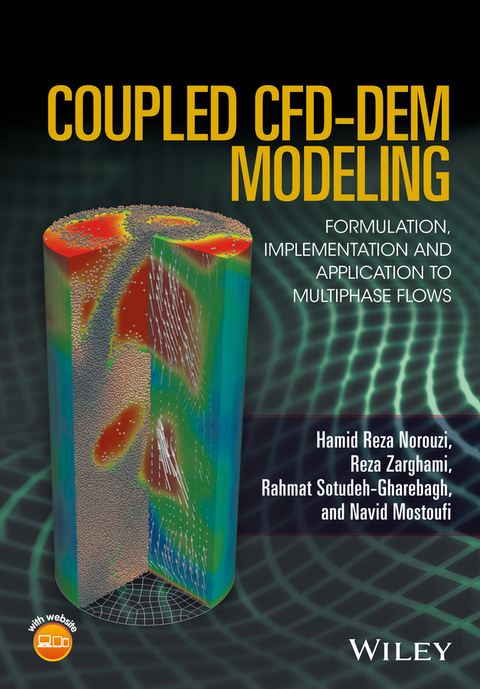
Coupled CFD-DEM Modeling (eBook)
John Wiley & Sons (Verlag)
978-1-119-00525-4 (ISBN)
Discusses the CFD-DEM method of modeling which combines both the Discrete Element Method and Computational Fluid Dynamics to simulate fluid-particle interactions.
- Deals with both theoretical and practical concepts of CFD-DEM, its numerical implementation accompanied by a hands-on numerical code in FORTRAN
- Gives examples of industrial applications
Hamid Reza Norouzi holds a PhD from the University of Tehran in chemical engineering. His research interests are discrete element modeling, computational fluid dynamics and multiphase flows in chemical and pharmaceutical processes.
Reza Zarghami is Head of the Pharmaceutical Engineering program and Assistant Professor at the School of Chemical Engineering at the University of Tehran. His research interests include pharmaceutical processing and manufacturing, powder technology, advanced fluid mechanics and CFD in chemical engineering, and he has published over 70 articles.
Rahmat Sotudeh-Gharebagh is Director of Standard Research Institute, ISIRI, Tehran, Iran and a Professor of Chemical Engineering, at the University of Tehran. He founded the Pharmaceutical Engineering program there. His research interests include fluidization engineering, process modeling and simulation, chemical engineering education, pharmaceutical engineering and information technology. He has published three books, over 230 articles, and serves as editor-in-chief of Chemical Product and Process Modeling, and Journal of Industrial Technology Development.
Navid Mostoufi is a Professor at the School of Chemical Engineering at the University of Tehran in Iran where he has taught for 14 years. His industry experience has included developing operator training simulators and feasibility studies for several companies. He is the author of more than 140 journal articles and 115 conference papers on process engineering and modeling, and is an editor for three journals including Chemical Product and Process Modeling where he is joint editor-in-chief with Professor Rahmat Sotudeh-Gharebagh.
Discusses the CFD-DEM method of modeling which combines both the Discrete Element Method and Computational Fluid Dynamics to simulate fluid-particle interactions. Deals with both theoretical and practical concepts of CFD-DEM, its numerical implementation accompanied by a hands-on numerical code in FORTRAN Gives examples of industrial applications
Hamid Reza Norouzi holds a PhD from the University of Tehran in chemical engineering. His research interests are discrete element modeling, computational fluid dynamics and multiphase flows in chemical and pharmaceutical processes. Reza Zarghami is Head of the Pharmaceutical Engineering program and Assistant Professor at the School of Chemical Engineering at the University of Tehran. His research interests include pharmaceutical processing and manufacturing, powder technology, advanced fluid mechanics and CFD in chemical engineering, and he has published over 70 articles. Rahmat Sotudeh-Gharebagh is Director of Standard Research Institute, ISIRI, Tehran, Iran and a Professor of Chemical Engineering, at the University of Tehran. He founded the Pharmaceutical Engineering program there. His research interests include fluidization engineering, process modeling and simulation, chemical engineering education, pharmaceutical engineering and information technology. He has published three books, over 230 articles, and serves as editor-in-chief of Chemical Product and Process Modeling, and Journal of Industrial Technology Development. Navid Mostoufi is a Professor at the School of Chemical Engineering at the University of Tehran in Iran where he has taught for 14 years. His industry experience has included developing operator training simulators and feasibility studies for several companies. He is the author of more than 140 journal articles and 115 conference papers on process engineering and modeling, and is an editor for three journals including Chemical Product and Process Modeling where he is joint editor-in-chief with Professor Rahmat Sotudeh-Gharebagh.
Title Page 5
Copyright Page 6
Contents 9
About the Authors 13
Preface 15
Chapter 1 Introduction 17
1.1 Multiphase Coupling 18
1.2 Modeling Approaches 18
1.3 Modeling with DEM 21
1.4 CFD-DEM Modeling 23
1.5 Applications 26
1.6 Scope and Overall Plan 26
Part I 27
Part II 28
1.7 Online Content 28
References 28
Part I DEM 31
Chapter 2 DEM Formulation 33
2.1 Hard-Sphere 34
2.1.1 Equation of Motion 35
2.1.2 Collision Model 35
2.1.3 Interparticle Forces 38
2.2 Soft-Sphere 40
2.2.1 Equations of Motion 41
2.3 Force-Displacement Laws 43
2.3.1 Linear Viscoelastic Model 45
2.3.2 Nonlinear Viscoelastic Models 52
2.3.3 Comparison of Viscoelastic Force-Displacement Models 61
2.3.4 Elastic Perfectly Plastic Models 65
2.4 Torque Expressions 72
2.4.1 Model A: Constant Torque Model 72
2.4.2 Model B: Viscous Model 73
2.4.3 Model C: Spring-Dashpot Model 73
2.5 Boundary and Initial Conditions 74
2.5.1 Boundary Conditions 74
2.5.2 Initial Condition 76
Nomenclature 76
References 80
Chapter 3 DEM Implementation 84
3.1 Computational View 84
3.2 Program Structure 87
3.3 Contact Search Algorithms 92
3.3.1 Definition of Problem 95
3.3.2 Cell-Based Algorithms 96
3.3.3 Sort-Based Algorithms 112
3.3.4 Tree-Based Broad Search Algorithms 115
3.3.5 Fine Search for Spherical Particles 119
3.4 Integration Methods 119
3.4.1 Single-Step Methods 122
3.4.2 Multi-Step Algorithms 126
3.4.3 Predictor-Corrector Methods 128
3.4.4 Evaluation of Integration Methods 130
3.5 Spring Stiffness 135
3.5.1 Maximum Overlap 138
3.5.2 Collision Time and Maximum Contact Force 139
3.6 Wall Implementation 139
3.6.1 Definition of Wall Elements 141
3.6.2 Contact Detection 144
3.6.3 Moving Wall 152
3.7 Parallelization 154
3.7.1 Distributed Memory Parallelization 154
3.7.2 Shared-Memory Parallelization 157
Nomenclature 161
References 163
Chapter 4 Non-Spherical Particles 168
4.1 Shape Representation 169
4.2 Kinematics and Dynamics of a Rigid Body 172
4.2.1 Euler Angles and Transformation Matrix 173
4.2.2 Equations of Motion 175
4.2.3 Quaternions for Rigid Body Dynamics 179
4.3 Superellipsoids 180
4.3.1 Contact Forces 182
4.3.2 Effective Radius and Curvatures 185
4.3.3 Torque Calculations 189
4.3.4 Contact Detection 190
4.4 Multi-Sphere Method 194
Nomenclature 200
References 202
Chapter 5 DEM Applications to Granular Flows 205
5.1 Packing of Particles 205
5.1.1 Confined Packing 205
5.1.2 Pile Formation 208
5.1.3 Rigid and Flexible Fibers 210
5.2 Flow in Hoppers 212
5.2.1 Flow Patterns 213
5.2.2 Segregation 215
5.2.3 Discharge Rate 217
5.3 Solid Mixing 219
5.3.1 Mechanisms of Mixing and Segregation 219
5.3.2 Mixing Index 221
5.3.3 Rotating Drums 225
5.3.4 Tumbling Blenders 236
5.3.5 Shaft Batch Mixers 239
5.3.6 Continuous Mixers 245
5.4 Screw Conveying 250
5.4.1 Simulation of Screw Conveyor 253
5.4.2 Results of the Simulations 254
5.4.3 Literature 255
5.5 Film Coating 257
5.5.1 Phenomenological Models 259
5.5.2 Monte-Carlo Method 260
Nomenclature 263
References 265
Part II CFD-DEM 273
Chapter 6 CFD-DEM Formulation and Coupling 275
6.1 Multiphase Coupling 276
6.1.1 Coupling Strategies 276
6.1.2 Types of Coupling 278
6.1.3 Interphase Interactions 281
6.2 Momentum Coupling 283
6.2.1 Single Phase Flow of Fluids 283
6.2.2 Fluid Resolution in CFD-DEM 290
6.2.3 Unresolved Surface CFD-DEM 291
6.2.4 Surface Force Decomposition 303
6.3 Energy Coupling 319
6.3.1 Governing Equations 320
6.3.2 Rates of Heat Transfer for Particles 324
6.3.3 Rates of Heat Transfer for Fluid 332
6.3.4 Sequence of Calculations 333
6.4 Mass Coupling 335
6.4.1 Governing Equations 335
6.4.2 Rates of Mass Transfer for Particles 340
6.4.3 Rates of Change in Fluid 345
6.4.4 Sequence of Calculations 345
Nomenclature 345
References 351
Chapter 7 CFD-DEM Applications to Multiphase Flow 357
7.1 Fluidization 357
7.1.1 Macro-Scale Phenomena 358
7.1.2 Meso-Scale Phenomena 360
7.1.3 Micro-Scale Phenomena 361
7.2 Spouting 363
7.3 Pneumatic Conveying 371
7.3.1 Dilute Phase and Dense Phase Conveying 372
7.3.2 Horizontal Conveying 373
7.3.3 Vertical Conveying 375
7.4 Non-Isothermal Flows 375
7.5 Reactive Flows 378
7.6 Miscellaneous 380
Nomenclature 381
References 382
Chapter 8 Interparticle Forces and External Fields 388
8.1 Governing Equations 389
8.1.1 Sequence of Calculations 391
8.2 Interparticle Forces 392
8.2.1 van der Waals Force 392
8.2.2 Liquid Bridge Force 395
8.2.3 Electrostatic Force 402
8.3 External Fields 406
8.3.1 Electric Field 406
8.3.2 Magnetic Field 409
8.3.3 Vibration Field 413
8.3.4 Acoustic Field 414
8.4 Applications 415
Nomenclature 420
References 423
Index 428
EULA 433
| Erscheint lt. Verlag | 14.9.2016 |
|---|---|
| Sprache | englisch |
| Themenwelt | Mathematik / Informatik ► Mathematik ► Angewandte Mathematik |
| Naturwissenschaften ► Chemie ► Technische Chemie | |
| Technik ► Maschinenbau | |
| Technik ► Umwelttechnik / Biotechnologie | |
| Schlagworte | CFD-DEM • chemical engineering • Chemie • Chemische Verfahrenstechnik • Chemistry • coupling • Discrete element method • Fluidization • fluid mechanics • Fluid-particle interactions • Grundoperationen d. Pharmazeutischen Verfahrenstechnik • Interparticle forces • Maschinenbau • mechanical engineering • Modeling • Multiphase Flow • Numerical Implementations • Pharmaceutical Unit Operations (Pharmaceutical Engineering) • pharmazeutische Verfahrenstechnik • Process Engineering • Prozesssteuerung • Strömungsmechanik • Strömungsmechanik • Two-phase formulation |
| ISBN-10 | 1-119-00525-6 / 1119005256 |
| ISBN-13 | 978-1-119-00525-4 / 9781119005254 |
| Informationen gemäß Produktsicherheitsverordnung (GPSR) | |
| Haben Sie eine Frage zum Produkt? |
 PDF (Adobe DRM)
Kopierschutz: Adobe-DRM
Adobe-DRM ist ein Kopierschutz, der das eBook vor Mißbrauch schützen soll. Dabei wird das eBook bereits beim Download auf Ihre persönliche Adobe-ID autorisiert. Lesen können Sie das eBook dann nur auf den Geräten, welche ebenfalls auf Ihre Adobe-ID registriert sind.
Details zum Adobe-DRM
Dateiformat: PDF (Portable Document Format)
Mit einem festen Seitenlayout eignet sich die PDF besonders für Fachbücher mit Spalten, Tabellen und Abbildungen. Eine PDF kann auf fast allen Geräten angezeigt werden, ist aber für kleine Displays (Smartphone, eReader) nur eingeschränkt geeignet.
Systemvoraussetzungen:
PC/Mac: Mit einem PC oder Mac können Sie dieses eBook lesen. Sie benötigen eine
eReader: Dieses eBook kann mit (fast) allen eBook-Readern gelesen werden. Mit dem amazon-Kindle ist es aber nicht kompatibel.
Smartphone/Tablet: Egal ob Apple oder Android, dieses eBook können Sie lesen. Sie benötigen eine
Geräteliste und zusätzliche Hinweise
Buying eBooks from abroad
For tax law reasons we can sell eBooks just within Germany and Switzerland. Regrettably we cannot fulfill eBook-orders from other countries.
aus dem Bereich