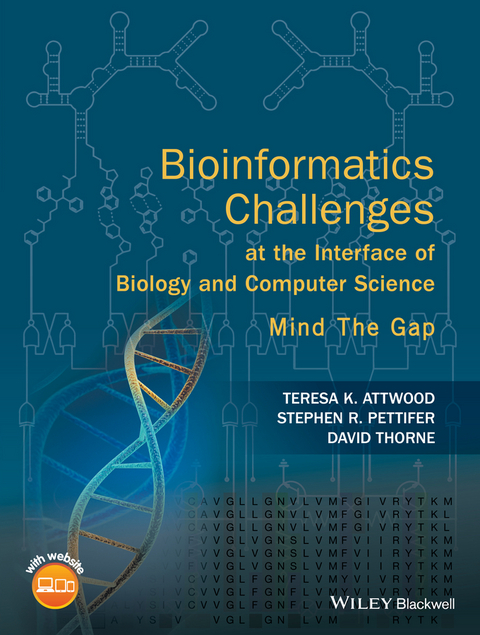
Bioinformatics Challenges at the Interface of Biology and Computer Science (eBook)
John Wiley & Sons (Verlag)
978-1-119-24345-8 (ISBN)
This innovative book provides a completely fresh exploration of bioinformatics, investigating its complex interrelationship with biology and computer science. It approaches bioinformatics from a unique perspective, highlighting interdisciplinary gaps that often trap the unwary.
The book considers how the need for biological databases drove the evolution of bioinformatics; it reviews bioinformatics basics (including database formats, data-types and current analysis methods), and examines key topics in computer science (including data-structures, identifiers and algorithms), reflecting on their use and abuse in bioinformatics.
Bringing these disciplines together, this book is an essential read for those who wish to better understand the challenges for bioinformatics at the interface of biology and computer science, and how to bridge the gaps. It will be an invaluable resource for advanced undergraduate and postgraduate students, and for lecturers, researchers and professionals with an interest in this fascinating, fast-moving discipline and the knotty problems that surround it.
Teresa K. Attwood, Professor of Bioinformatics, University of Manchester, UK.
Stephen R. Pettifer, Lecturer of Computer Science,?University of Manchester, UK.
Teresa K. Attwood, Professor of Bioinformatics, University of Manchester, UK. Stephen R. Pettifer, Lecturer of Computer Science,?University of Manchester, UK.
Preface
0.1 Who this book is for, and why
As you pick up this book and flick through its pages, we'd like to interrupt you for a moment to tell you who we think this book is for, and why. Let's start with the why. One main thought prompted us to tackle this project. There are now many degree courses in bioinformatics1 throughout the world, and many excellent accompanying textbooks. In general, these texts tend to focus either on how to use standard bioinformatics tools, or on how to implement the algorithms and get to grips with the programming languages that underpin them. The ‘how to use' approach is appropriate for students who want to become familiar with the tools of the trade quickly so that they can apply them to their own interests; the ‘what's behind them' approach might appeal more to students who want to go on to develop their own software and databases. Books like this are extremely useful, but there's often something missing – bioinformatics isn't just about writing faster programs or creating new databases; it's also about coupling solid computer science with an appreciation of how computers can (or can't) solve biological problems.
During the years we've been working together, we realised that this issue is seldom, if ever, tackled head-on – it's an issue rooted in the nature of bioinformatics itself. Bioinformatics is often described as the interface where computer science and biology meet and overlap, as shown in Figure 0.1.
Figure 0.1 The traditional view of bioinformatics.
However, the reality is that modern bioinformatics has become a discipline in its own right – bigger, broader and more complex than this seemingly trivial overlap might suggest, and bringing with it many new challenges of its own. The reality, then, tends to look more like Figure 0.2.
Figure 0.2 Mind the Gap.
A common difficulty for teachers of bioinformatics courses is that they often have to cater for mixed audiences – for students with diverse backgrounds in biology and computer science. As a result, there generally isn't enough time to cover all of the basic biology and all of the basic bioinformatics, and even less time to deal, at an appropriate level, with some of the emerging issues in computer science and how these relate to bioinformatics. It's hard enough to do justice to each of these disciplines on its own, let alone to tackle the problems that emerge when they're brought together.
For teachers and students, this book is therefore an attempt to bridge the interdisciplinary gap, to address some of the challenges for bioinformatics at the interface of biology and computer science. Compared to other textbooks, it offers rather different perspectives on the challenges, and on the relationship between these disciplines necessary for the success of bioinformatics in the future. It will appeal, we hope, to undergraduate and postgraduate students who want to look beyond ‘how to use this tool' or ‘how to write that program'; it will speak to students who want to discover why the things we often want to do in bioinformatics are not as straightforward as they should be; it will resonate with those who want to understand how we can use computer science to make such tasks more straightforward than they currently are; and it will challenge the thoughtful to reflect on where the limits are in terms of what we want computers to be able to do and what's actually doable.
0.2 Who has written this book
The authors of the book have backgrounds in biophysics and computer science. We've worked together successfully for many years, but early in our relationship we often found it harder to communicate than we imagined it either could or should be. It wasn't just about meeting a different discipline head on and having to grapple with new terminology – the real problem was that we often thought we understood each other, only to find later that we actually meant quite different things, despite having used what appeared to be the same vocabulary. Learning new terminology is relatively easy; learning to spot that the thing you mean and the thing you think he means are different is much harder! It's a bit like trying to read the bottom line of an optician's test chart – the scale of the problem only comes into focus when viewed from another perspective: the optician provides the correct lens, and clarity dawns.
The scale of our communication problem was thrown into focus when we began developing software together. Initially, there was the usual learning curve to negotiate, as we each had to understand the jargon of the other's discipline. When our new software eventually emerged, we were invited to give a talk about it. It was only when we tried to write the talk, and stood back and looked at the work in a different way, that a kind of fog lifted – thinking we'd been speaking the same language, we'd actually reached this point by understanding different things by using the same words. This revelation provided a catalyst for the book: if we could so easily have reached apparent understanding through misunderstanding of basic concepts, could bioinformatics be a similar house of cards, waiting to topple? We reasoned that our different scientific perspectives, focused on some straightforward bioinformatics applications, might help to shed a little light on this question. So, let's now briefly introduce our different backgrounds – this should help to explain why the book is written in the way that it is, and why it contains what it does.
0.2.1 The biophysicist
The biophysicist isn't really a biologist and certainly isn't a computer scientist. She was engaged in her early postdoctoral work on protein sequence and structure analysis when the field of bioinformatics was just emerging; some of it rubbed off. The introductory chapters of the book therefore derive mostly from those early experiences, when the term bioinformatics was more or less synonymous with sequence analysis. Thus, sequence analysis provides an important backdrop for the book. Of course, it isn't the only theme, either of the book or of bioinformatics in general – it's just a convenient place to start, a place that's both historically and conceptually easy to build from, and one that's arguably even more relevant today than it was when the discipline began. To maintain an appropriate focus, then, we use sequence analysis as our springboard and, in deference to their expertise, we leave other aspects of bioinformatics to the relevant specialists in those particular fields.
0.2.2 The computer scientists
The computer scientists aren't really bioinformaticians and certainly aren't biologists. They began developing software tools in collaboration with bioinformaticians about ten years ago; in the process, a bit of bioinformatics rubbed off on them too. They come at the subject from various perspectives, including those of distributed systems, computer graphics, human–computer interaction and scientific visualisation. Especially important for this book, as you'll see if you view the online supplementary materials (which we encourage you to do), is their interest in the design of collaborative and semantically rich software systems for the biosciences, with a particular focus on improving access to scholarly literature and its underlying biochemical/biomedical data.
0.3 What's in this book
0.3.1 The scope
Rather than offering an authoritative exposition of current hot topics in bioinformatics, this book provides a framework for thinking critically about fundamental concepts, giving new perspectives on, and hence trying to bridge the gap between, where traditional bioinformatics is now and where computer science is preparing to take it in the future. In essence, it's an exploration of the philosophical divide between what we want computers to do for us in the life sciences and what it's actually possible to do, today, with current computer technology. You might wonder why this is interesting – don't all the other books out there deal with this sort of thing? And the answer is, no – this book is different. It isn't about how to do bioinformatics, computer science or biology; it's about what happens when all of these disciplines collide, about how to pick up the pieces afterwards, and about what's likely to happen if we can't put all the bits back together again in the right places.
The problem is, when bioinformatics began to emerge as a new discipline in the 1980s, it was, in a sense, a fix for what the biological sciences needed at the time and what computer science could provide at that time (mostly database technology and fast database-search algorithms). The discipline evolved in a very pragmatic way, addressing local problems with convenient, more-or-less readily available solutions. That, of course, is the very essence of evolution: there is no grand plan, no sweeping vision of the future – just a problem that needs to be solved, now, in the most efficient, economical way possible.
The ramifications for systems that...
| Erscheint lt. Verlag | 26.8.2016 |
|---|---|
| Sprache | englisch |
| Themenwelt | Mathematik / Informatik ► Informatik ► Theorie / Studium |
| Naturwissenschaften ► Biologie ► Genetik / Molekularbiologie | |
| Technik | |
| Schlagworte | analysis methods • Bioinformatics • Bioinformatics & Computational Biology • Bioinformatik • Bioinformatik u. Computersimulationen in der Biowissenschaften • Biological databases • Biology • Biowissenschaften • Computational Biology • Computer Science • Computer Technology • data mining • Data Mining & Knowledge Discovery • Data Mining u. Knowledge Discovery • Data Types • Genetik • Human Computer Interaction • Informatik • Infrastructure • Knowledge • Life Sciences • Management • Mathematics • Mathematik • Mathematik in der Biologie |
| ISBN-10 | 1-119-24345-9 / 1119243459 |
| ISBN-13 | 978-1-119-24345-8 / 9781119243458 |
| Informationen gemäß Produktsicherheitsverordnung (GPSR) | |
| Haben Sie eine Frage zum Produkt? |
 EPUB (Adobe DRM)
Kopierschutz: Adobe-DRM
Adobe-DRM ist ein Kopierschutz, der das eBook vor Mißbrauch schützen soll. Dabei wird das eBook bereits beim Download auf Ihre persönliche Adobe-ID autorisiert. Lesen können Sie das eBook dann nur auf den Geräten, welche ebenfalls auf Ihre Adobe-ID registriert sind.
Details zum Adobe-DRM
Dateiformat: EPUB (Electronic Publication)
EPUB ist ein offener Standard für eBooks und eignet sich besonders zur Darstellung von Belletristik und Sachbüchern. Der Fließtext wird dynamisch an die Display- und Schriftgröße angepasst. Auch für mobile Lesegeräte ist EPUB daher gut geeignet.
Systemvoraussetzungen:
PC/Mac: Mit einem PC oder Mac können Sie dieses eBook lesen. Sie benötigen eine
eReader: Dieses eBook kann mit (fast) allen eBook-Readern gelesen werden. Mit dem amazon-Kindle ist es aber nicht kompatibel.
Smartphone/Tablet: Egal ob Apple oder Android, dieses eBook können Sie lesen. Sie benötigen eine
Geräteliste und zusätzliche Hinweise
Buying eBooks from abroad
For tax law reasons we can sell eBooks just within Germany and Switzerland. Regrettably we cannot fulfill eBook-orders from other countries.
aus dem Bereich