


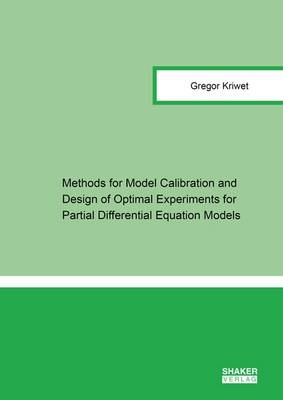
Methods for Model Calibration and Design of Optimal Experiments for Partial Differential Equation Models
Seiten
2016
Shaker (Verlag)
9783844047493 (ISBN)
Shaker (Verlag)
9783844047493 (ISBN)
- Keine Verlagsinformationen verfügbar
- Artikel merken
Mathematical models are of great importance in manufacturing and engineering. Besides providing a scientific insight into processes, the mathematical models are used in process optimization and control. However, the results from simulation and optimization are only reliable if the underlying model precisely describes the underlying process. This implies a model validated by experimental data with sufficiently good estimates for model parameters.
In recent decades, powerful and efficient methods for model calibration and design of optimal experiments for ordinary differential equation (ODE) models have been developed. First steps towards model validation of partial differential equations (PDE) have been made by semi discretization in space, which transforms the PDE into a huge system of ODEs. In this case, it is not possible to use modern methods for PDE constrained optimization. Consequently, it is hardly possible to solve the problem on standard computers.
To cope with this problem, this dissertation combines modern methods for PDE constrained optimization with established approaches for model validation. The optimum experimental design problem is not of standard type. In order to consider the finite measurement time points, the problem is formulated as a multistage optimization problem. Furthermore, the evaluation of the objective function requires the computation of derivatives. Despite these problems, this dissertation successfully adapts the adjoint approach for the computation of the reduced gradient. Furthermore, the thesis presents a positive definite approximation of the second order derivatives, which can be computed very efficiently by adjoint PDEs.
In recent decades, powerful and efficient methods for model calibration and design of optimal experiments for ordinary differential equation (ODE) models have been developed. First steps towards model validation of partial differential equations (PDE) have been made by semi discretization in space, which transforms the PDE into a huge system of ODEs. In this case, it is not possible to use modern methods for PDE constrained optimization. Consequently, it is hardly possible to solve the problem on standard computers.
To cope with this problem, this dissertation combines modern methods for PDE constrained optimization with established approaches for model validation. The optimum experimental design problem is not of standard type. In order to consider the finite measurement time points, the problem is formulated as a multistage optimization problem. Furthermore, the evaluation of the objective function requires the computation of derivatives. Despite these problems, this dissertation successfully adapts the adjoint approach for the computation of the reduced gradient. Furthermore, the thesis presents a positive definite approximation of the second order derivatives, which can be computed very efficiently by adjoint PDEs.
| Erscheinungsdatum | 20.09.2016 |
|---|---|
| Reihe/Serie | Industriemathematik und Angewandte Mathematik |
| Verlagsort | Aachen |
| Sprache | englisch |
| Maße | 170 x 240 mm |
| Gewicht | 332 g |
| Einbandart | geklebt |
| Themenwelt | Mathematik / Informatik ► Mathematik ► Angewandte Mathematik |
| Schlagworte | Model Validation of PDE • optimum experimental design • Parameter Estimation |
| ISBN-13 | 9783844047493 / 9783844047493 |
| Zustand | Neuware |
| Informationen gemäß Produktsicherheitsverordnung (GPSR) | |
| Haben Sie eine Frage zum Produkt? |
Mehr entdecken
aus dem Bereich

aus dem Bereich
für Ingenieure und Naturwissenschaftler
Buch | Softcover (2024)
Springer Vieweg (Verlag)
CHF 48,95
Buch | Softcover (2025)
Springer Vieweg (Verlag)
CHF 62,95
Buch | Softcover (2025)
Springer Fachmedien Wiesbaden (Verlag)
CHF 69,95


