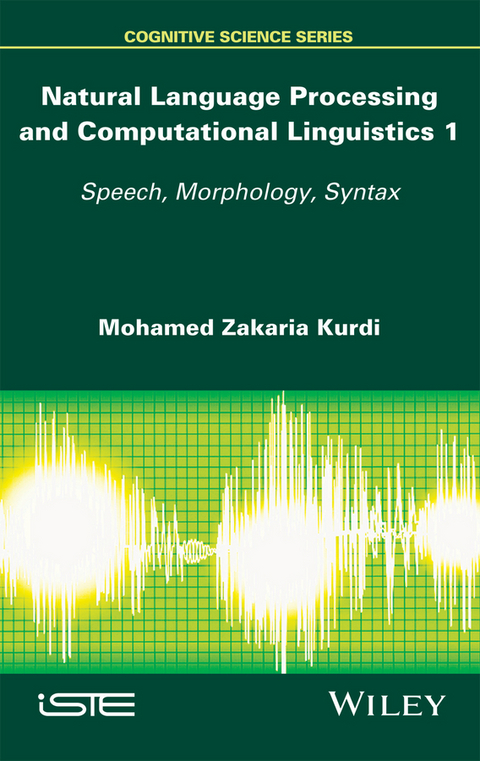
Natural Language Processing and Computational Linguistics (eBook)
296 Seiten
John Wiley & Sons (Verlag)
978-1-119-14557-8 (ISBN)
In four chapters, this book presents the fundamental concepts of phonetics and phonology and the two most important applications in the field of speech processing: recognition and synthesis. Also presented are the fundamental concepts of corpus linguistics and the basic concepts of morphology and its NLP applications such as stemming and part of speech tagging. The fundamental notions and the most important syntactic theories are presented, as well as the different approaches to syntactic parsing with reference to cognitive models, algorithms and computer applications.
Mohamed Zakaria Kurdi is Assistant Professor at the CS Department of Lynchburg College in Virginia, USA. His research interests include natural language processing, robust parsing, text mining and intelligent computer-assisted language learning.
Introduction ix
Chapter 1. Linguistic Resources for NLP 1
1.1. The concept of a corpus 1
1.2. Corpus taxonomy 4
1.2.1. Written versus spoken 4
1.2.2. The historical point of view 5
1.2.3. The language of corpora 5
1.2.4. Thematic representativity 7
1.2.5. Age range of speakers 8
1.3. Who collects and distributes corpora? 8
1.3.1. The Gutenberg project 9
1.3.2. The linguistic data consortium 9
1.3.3. European language resource agency 9
1.3.4. Open language archives community 10
1.3.5. Miscellaneous 10
1.4. The lifecycle of a corpus 10
1.4.1. Needs analysis 12
1.4.2. Design of scenarios to collect data for the corpus 12
1.4.3. Collection of the corpus 12
1.4.4. Transcription 16
1.4.5. Corpus annotation 18
1.4.6. Corpus documentation 22
1.4.7. Statistical analysis of data 22
1.4.8. The use of corpora in NLP 23
1.5. Examples of existing corpora 23
1.5.1. American National Corpus 23
1.5.2. Oxford English Corpus 23
1.5.3. The Grenoble Tourism Office Corpus 24
Chapter 2. The Sphere of Speech 25
2.1. Linguistic studies of speech 25
2.1.1. Phonetics 25
2.1.2. Phonology 46
2.2. Speech processing 61
2.2.1. Automatic speech recognition 62
2.2.2. Speech synthesis 80
Chapter 3. Morphology Sphere 89
3.1. Elements of morphology 89
3.1.1. Morphological typology 90
3.1.2. Morphology of English 91
3.1.3. Parts of speech 95
3.1.4. Terms, collocations and colligations 99
3.2. Automatic morphological analysis 100
3.2.1. Stemming 101
3.2.2. Regular expressions for morphological analysis 104
3.2.3. Informal introduction to finite-state machines 108
3.2.4. Two-level morphology and FST 112
3.2.5. Part-of-speech tagging 117
Chapter 4. Syntax Sphere 127
4.1. Basic syntactic concepts 127
4.1.1. Delimitation of the field of syntax 127
4.1.2. The concept of grammaticality 128
4.1.3. Syntactic constituents 129
4.1.4. Syntactic typology of topology and agreement 139
4.1.5. Syntactic ambiguity 140
4.1.6. Syntactic specificities of spontaneous oral language 141
4.2. Elements of formal syntax 145
4.2.1. Syntax trees and rewrite rules 145
4.2.2. Languages and formal grammars 152
4.2.3. Hierarchy of languages (Chomsky-Schützenberger) 154
4.2.4. Feature structures and unification 162
4.2.5. Definite clause grammar 169
4.3. Syntactic formalisms 171
4.3.1. X-bar 171
4.3.2. Head-driven phrase structure grammar 178
4.3.3. Lexicalized tree-adjoining grammar 193
4.4. Automatic parsing 201
4.4.1. Finite-state automata 202
4.4.2. Recursive transition networks 203
4.4.3. Top-down approach 207
4.4.4. Bottom-up approach 212
4.4.5. Mixed approach: left-corner 215
4.4.6. Tabular parsing (chart) 221
4.4.7. Probabilistic parsing 225
4.4.8. Neural network 233
4.4.9. parsing algorithms for unification-based grammars 237
4.4.10. Robust parsing approaches 238
4.4.11. Generation algorithms 242
Bibliography 245
Index 275
| Erscheint lt. Verlag | 17.8.2016 |
|---|---|
| Sprache | englisch |
| Themenwelt | Informatik ► Theorie / Studium ► Künstliche Intelligenz / Robotik |
| Technik ► Elektrotechnik / Energietechnik | |
| Schlagworte | Audio & Speech Processing & Broadcasting • Audio-, Sprachverarbeitung u. Ãbertragung • Audio-, Sprachverarbeitung u. Übertragung • cognitive science • Electrical & Electronics Engineering • Elektrotechnik u. Elektronik • Kognitionswissenschaft • Psychologie • Psychology |
| ISBN-10 | 1-119-14557-0 / 1119145570 |
| ISBN-13 | 978-1-119-14557-8 / 9781119145578 |
| Informationen gemäß Produktsicherheitsverordnung (GPSR) | |
| Haben Sie eine Frage zum Produkt? |
 EPUB (Adobe DRM)
Kopierschutz: Adobe-DRM
Adobe-DRM ist ein Kopierschutz, der das eBook vor Mißbrauch schützen soll. Dabei wird das eBook bereits beim Download auf Ihre persönliche Adobe-ID autorisiert. Lesen können Sie das eBook dann nur auf den Geräten, welche ebenfalls auf Ihre Adobe-ID registriert sind.
Details zum Adobe-DRM
Dateiformat: EPUB (Electronic Publication)
EPUB ist ein offener Standard für eBooks und eignet sich besonders zur Darstellung von Belletristik und Sachbüchern. Der Fließtext wird dynamisch an die Display- und Schriftgröße angepasst. Auch für mobile Lesegeräte ist EPUB daher gut geeignet.
Systemvoraussetzungen:
PC/Mac: Mit einem PC oder Mac können Sie dieses eBook lesen. Sie benötigen eine
eReader: Dieses eBook kann mit (fast) allen eBook-Readern gelesen werden. Mit dem amazon-Kindle ist es aber nicht kompatibel.
Smartphone/Tablet: Egal ob Apple oder Android, dieses eBook können Sie lesen. Sie benötigen eine
Geräteliste und zusätzliche Hinweise
Buying eBooks from abroad
For tax law reasons we can sell eBooks just within Germany and Switzerland. Regrettably we cannot fulfill eBook-orders from other countries.
aus dem Bereich