


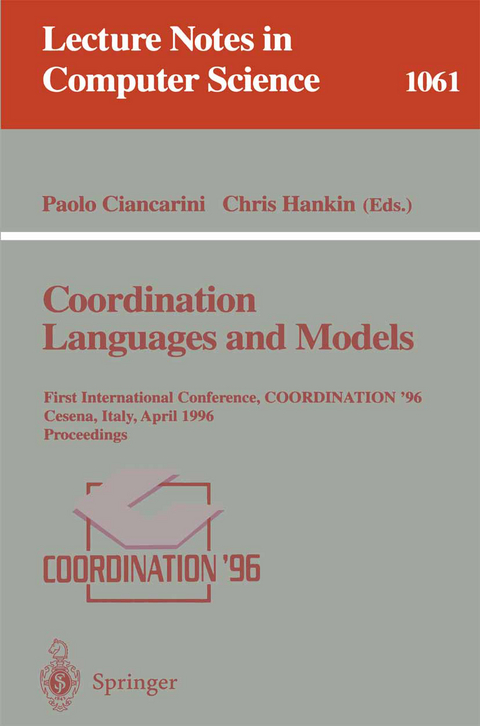
Coordination Languages and Models
Springer Berlin (Verlag)
978-3-540-61052-6 (ISBN)
Parallel multiset processing: From explicit coordination to chemical reaction.- Graph rewriting and constraint solving for modelling distributed systems with synchronization (extended abstract).- Coordination as constrained interaction (extended abstract).- The IWIM model for coordination of concurrent activities.- Sonia: An adaptation of Linda for coordination of activities in organizations.- The ToolBus coordination architecture.- Enhancing coordination and modularity mechanisms for a language with objects-as-multisets.- Towards a compositional method for coordinating Gamma programs.- Introducing a calculus for higher-order multiset programming.- ?2Log: Towards remote coordination.- A process algebra based on Linda.- Intra- and inter-object coordination with MESSENGERS.- Ariadne and HOPLa: Flexible coordination of collaborative processes.- Coordination in the ImpUnity framework.- Compiler correctness for concurrent languages.- A software environment for concurrent coordinated programming.- Designing a coordination model for open systems.- CCE: A process-calculus based formalism for specifying multi-object coordination.- An extensible framework for the development of coordinated applications.- Broadcasting in time.- Semantics of a higher-order coordination language.- Solving the Linda multiple rd problem.- Coordinating distributed objects with declarative interfaces.- Coordinating services in open distributed systems with Laura.- Visifold: A visual environment for a coordination language.- ALWAN: A skeleton programming language.- Weaving the Web using coordination.- Investigating strategies for cooperative planning of independent agents through prototype evaluation.- A case study of integration of a software process management system with software engineeringenvironments for process monitoring and management.- Nepi: A network programming language based on the ?-calculus.- Modelling interoperability by CHAM: A case study.- Integrating coordination features in PVM.- A simulator framework for embedded systems.- Understanding behavior of business process models.
| Erscheint lt. Verlag | 3.4.1996 |
|---|---|
| Reihe/Serie | Lecture Notes in Computer Science |
| Zusatzinfo | XI, 452 p. |
| Verlagsort | Berlin |
| Sprache | englisch |
| Maße | 155 x 235 mm |
| Gewicht | 629 g |
| Themenwelt | Mathematik / Informatik ► Informatik ► Netzwerke |
| Mathematik / Informatik ► Informatik ► Theorie / Studium | |
| Schlagworte | broadcast • Distributed Systems • Embedded Systems • Hardcover, Softcover / Informatik, EDV/Informatik • HC/Informatik, EDV/Informatik • HC/Informatik, EDV/Programmiersprachen • Modularity • Monitor • Programmiersprache • programming • Programming language • Roadcasting • Semantics • Verteilte Verarbeitung |
| ISBN-10 | 3-540-61052-9 / 3540610529 |
| ISBN-13 | 978-3-540-61052-6 / 9783540610526 |
| Zustand | Neuware |
| Informationen gemäß Produktsicherheitsverordnung (GPSR) | |
| Haben Sie eine Frage zum Produkt? |
aus dem Bereich


