


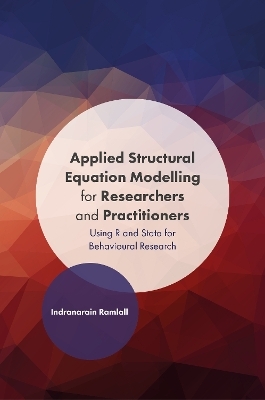
Applied Structural Equation Modelling for Researchers and Practitioners
Using R and Stata for Behavioural Research
Seiten
2016
Emerald Group Publishing Limited (Verlag)
978-1-78635-883-7 (ISBN)
Emerald Group Publishing Limited (Verlag)
978-1-78635-883-7 (ISBN)
This book explains in a rigorous, concise and practical manner all the vital components embedded in structural equation modelling. Focusing on R and stata to implement and perform various structural equation models.
During the last two decades, structural equation modelling (SEM) has emerged as a powerful multivariate data analysis tool in social science research settings, especially in the fields of sociology, psychology, and education. Social science researchers and students benefit greatly from acquiring knowledge and skills in SEM, since the methods can provide a bridge between the theoretical and empirical aspects of behavioural research. Ramlall explains in a rigorous, concise, and practical manner all the vital components embedded in structural equation modelling (SEM). Focusing on R and Stata to implement and perform various structural equation models, Ramlall examines the types, benefits, and drawbacks of SEM, delving into model specifications and identifications, fit evaluations, and path diagrams.
During the last two decades, structural equation modelling (SEM) has emerged as a powerful multivariate data analysis tool in social science research settings, especially in the fields of sociology, psychology, and education. Social science researchers and students benefit greatly from acquiring knowledge and skills in SEM, since the methods can provide a bridge between the theoretical and empirical aspects of behavioural research. Ramlall explains in a rigorous, concise, and practical manner all the vital components embedded in structural equation modelling (SEM). Focusing on R and Stata to implement and perform various structural equation models, Ramlall examines the types, benefits, and drawbacks of SEM, delving into model specifications and identifications, fit evaluations, and path diagrams.
Indranarain Ramlall, University of Mauritius, Mauritius
Preface
1. Definition of SEM
2. Types of SEM
3. Benefits of SEM
4. Drawbacks of SEM
5. Steps in Structural Equation Modelling
6. Model Specification: Path Diagram in SEM
7. Model Identification
8. Model Estimation
9. Model Fit Evaluation
10. Model Modification
11. Model Cross-Validation
12. Parameter Testing
13. Reduced-Form Version of SEM
14. Multiple Indicators Multiple Causes Model of SEM
15. Practical Issues to Consider when Implementing SEM
16. Review Questions
17. Enlightening Questions on SEM
18. Applied Structural Equation Modelling Using R
19. Applied Structural Equation Modelling using STATA
Appendix
Bibliography
About the Author
| Erscheinungsdatum | 07.12.2016 |
|---|---|
| Verlagsort | Bingley |
| Sprache | englisch |
| Maße | 152 x 229 mm |
| Gewicht | 350 g |
| Themenwelt | Mathematik / Informatik ► Informatik ► Programmiersprachen / -werkzeuge |
| Mathematik / Informatik ► Mathematik ► Angewandte Mathematik | |
| Sozialwissenschaften ► Soziologie | |
| ISBN-10 | 1-78635-883-2 / 1786358832 |
| ISBN-13 | 978-1-78635-883-7 / 9781786358837 |
| Zustand | Neuware |
| Informationen gemäß Produktsicherheitsverordnung (GPSR) | |
| Haben Sie eine Frage zum Produkt? |
Mehr entdecken
aus dem Bereich


aus dem Bereich
Grundlagen und praktische Anwendungen von Transpondern, kontaktlosen …
Buch (2023)
Hanser (Verlag)
CHF 125,95


