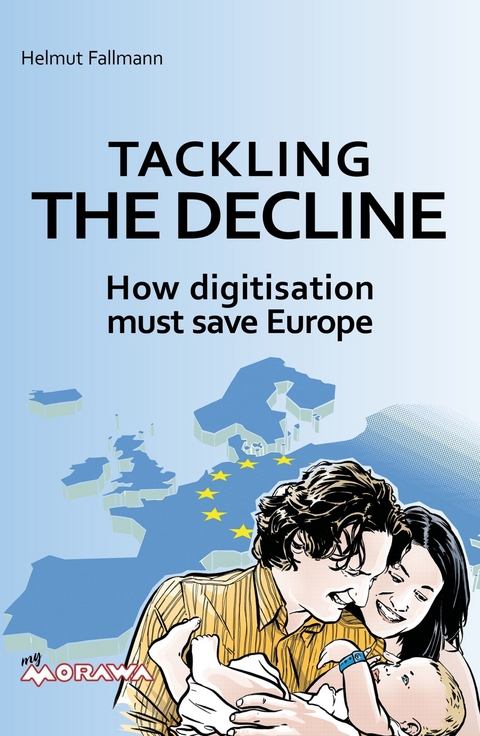
TACKLING THE DECLINE (eBook)
100 Seiten
Morawa Lesezirkel (Verlag)
978-3-99057-105-7 (ISBN)
PART 1
Europe and the USA have been communicating with one another via submarine cable for more than a hundred years. During this time, the balance of power has shifted 180 degrees: while the Europeans started the process of laying the cable, it is now the internet giants of Silicon Valley who regulate the data flow.
WHAT HAS HAPPENED TO DATE
An ultra-modern farm of gigantic proportions. Windowless, beleaguered by monstrous cooling units. Slowly, the viewer is guided round the building. If you are having visions of animal heads stacked one on top of the other – it’s even worse than that. Our data is stewing here – private things, professional things, sensitive things and forgotten things. What we do know is that each time we hit a key on the keyboard it leaves a trace, and the immeasurable treasure of Google and Co continues to grow. The volumes of data, Big Data, are indescribably valuable for politics and the economy. And rummaging around in the data mountain has consequences for both citizens and the global economy which are difficult to foresee.
Google operates seven data storage facilities of this type in various godforsaken parts of the USA. This was the situation in 2015, when the Irish digital artist John Gerrard completed his project Farm (Pryor Creek, Oklahoma). John Gerrard would actually have liked to see the final storage place of our virtual actions there, but Google rejected his request. He sought advice from the local police, who reckoned: “All we can say, the air is free.”1
Inspired by this information, the artist photographed the Google Data Farm in Pryor Creek, Oklahoma from a helicopter and compiled the images into a video simulation in his workshop in Vienna.2
Looking at the sterile construction, which could also have been used as a high-security prison, it is difficult to comprehend that individual communication strings and data that were created by people on the sofa, on the bus or at their office computer, are stored here with no expiry date and subject to as high security as treasure.
This is because data is the new gold, a source of fuel for the military and for companies. A valuable commodity that the consumer will willingly give away for a few glass beads in the form of “free” apps. Or, as John Gerrard describes the data storage facility at Pryor Creek: “A farm which is eating us as we eat it”.3
This data theft is being increasingly reported in the media. But the leap from the feature pages to general consciousness is a very big one. This is bad because the actual impact could be a painful one.
For example, what does “virtual” mean to the average consumer? Are these ethereal pieces of information, light and airy like the traditional dumplings from Salzburg which have to be eaten quickly or they collapse in on themselves?
Our data doesn’t float around
and then suddenly disappear.
Even if information is stored in what is known as a cloud, this simply and pragmatically means that information moves to servers which are not at home or at the office as long rows of binary codes4 – those endless sequences of ones and zeros, do you remember them?
Fig. 1: In this book, Marie and Kasper and their daughter Mücke live the new, digital Europe together as a family. © Peter M. Hoffmann
Virtual means “not physical”, but where exactly the limits of this lie is almost a philosophical question. For example, a clumsily placed ship’s anchor can bring the internet to a standstill in many areas. Many glass fibre cables now run along the seabed in thick bundles with the necessary protective layers to keep our data traffic free from moisture, salt and the other disruptive elements of the sea highways.5 But accidents still happen, such as when ships’ anchors cut through the protective shells or fishing nets pull at the cables. The seabed can quake, and sharks sometimes even confuse the underwater cables for snacks.
Laying submarine cables of this type is expensive. The nations who are interested in more rapid data connections assume the costs of this, and to an increasing extent also private consortia. Around a quarter of the global data volume already flows through private networks. According to the US market research institute Tele-Geography, this figure is 40 percent for Transatlantic data traffic. Google, for example, is currently involved in cabling between Japan and the USA (Project “Faster”)6 and in another project to create a new, rapid route for data between the USA and Brazil. This initiative would incur costs of a total of 60 million US dollars and will offer a data throughput rate of 64 TBit/s.7 Of course, Google has intentions with these major investments: the company will have a say in bandwidths, type of use and access.
Europe and the USA have been connected to one another via the seabed for more than a century.8 If you could pull together the many transatlantic telephone cables (TATs) there into a thick cord, you would be holding the aorta of international data traffic in your hand. More than half of the 19 strings are coaxial cables, while all other lines are made of glass fibre optic, which is not sensitive to electromagnetic impulses. The switch to these expensive cables was made in the early 1990s to meet the new requirements of online technology. Two glass fibre cables are currently in operation between Europe and the USA: TAT 12-13 and TAT 14.
Fig. 2: Submarine cables around the world, cable data by Greg Mahlknecht, 2015-07-21, world map: Openstreetmap contributors
Source: https://upload.wikimedia.org/wikipedia/commons/8/89/Submarine_cable_map_umap.png?uselang =de-at, accessed on 30/03/2016
If we remain with the metaphor of the aorta, as with blood circulation, data flow deep under the sea now goes in just one direction – from Europe to the USA. And 54 percent of the gadgets which generate this data in Europe originated in the USA. Conversely, just four percent of European products are used on the other side of the Atlantic.9 Everything started so differently.
Stefan Zweig, author, portrait painter and sensitive chronicler of the dying Imperial and Royal Empire (“The World of Yesterday”10) , described how a “gigantic belly button” was first laid between the northwestern coast of Ireland and Newfoundland:11
The approximate costs of laying the cable are pretty much the only thing about this beginning which can reliably be calculated. There is no model for the actual technical implementation. We haven’t thought or planned in similar dimensions in the entire nineteenth century. [...] But we’re taking a chance! The factories are now buzzing day and night, the demonic will of this one man is driving all of the wheels forward. Whole mines of iron and copper are being used for this one line, whole forests of rubber trees have to bleed to create the gutta-percha casing for so great a distance. And nothing more sensually demonstrates the enormous proportions of the undertaking than the three hundred and seventy-seven thousand miles of individual wire being spun together in this one cable – thirteen times as much as you would need to encompass the entire world and enough to connect the earth to the moon in a single line. From a technical perspective, humanity hasn‘t dared to try anything this grand since the construction of the Tower of Babel.
The “one man” who Zweig mentioned in Decisive Moments in History, is Cyrus W. Field. The first attempts to lay a cable on the bed of the Atlantic were made under his guidance in 1857. This was a monstrous task: two ships specially converted for the quantities of material – the Niagara and the Agamemnon left opposite coasts, unrolling the freight during their trip across the waves. The plan was to meet in the middle of the Atlantic. Nobody above the depths knew for certain which creatures and rocks the cable would be exposed to in the deep, dark water. But it didn’t come to that at the start, and 600 kilometres of cable were unwound and sunk into the sea.
Just a few weeks later it was done. On the third attempt. The ends of the cables were spliced together on the high seas, and initial attempts showed that the electronic connection was working! It took 16 hours, however, for the greeting sent by Queen Victoria to US President James Buchanan to be transferred in full. This is no comparison with the data speed previously mentioned of 60 terabytes per second which will race between the USA and Japan through the “Faster” glass fibre connection from 2016. The celebrated cable adventure of Cyrus W. Field stopped working just a few days later. Rust was apparently responsible for the premature end. It took a few more attempts before telegrams were able to be sent between the continents without any interruptions from 1866.
The pioneering spirit of the people who were involved was astounding, and some of this formed the basis of many...
| Erscheint lt. Verlag | 11.8.2016 |
|---|---|
| Sprache | englisch |
| Themenwelt | Mathematik / Informatik ► Informatik |
| ISBN-10 | 3-99057-105-2 / 3990571052 |
| ISBN-13 | 978-3-99057-105-7 / 9783990571057 |
| Informationen gemäß Produktsicherheitsverordnung (GPSR) | |
| Haben Sie eine Frage zum Produkt? |
 EPUB (Ohne DRM)
Größe: 4,2 MB
Digital Rights Management: ohne DRM
Dieses eBook enthält kein DRM oder Kopierschutz. Eine Weitergabe an Dritte ist jedoch rechtlich nicht zulässig, weil Sie beim Kauf nur die Rechte an der persönlichen Nutzung erwerben.
Dateiformat: EPUB (Electronic Publication)
EPUB ist ein offener Standard für eBooks und eignet sich besonders zur Darstellung von Belletristik und Sachbüchern. Der Fließtext wird dynamisch an die Display- und Schriftgröße angepasst. Auch für mobile Lesegeräte ist EPUB daher gut geeignet.
Systemvoraussetzungen:
PC/Mac: Mit einem PC oder Mac können Sie dieses eBook lesen. Sie benötigen dafür die kostenlose Software Adobe Digital Editions.
eReader: Dieses eBook kann mit (fast) allen eBook-Readern gelesen werden. Mit dem amazon-Kindle ist es aber nicht kompatibel.
Smartphone/Tablet: Egal ob Apple oder Android, dieses eBook können Sie lesen. Sie benötigen dafür eine kostenlose App.
Geräteliste und zusätzliche Hinweise
Buying eBooks from abroad
For tax law reasons we can sell eBooks just within Germany and Switzerland. Regrettably we cannot fulfill eBook-orders from other countries.
aus dem Bereich