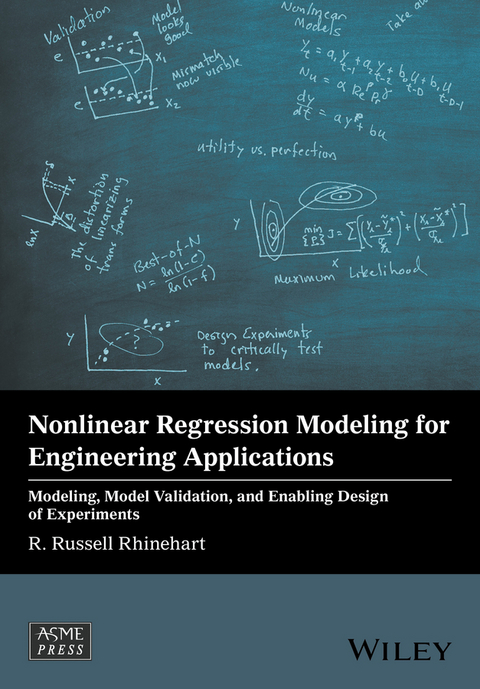
Nonlinear Regression Modeling for Engineering Applications (eBook)
John Wiley & Sons (Verlag)
978-1-118-59795-8 (ISBN)

Since mathematical models express our understanding of how nature behaves, we use them to validate our understanding of the fundamentals about systems (which could be processes, equipment, procedures, devices, or products). Also, when validated, the model is useful for engineering applications related to diagnosis, design, and optimization.
First, we postulate a mechanism, then derive a model grounded in that mechanistic understanding. If the model does not fit the data, our understanding of the mechanism was wrong or incomplete. Patterns in the residuals can guide model improvement. Alternately, when the model fits the data, our understanding is sufficient and confidently functional for engineering applications.
This book details methods of nonlinear regression, computational algorithms,model validation, interpretation of residuals, and useful experimental design. The focus is on practical applications, with relevant methods supported by fundamental analysis.
This book will assist either the academic or industrial practitioner to properly classify the system, choose between the various available modeling options and regression objectives, design experiments to obtain data capturing critical system behaviors, fit the model parameters based on that data, and statistically characterize the resulting model. The author has used the material in the undergraduate unit operations lab course and in advanced control applications.
R. Russell Rhinehart, Oklahoma State University, USA.
Professor Rhinehart obtained his Ph.D. in Chemical Engineering in 1985 from North Carolina State University, USA. His research interests include process improvement (modeling, optimization, and control), and product improvement (modeling and design). In 2004 he was named as one of InTECHs 50 most influential industry innovators of the past 50 years, and was inducted into the Automation Hall of Fame for the Process Industries in 2005. He has written extensively for numerous journals and refereed articles.
Since mathematical models express our understanding of how nature behaves, we use them to validate our understanding of the fundamentals about systems (which could be processes, equipment, procedures, devices, or products). Also, when validated, the model is useful for engineering applications related to diagnosis, design, and optimization. First, we postulate a mechanism, then derive a model grounded in that mechanistic understanding. If the model does not fit the data, our understanding of the mechanism was wrong or incomplete. Patterns in the residuals can guide model improvement. Alternately, when the model fits the data, our understanding is sufficient and confidently functional for engineering applications. This book details methods of nonlinear regression, computational algorithms,model validation, interpretation of residuals, and useful experimental design. The focus is on practical applications, with relevant methods supported by fundamental analysis. This book will assist either the academic or industrial practitioner to properly classify the system, choose between the various available modeling options and regression objectives, design experiments to obtain data capturing critical system behaviors, fit the model parameters based on that data, and statistically characterize the resulting model. The author has used the material in the undergraduate unit operations lab course and in advanced control applications.
R. Russell Rhinehart, Oklahoma State University, USA. Professor Rhinehart obtained his Ph.D. in Chemical Engineering in 1985 from North Carolina State University, USA. His research interests include process improvement (modeling, optimization, and control), and product improvement (modeling and design). In 2004 he was named as one of InTECHs 50 most influential industry innovators of the past 50 years, and was inducted into the Automation Hall of Fame for the Process Industries in 2005. He has written extensively for numerous journals and refereed articles.
Preface
Utility
Mathematical models are important.
Engineers use mathematical models to describe the natural world and then rearrange the model equations to answer the question, “How do I create an environment that makes Nature behave the way I want it to?” The answer to the mathematical rearrangement of the model equations reveals how to design processes, products, and procedures. It also reveals how to operate, use, monitor, and control them. Modeling is a critical underpinning for engineering analysis, design, control, and system optimization.
Further, since mathematical models express our understanding of how Nature behaves, we use them to validate our understanding of the fundamentals about processes and products. We postulate a mechanism and then derive a model grounded in that mechanistic understanding. If the model does not fit the data, our understanding of the mechanism was wrong or incomplete. Alternately, if the model fits the data we can claim our understanding may be correct. Models help us develop knowledge.
These models usually have coefficients representing some property of Nature, which has an unknown value (e.g., the diffusivity of a new molecule in a new medium, drag coefficient on a new shape, curing time of a new concrete mix, a catalyst effective surface area per unit mass, a heat transfer fouling factor). Model coefficient values must be adjusted to make the model match the experimentally obtained data, and obtaining the value of the coefficient adds to knowledge.
The procedure for finding the model coefficient values that makes a model best fit the data is called regression.
Although regression is ages old, there seem to be many opportunities for improvements related to finding a global optimum; finding a universal, effective, simple, and single stopping criterion for nonlinear regression; validating the model; balancing model simplicity and sufficiency with perfection and complexity; discriminating between competing models; and distinguishing functional sufficiency from prediction accuracy.
I developed and used process and product models throughout my 13-year industrial career. However, my college preparation for the engineering career did not teach me what I needed to know about how to create and evaluate models. I recognized that my fellow engineers, regardless of their alma mater, were also underprepared. We had to self-learn as to what was needed. Recognizing the centrality of modeling to engineering analysis, I have continued to explore model development and use during my subsequent academic career.
This textbook addresses nonlinear regression from a perspective that balances engineering utility with scientific perfection, a view that is often missing in the classroom, wherein the focus is often on the mathematical analysis, which pretends that there are simple, first-attempt solutions. Mathematical analysis is intellectually stimulating and satisfying, and sometimes useful for the practitioner. Where I think it adds value, I included analysis in this book. However, development of a model, choosing appropriate regression features, and designing experiments to generate useful data are iterative procedures that are guided by insight from progressive experience. It would be a rare event to jump to the right answers on the first try. Accordingly, balancing theoretical analysis, this book provides guides for procedure improvement.
This work is a collection of what I consider to be best practices in nonlinear regression modeling, which necessarily includes guides to design experiments to generate the data and guides to interpret the models. Undoubtedly, my view of best has been shaped with my particular uses for the models within the context of process and product modeling. Accordingly, this textbook has a focus on models with continuous-valued variables (either deterministic, discretized, or probabilities) as opposed to rank or classification, nonlinear as opposed to linear, constrained as opposed to not, and of a modest number of variables as opposed to Big Data.
This textbook includes the material I wish I had known when starting my engineering career and now what I would like my students to know. I hope it is useful for you.
The examples and discussion presume basic understanding of engineering models, regression, statistics, optimization, and calculus. This textbook provides enough details, explicit equation derivations, and examples to be useful as an introductory learning device for an upper-level undergraduate or graduate. I have used much of this material in the undergraduate unit operations lab course, in my explorations of model-based control on pilot-scale units, and in modeling of diverse processes (including the financial aspects of my retirement and the use of academic performance in the first two college years to project upper-level success). A person with an engineering degree and some experience with regression should be able to follow the concepts, analysis, and discussion.
My objective is to help you answer these questions:
- How to choose model inputs (variables, delays)?
- How to choose model form (linear, quadratic, or higher order, or equivalent model structures or architectures such as dimension or number of neurons)?
- How to design experiments to obtain adequate data (in number, precision, and placement) for determining model coefficient values?
- What to use for the regression objective (vertical least squares, total least squares, or maximum likelihood)?
- How to define goodness of model (r-square, fitness for use, utility, simplicity, data-based validation, confidence interval for prediction)?
- How to choose the right model between two different models?
- What optimization algorithm should be used for the regression to be able to handle the confounding issues of hard or soft constraints, discontinuities, discrete and continuous variables, multiple optima, and so on?
- What convergence criteria should be used to stop the optimizer (to recognize when it is close enough to optimum)?
- Should you linearize and use linear regression or use nonlinear regression?
- How to recognize outliers?
- How can you claim that a model properly captures some natural phenomena?
The underlying techniques needed for the answers include propagation of uncertainty, probability and statistics, optimization, and experience and heuristics. The initial chapters review/develop the basics. Subsequent chapters provide the application techniques, description of the algorithms, and guides for application.
Access to Computer Code
Those interested can visit the author's web site, www.r3eda.com, for open access to Excel VBA macros to many of the procedures in this book.
Years back our college decided to standardize with Visual Basic for Applications (VBA) for the undergraduate computer programming course. As a result, routines supporting this text are written in VBA, which is convenient to me, and also a widely accessible platform. However, VBA is not the fastest, and some readers may not be familiar with that language. Therefore, this text also provides a VBA primer and access to the code so that a reader may convert the VBA code to some other personally preferred platform. If you understand any structured text procedures, you can understand the VBA code here.
Preview of the Recommendations
Some of the recommendations in this book are counter to traditional practice in regression and design of experiments (DoE), which seem to be substantially grounded in linear regression. As a preview, opinions offered in this textbook are:
- If the equation is nonlinear in the coefficients, use nonlinear regression. Even if the equation can be log-transformed into a linear form, do not do it. Linearizing transformations distort the relative importance of data points within the data set. Unless data variance is relatively low and/or there are many data points, linearizing can cause significant error in the model coefficient values.
- Use data pre-processing and post-processing to eliminate outliers.
- Use direct search optimizers for nonlinear regression rather than gradient-based optimizers. Although gradient-based algorithms converge rapidly in the vicinity of the optimum, direct search optimizers are more robust to surface aberrations, can cope with hard constraints, and are faster for difficult problems. Leapfrogging is offered as a good optimizer choice.
- Nonlinear regression may have multiple minima. No optimizer can guarantee finding the global minimum on a first trial. Therefore, run the optimizer for N trials, starting from random locations, and take the best of the N trials. N can be calculated to meet the user desire for the probability of finding an optimum within a user-defined best fraction. The equation is shown.
- Pay as much attention to how constraints are defined and included in the optimization application as you do to deriving the model and objective function (OF) statement. Constraints can have a substantial influence on the regression solution.
- The choice of stopping criteria is also influential to the solution. Conventional stopping criteria are based on thresholds on the adjustable model coefficient values (decision variables, DVs), and/or the regression target (usually the sum of squared deviations) that we are seeking to optimize (OF). Since the right choice for the thresholds requires a priori knowledge, is scale-dependent, and requires threshold values on each regression coefficient (DV) and/or optimization target (OF), determining right threshold values...
| Erscheint lt. Verlag | 1.8.2016 |
|---|---|
| Reihe/Serie | Wiley-ASME Press Series |
| Wiley-ASME Press Series | Wiley-ASME Press Series |
| Sprache | englisch |
| Themenwelt | Mathematik / Informatik ► Mathematik ► Angewandte Mathematik |
| Technik ► Maschinenbau | |
| Schlagworte | Computational Algorithms • Computational / Numerical Methods • Maschinenbau • Maschinenbau - Entwurf • Mathematical Modeling • Mathematics • Mathematik • Mathematische Modellierung • mechanical engineering • Mechanical Engineering - Design • model validation • Nichtlineare Regression • nonlinear regression • Rechnergestützte / Numerische Verfahren im Maschinenbau • Rechnergestützte / Numerische Verfahren im Maschinenbau |
| ISBN-10 | 1-118-59795-8 / 1118597958 |
| ISBN-13 | 978-1-118-59795-8 / 9781118597958 |
| Informationen gemäß Produktsicherheitsverordnung (GPSR) | |
| Haben Sie eine Frage zum Produkt? |
 EPUB (Adobe DRM)
Kopierschutz: Adobe-DRM
Adobe-DRM ist ein Kopierschutz, der das eBook vor Mißbrauch schützen soll. Dabei wird das eBook bereits beim Download auf Ihre persönliche Adobe-ID autorisiert. Lesen können Sie das eBook dann nur auf den Geräten, welche ebenfalls auf Ihre Adobe-ID registriert sind.
Details zum Adobe-DRM
Dateiformat: EPUB (Electronic Publication)
EPUB ist ein offener Standard für eBooks und eignet sich besonders zur Darstellung von Belletristik und Sachbüchern. Der Fließtext wird dynamisch an die Display- und Schriftgröße angepasst. Auch für mobile Lesegeräte ist EPUB daher gut geeignet.
Systemvoraussetzungen:
PC/Mac: Mit einem PC oder Mac können Sie dieses eBook lesen. Sie benötigen eine
eReader: Dieses eBook kann mit (fast) allen eBook-Readern gelesen werden. Mit dem amazon-Kindle ist es aber nicht kompatibel.
Smartphone/Tablet: Egal ob Apple oder Android, dieses eBook können Sie lesen. Sie benötigen eine
Geräteliste und zusätzliche Hinweise
Buying eBooks from abroad
For tax law reasons we can sell eBooks just within Germany and Switzerland. Regrettably we cannot fulfill eBook-orders from other countries.
aus dem Bereich