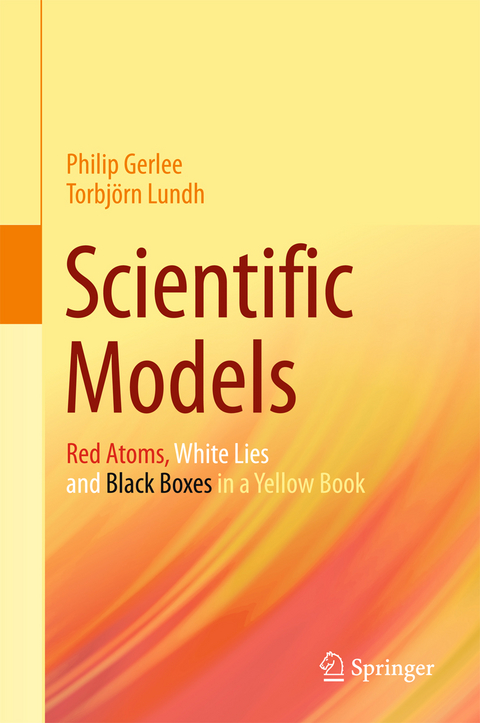
Scientific Models (eBook)
96 Seiten
Springer International Publishing (Verlag)
978-3-319-27081-4 (ISBN)
A zebrafish, the hull of a miniature ship, a mathematical equation and a food chain - what do these things have in common? They are examples of models used by scientists to isolate and study particular aspects of the world around us. This book begins by introducing the concept of a scientific model from an intuitive perspective, drawing parallels to mental models and artistic representations. It then recounts the history of modelling from the 16th century up until the present day. The iterative process of model building is described and discussed in the context of complex models with high predictive accuracy versus simpler models that provide more of a conceptual understanding. To illustrate the diversity of opinions within the scientific community, we also present the results of an interview study, in which ten scientists from different disciplines describe their views on modelling and how models feature in their work. Lastly, it includes a number of worked examples that span different modelling approaches and techniques. It provides a comprehensive introduction to scientific models and shows how models are constructed and used in modern science. It also addresses the approach to, and the culture surrounding modelling in different scientific disciplines. It serves as an inspiration for model building and also facilitates interdisciplinary collaborations by showing how models are used in different scientific fields.
The book is aimed primarily at students in the sciences and engineering, as well as students at teacher training colleges but will also appeal to interested readers wanting to get an overview of scientific modelling in general and different modelling approaches in particular.
Philip Gerlee is a researcher in biomathematics and works on problems in cancer research, evolutionary dynamics and ecology. He earned his undergraduate degree in Physics and went on to pursue a Master's degree in Complex and Adaptive systems at Chalmers University of Technology. His PhD was earned at University of Dundee for theoretical research into the evolutionary dynamics of solid tumour growth. After completing his doctoral work he worked as a postdoc at the Niels Bohr Institute, University of Gothenburg and the Moffitt Cancer Center in Tampa. He is currently working as assistant professor in the Department of Mathematical Sciences at Chalmers and University of Gothenburg.
After obtaining a masters in technology and a PhD in pure mathematics in Uppsala, Sweden, Torbjörn Lundh got three Postdoctoral Fellowships at: Cambridge University, Stony Brook University and Institute Mittag-Leffler. During these postdocs he got increasingly interested in biological applications, especially morphogenesis, speciation and artificial ecology. He has then been pursuing this interest at the department of Mathematical Sciences in Chalmers and University of Gothenburg. He recently became the vice president of the European Society for Mathematical and Theoretical Biology and is currently on a sabbatical working on stent related interdisciplinary questions in vascular surgery at Stanford Hospital.Philip Gerlee is a researcher in biomathematics and works on problems in cancer research, evolutionary dynamics and ecology. He earned his undergraduate degree in Physics and went on to pursue a Master’s degree in Complex and Adaptive systems at Chalmers University of Technology. His PhD was earned at University of Dundee for theoretical research into the evolutionary dynamics of solid tumour growth. After completing his doctoral work he worked as a postdoc at the Niels Bohr Institute, University of Gothenburg and the Moffitt Cancer Center in Tampa. He is currently working as assistant professor in the Department of Mathematical Sciences at Chalmers and University of Gothenburg.After obtaining a masters in technology and a PhD in pure mathematics in Uppsala, Sweden, Torbjörn Lundh got three Postdoctoral Fellowships at: Cambridge University, Stony Brook University and Institute Mittag-Leffler. During these postdocs he got increasingly interested in biological applications, especially morphogenesis, speciation and artificial ecology. He has then been pursuing this interest at the department of Mathematical Sciences in Chalmers and University of Gothenburg. He recently became the vice president of the European Society for Mathematical and Theoretical Biology and is currently on a sabbatical working on stent related interdisciplinary questions in vascular surgery at Stanford Hospital.
Prologue.- History.- Structure, Relation and Use.- Interviews.- Worked Examples.- Epilogue.- Further Reading.
| Erscheint lt. Verlag | 7.7.2016 |
|---|---|
| Zusatzinfo | X, 96 p. 28 illus., 8 illus. in color. |
| Verlagsort | Cham |
| Sprache | englisch |
| Original-Titel | Vetenskapliga modeler – Svarta lådor, röda atomer och vita lögner |
| Themenwelt | Mathematik / Informatik ► Mathematik ► Wahrscheinlichkeit / Kombinatorik |
| Technik | |
| Schlagworte | Forecast • philosophy of science • Prediction • Scientific Method • Scientific models |
| ISBN-10 | 3-319-27081-8 / 3319270818 |
| ISBN-13 | 978-3-319-27081-4 / 9783319270814 |
| Informationen gemäß Produktsicherheitsverordnung (GPSR) | |
| Haben Sie eine Frage zum Produkt? |
 PDF (Wasserzeichen)
DRM: Digitales Wasserzeichen
Dieses eBook enthält ein digitales Wasserzeichen und ist damit für Sie personalisiert. Bei einer missbräuchlichen Weitergabe des eBooks an Dritte ist eine Rückverfolgung an die Quelle möglich.
Dateiformat: PDF (Portable Document Format)
Mit einem festen Seitenlayout eignet sich die PDF besonders für Fachbücher mit Spalten, Tabellen und Abbildungen. Eine PDF kann auf fast allen Geräten angezeigt werden, ist aber für kleine Displays (Smartphone, eReader) nur eingeschränkt geeignet.
Systemvoraussetzungen:
PC/Mac: Mit einem PC oder Mac können Sie dieses eBook lesen. Sie benötigen dafür einen PDF-Viewer - z.B. den Adobe Reader oder Adobe Digital Editions.
eReader: Dieses eBook kann mit (fast) allen eBook-Readern gelesen werden. Mit dem amazon-Kindle ist es aber nicht kompatibel.
Smartphone/Tablet: Egal ob Apple oder Android, dieses eBook können Sie lesen. Sie benötigen dafür einen PDF-Viewer - z.B. die kostenlose Adobe Digital Editions-App.
Buying eBooks from abroad
For tax law reasons we can sell eBooks just within Germany and Switzerland. Regrettably we cannot fulfill eBook-orders from other countries.
aus dem Bereich