


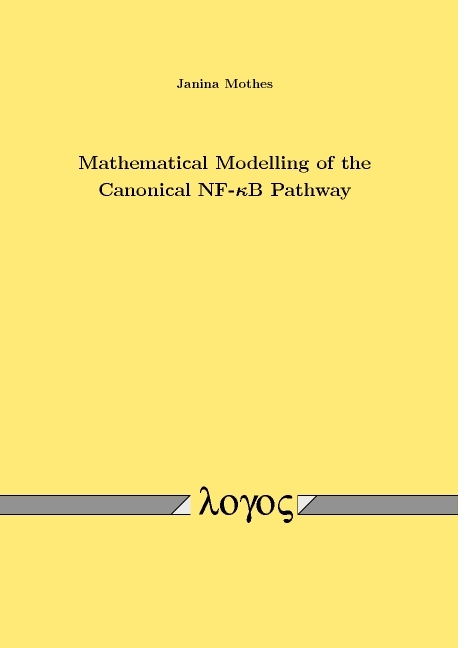
Mathematical Modelling of the Canonical NF- kappaB Pathway
Seiten
- Keine Verlagsinformationen verfügbar
- Artikel merken
The regulation of the transcription factor NF-kappaB plays a central role in physiological processes by influencing cell differentiation, proliferation and survival. Experiments revealed great differences in the dynamical behaviour of NF-kappaB ranging from sustained oscillations to damped oscillations and monotone increase evolving to a stable steady state. In this work, a theoretical approach was used to determine internal sources of the observed variability in the dynamics. A core model of the canonical NF-kappaB pathway was developed to study the dynamical properties using a bifurcation analysis. The total NF-kappaB concentration as well as the transcription rate constant of the NF-kappaB inhibitor IkappaBalphawere identified as two key parameters that influence the dynamics of NF-kappaB.
Further, the activation and deactivation of NF-kappaB is tightly regulated by negative feed-back loops. The transcription of the two NF-kappaB inhibitors IkappaBalphaand A20 is induced by NF-kappaB itself. In this work, a mathematical model was developed comprising both negative feedbacks to determine if post-transcriptional regulation of the two inhibitor mRNAs by the RNA-binding protein RC3H1 can impact the NF-kappaB signal transduction. Additionally, the interplay of the two feedbacks was analysed and cell type specific differences were examined. Again, the total NF-kappaB concentration was found to have a crucial impact. It determines the influence of RC3H1 on the NF-kappaB activity and the interplay of the two feedbacks.
Further, the activation and deactivation of NF-kappaB is tightly regulated by negative feed-back loops. The transcription of the two NF-kappaB inhibitors IkappaBalphaand A20 is induced by NF-kappaB itself. In this work, a mathematical model was developed comprising both negative feedbacks to determine if post-transcriptional regulation of the two inhibitor mRNAs by the RNA-binding protein RC3H1 can impact the NF-kappaB signal transduction. Additionally, the interplay of the two feedbacks was analysed and cell type specific differences were examined. Again, the total NF-kappaB concentration was found to have a crucial impact. It determines the influence of RC3H1 on the NF-kappaB activity and the interplay of the two feedbacks.
Die Kunst der Übersetzung
| Erscheinungsdatum | 27.06.2016 |
|---|---|
| Sprache | englisch |
| Maße | 145 x 210 mm |
| Einbandart | Paperback |
| Themenwelt | Mathematik / Informatik ► Mathematik ► Angewandte Mathematik |
| Naturwissenschaften ► Biologie ► Humanbiologie | |
| Schlagworte | Dynamik • mathematisches Model • Nuklearfactor kappa B • Oszillation • Signalweg |
| ISBN-10 | 3-8325-4277-9 / 3832542779 |
| ISBN-13 | 978-3-8325-4277-1 / 9783832542771 |
| Zustand | Neuware |
| Informationen gemäß Produktsicherheitsverordnung (GPSR) | |
| Haben Sie eine Frage zum Produkt? |
Mehr entdecken
aus dem Bereich
aus dem Bereich
Buch | Softcover (2025)
Springer Vieweg (Verlag)
CHF 62,95
Buch | Softcover (2025)
Springer Fachmedien Wiesbaden (Verlag)
CHF 69,95
Buch | Softcover (2024)
Springer Vieweg (Verlag)
CHF 53,15


