


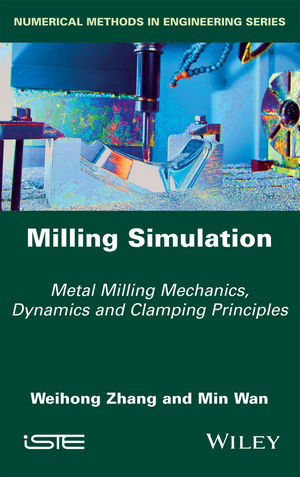
Milling Simulation (eBook)
John Wiley & Sons (Verlag)
978-1-119-26291-6 (ISBN)
Weihong Zhang, Professor, School of Mechanical Engineering, Northwestern Polytechnical University, Shaanxi, People's Republic of China. Min Wan, Professor, School of Mechanical Engineering, Northwestern Polytechnical University, Shaanxi, People's Republic of China.
Preface ix
Introduction xi
Chapter 1 Cutting Forces in Milling Processes 1
1.1 Formulations of cutting forces 1
1.1.1 Mechanics of orthogonal cutting 1
1.1.2 Cutting force model for a general milling cutter 4
1.2 Milling process geometry 8
1.2.1 Calculations of uncut chip thickness 8
1.2.2 Determination of entry and exit angles 12
1.3 Identification of the cutting force coefficients 24
1.3.1 Calibration method for general end mills 24
1.3.2 Calibration method in the frequency domain 33
1.3.3 Calibration method involving four cutter runout parameters 39
1.3.4 Identification of shear stress, shear angle and friction angle using milling tests 48
1.4 Ternary cutting force model including bottom edge cutting effect 55
1.4.1. Calculations of FB(phi) 57
1.4.2. Calculations of FB(phi) 57
1.4.3 Calibration of Kqc (q = T, R) 58
1.4.4 Calibrations of Kq,B (q = T, R) 59
1.4.5 Experimental work 61
1.5 Cutting force prediction in peripheral milling of a curved surface 61
1.5.1 Calculations of instantaneous uncut chip thickness 65
1.5.2 Calculations of entry and exit angles 67
Chapter 2 Surface Accuracy in Milling Processes 71
2.1 Predictions of surface form errors 71
2.1.1 Calculation of cutting forces and process geometries 73
2.1.2 Iterative algorithms of surface form errors 81
2.2 Control strategy of surface form error 89
2.2.1 Development of control strategy 89
2.2.2 Verification of control strategy 93
2.3 Surface topography in milling processes 95
2.3.1 Prediction method for flat-end milling 97
2.3.2 Prediction method for multi-axis ball end milling 101
Chapter 3 Dynamics of Milling Processes 115
3.1 Governing equation of the milling process 115
3.2 Method for obtaining the frequency response function 120
3.2.1 Derivation of calculation formulations 121
3.2.2 Identification of model parameters 134
3.3 Prediction of stability lobe 139
3.3.1 Improved semi-discretization method 139
3.3.2 Lowest envelope method 144
3.3.3 Time-domain simulation method 155
Chapter 4 Mathematical Modeling of the Workpiece-Fixture System 165
4.1 Criteria of locating scheme correctness 165
4.1.1 The DOFs constraining principle 165
4.1.2 The locating scheme 168
4.1.3 Judgment criteria of locating scheme correctness 172
4.1.4 Analysis of locating scheme incorrectness 173
4.2 Analysis of locating scheme correctness 175
4.2.1 Localization source errors 175
4.2.2 Fixture modeling 176
4.2.3 Locating scheme correctness 182
4.3 Analysis of workpiece stability 186
4.3.1 Modeling of workpiece stability 186
4.3.2 Solution techniques to the model of workpiece stability 194
4.4 Modeling of the workpiece-fixture geometric default and compliance 201
4.4.1 Source error analysis 201
4.4.2 Workpiece position error 207
4.4.3 Machining error analysis 212
4.5 Optimal design of the fixture clamping sequence 218
4.5.1 Effect of clamping sequence on high-stiffness workpiece 218
4.5.2 Effect of clamping sequence on low-stiffness workpiece 224
4.5.3 Optimization of clamping sequence 225
Bibliography 229
Index 245
| Erscheint lt. Verlag | 15.6.2016 |
|---|---|
| Sprache | englisch |
| Themenwelt | Mathematik / Informatik ► Informatik ► Theorie / Studium |
| Mathematik / Informatik ► Mathematik ► Algebra | |
| Mathematik / Informatik ► Mathematik ► Angewandte Mathematik | |
| Technik | |
| Schlagworte | Applied Mathematics in Science • calculations • Calibration • Chip • Coefficients • Determination • End • force • Forces • formulations • frequency domain • General • Identification • Introduction • Ix • Mathematical Modeling • Mathematics • Mathematik • Mathematik in den Naturwissenschaften • Mathematische Modellierung • Mechanics • Mills • Model • orthogonal • processes • thickness • uncut |
| ISBN-10 | 1-119-26291-7 / 1119262917 |
| ISBN-13 | 978-1-119-26291-6 / 9781119262916 |
| Informationen gemäß Produktsicherheitsverordnung (GPSR) | |
| Haben Sie eine Frage zum Produkt? |
 EPUB (Adobe DRM)
Kopierschutz: Adobe-DRM
Adobe-DRM ist ein Kopierschutz, der das eBook vor Mißbrauch schützen soll. Dabei wird das eBook bereits beim Download auf Ihre persönliche Adobe-ID autorisiert. Lesen können Sie das eBook dann nur auf den Geräten, welche ebenfalls auf Ihre Adobe-ID registriert sind.
Details zum Adobe-DRM
Dateiformat: EPUB (Electronic Publication)
EPUB ist ein offener Standard für eBooks und eignet sich besonders zur Darstellung von Belletristik und Sachbüchern. Der Fließtext wird dynamisch an die Display- und Schriftgröße angepasst. Auch für mobile Lesegeräte ist EPUB daher gut geeignet.
Systemvoraussetzungen:
PC/Mac: Mit einem PC oder Mac können Sie dieses eBook lesen. Sie benötigen eine
eReader: Dieses eBook kann mit (fast) allen eBook-Readern gelesen werden. Mit dem amazon-Kindle ist es aber nicht kompatibel.
Smartphone/Tablet: Egal ob Apple oder Android, dieses eBook können Sie lesen. Sie benötigen eine
Geräteliste und zusätzliche Hinweise
Buying eBooks from abroad
For tax law reasons we can sell eBooks just within Germany and Switzerland. Regrettably we cannot fulfill eBook-orders from other countries.
aus dem Bereich


