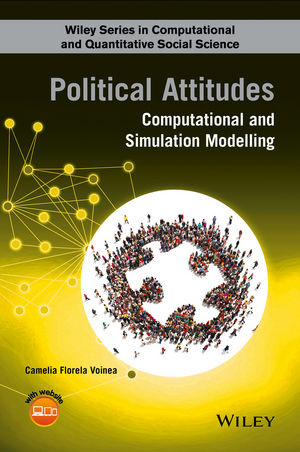
Political Attitudes (eBook)
John Wiley & Sons (Verlag)
978-1-118-83321-6 (ISBN)
Political Attitudes: Computational and Simulation Modeling
Camelia Florela Voinea, Department of Political Science, International Relations and Security Studies, University of Bucharest, Bucharest, Romania
Political Science has traditionally employed empirical research and analytical resources to understand, explain and predict political phenomena. One of the long-standing criticisms against empirical modeling targets the static perspective provided by the model-invariant paradigm. In political science research, this issue has a particular relevance since political phenomena prove sophisticated degrees of context-dependency whose complexity could be hardly captured by traditional approaches. To cope with the complexity challenge, a new modeling paradigm was needed. This book is concerned with this challenge. Moreover, the book aims to reveal the power of computational modeling of political attitudes to reinforce the political methodology in facing two fundamental challenges: political culture modeling and polity modeling. The book argues that an artificial polity model as a powerful research instrument could hardly be effective without the political attitude and, by extension, the political culture computational and simulation modeling theory, experiments and practice.
This book:
- Summarizes the state of the art in computational modeling of political attitudes, with illustrations and examples featured throughout.
- Explores the different approaches to computational modeling and how the complexity requirements of political science should determine the direction of research and evaluation methods.
- Addresses the newly emerging discipline of computational political science.
- Discusses modeling paradigms, agent-based modeling and simulation, and complexity-based modeling.
- Discusses model classes in the fundamental areas of voting behavior and decision-making, collective action, ideology and partisanship, emergence of social uprisings and civil conflict, international relations, allocation of public resources, polity and institutional function, operation, development and reform, political attitude formation and change in democratic societies.
This book is ideal for students who need a conceptual and operational description of the political attitude computational modeling phases, goals and outcomes in order to understand how political attitudes could be computationally modeled and simulated. Researchers, Governmental and international policy experts will also benefit from this book.
Political Science has traditionally employed empirical research and analytical resources to understand, explain and predict political phenomena. One of the long-standing criticisms against empirical modeling targets the static perspective provided by the model-invariant paradigm. In political science research, this issue has a particular relevance since political phenomena prove sophisticated degrees of context-dependency whose complexity could be hardly captured by traditional approaches. To cope with the complexity challenge, a new modeling paradigm was needed. This book is concerned with this challenge. Moreover, the book aims to reveal the power of computational modeling of political attitudes to reinforce the political methodology in facing two fundamental challenges: political culture modeling and polity modeling. The book argues that an artificial polity model as a powerful research instrument could hardly be effective without the political attitude and, by extension, the political culture computational and simulation modeling theory, experiments and practice. This book: Summarizes the state of the art in computational modeling of political attitudes, with illustrations and examples featured throughout. Explores the different approaches to computational modeling and how the complexity requirements of political science should determine the direction of research and evaluation methods. Addresses the newly emerging discipline of computational political science. Discusses modeling paradigms, agent-based modeling and simulation, and complexity-based modeling. Discusses model classes in the fundamental areas of voting behavior and decision-making, collective action, ideology and partisanship, emergence of social uprisings and civil conflict, international relations, allocation of public resources, polity and institutional function, operation, development and reform, political attitude formation and change in democratic societies. This book is ideal for students who need a conceptual and operational description of the political attitude computational modeling phases, goals and outcomes in order to understand how political attitudes could be computationally modeled and simulated. Researchers, Governmental and international policy experts will also benefit from this book.
Camelia Florela Voinea, Department of Political Science, International Relations and Security Studies, University of Bucharest, Bucharest, Romania
Preface ix
Acknowledgements xix
Introduction xxi
PART I SOCIAL AND POLITICAL ATTITUDE MODELLING 1
1 Attitudes: A Brief History of the Concept 3
2 Political Attitudes: Conceptual and Computational Modelling Backgrounds 31
PART II SOCIAL AND POLITICAL INFLUENCE MODELS OF ATTITUDE CHANGE 63
3 Voting Choice Computer Simulation Model 65
4 Community Referendum Model 83
PART III THE ROLE OF PHYSICAL SPACE IN POLITICAL ATTITUDE MODELLING 93
5 Social Impact Theory and Model 95
6 Dynamic Social Impact Theory and Model 107
PART IV POLITICAL ATTITUDE APPROACHES BASED ON SOCIAL INFLUENCE, CULTURE CHANGE AND COLLECTIVE ACTION MODELLING 139
7 Culture Dissemination Model 141
8 Diversity Survival Model 147
9 Collective Action Modelling 159
PART V MULTIDIMENSIONAL SPATIAL MODELS 165
10 The System Dynamics Modelling Paradigm 169
11 Multidimensional Attitude Change Models. Galileo 179
PART VI POLITICAL COGNITION MODELLING 189
12 The JQP Model 197
13 Political Attitude Strength Simulation Modelling 211
PART VII COMPUTATIONAL AND SIMULATION MODELLING OF IDEOLOGY 219
14 Ideological Polarization Model 227
15 Ideological Landscapes Model 237
16 Complex Integrative Models of Political Ideology 241
PART VIII POLITY MODELLING 245
17 Polity Instability Models Featuring Ethnic and Nationalist Insurgence 253
18 Polity Instability Model Featuring Reconstruction after State Failure 263
19 Polity Dynamics Model Featuring the Relationship between Public Issue Emergence and Public Policy Development 269
20 Polity Instability Model Featuring Revolution against Authoritarian Regime 277
PART IX EPILOGUE 285
21 Shaping New Science 287
Author Index 293
Subject Index 299
"From the outside the field of political science or studies seems left behind in terms of time, techniques and issues addressed. This book brings together, for the first time, the various strands that together might make up a new direction for the field - that of using computational approaches to understand how political attitudes, beliefs and thinking might result in the macro political outcomes reported in the press and media. There have been some brave researchers who have attempted to introduce computer models in the field, but they have been widely scattered and largely ignored. By bringing together all these approaches within a coherent framework the author shows how much work has been done and its future potential. But she also places these within a systematic framework showing how they might relate. The coverage of this book is astounding, covering history, theoretical bases, cognitive perspective, computational details and all the main approaches that have been developed. This makes the book a valuable reference work, enabling researchers to see the power of the approach and giving them a solid foundation from which to develop future work. "
Dr. Bruce Edmonds, Research Professor, Director of the Centre for Policy Modelling
Manchester Metropolitan University Business School
Preface
Political Science …
Once strongly conceived by both its schoolmasters and apprentices as an exclusive area of qualitative research, political science nonetheless developed during the twentieth century on experimental research dimensions. This systematic orientation took almost one century to get established on solid methodological and epistemological backgrounds. Though quite long, this process has proved wrong all those who either occasionally or systematically blamed, contested or doubted that political science had tremendous potential for quantitative analysis and an ever‐increasing appetite for paradigmatic change.
Otherwise unavoidable, this process of change was sustained and reinforced by technological advances which enhanced the use of artificial media from single computer platforms to computer networks and the Internet. Huge volumes of public survey data put considerable pressure on the capacity of political science methodology to face the challenge of data processing. This kind of pressure demanded a powerful response. All this transformed the exquisite analytical machine, developed and refined over the entire past century, into what has only lately been established as Experimental Political Science (Druckman et al., 2011). This has revealed, first and foremost, how political science has employed experimental research and rich analytical resources to understand, explain and predict political phenomena, no matter if we talk about the outcomes of elections, about the variability of public opinion or about the public perception and the sustainability of governmental policies. This is but one of the trends which explain the methodological and paradigmatic shift toward enforcing experimental research. This has placed the utility of experimental and analytical research beyond doubt. However, utility alone would not be able to describe the ever‐increasing research methodological needs in political science. In fact, it has not. Instead, it has complicated the methodology picture in one particular area of political science research: modelling.
It was precisely in the modelling area that the sociological and political methodology research based on empirical data had its golden age: the age of the nomothetic modelling approach working on model‐invariant patterns in huge volumes of empirical data. However, it was also here where its decline started.
The modelling area, especially the realm of the nomothetic theory of modelling, proved to be a true battlefield for two competing methodological approaches: while one, namely Experimental Political Science, seems to have lost terrain and prestige as its performances diminish after a century‐long dominance and a stable period of development, the other one, namely Computational Political Science, seems to have currently emerged in a sustained (and sustainable) effort to replace the nomothetic modelling paradigm with the complexity‐oriented paradigmatic alternatives reinforced by the new artificial life technologies. The nomothetic view in the political science methodological picture has finally run out of breath, crashed by mountains of survey data, rigidly anchored in determinism and model‐invariant patterns, stiffened in too static a paradigm.
Notwithstanding high recognition, survey analytical research has been the target of harsh criticism. The reasons, now and then, concern not only measurement issues, but mainly the true capacity of survey data to provide for the modelling of real‐world phenomena on large scales and in highly complex contexts. One of the long‐standing criticisms against the experimental methods and their analytical approach targets the static perspective provided by the empirical models. In political science research, this issue has a particular relevance, since political phenomena show not only high variability, but also sophisticated degrees of context dependency whose complexity could hardly be captured by empirical data and theoretical modelling. Panel techniques as well as longitudinal analytical studies have thus forced penetration of the mathematical–statistics theories and instruments aimed at overcoming this weakness. Moreover, the subsequently developed mathematical design of dynamic nonlinear variable‐based modelling has added value to the analytical power of the theoretical models. Besides the strong requirements for the processing of massive amounts of survey data in empirical research, the study of the space–time unfolding of political phenomena raised one more challenge: complexity. To cope with it, a new modelling paradigm was needed. And this reinforced the demands for a change in political modelling methodology.
In this book we are concerned with this change, which started emerging in political science more than half a century ago. Once initiated, the main problem is to understand where it is heading to.
This change process started in the early 1950s and is still going on. It has merged two modelling schools of thought: modelling in social and political sciences, on the one hand, and computational modelling and simulation, on the other hand. What has resulted from this blending is, perhaps, the most important question so far. Answering this question is not a trivial task, and reflection on this issue has guided the project of writing this book.
In order to answer this question, we need to assume a conceptual perspective on social and political modelling in general and on political attitude modelling in particular. Research in these two areas has met a common boundary.
Let us take a look at their separate histories and the side effects of their merging into a paradigm of evaluation for political attitude phenomena.
… and Computational Modelling
Starting with the early 1940s, the computational modelling approach began to take shape in both theoretical and experimental research. John von Neumann and Oskar Morgenstern’s ([1944]2007) work on economic behaviour laid the foundations of game theory, but also the foundations of a new approach in modelling theory: computational modelling. The decade between the mid‐1940s and the mid‐1950s brought the fastest, the deepest and the most amazing advances in computer technology, memory storage capacity and computational speed (Forrester, 1989). It was also the time when digital computation techniques, though in their infancy, suddenly got a modelling flavour, making the same decade and the next one appear as a time of explosive computational modelling development. Jay Forrester laid the theoretical and experimental foundations of the computational modelling of complex systems like organizational, economic and social systems (Forrester, [1956]2003, 1958, 1961, 1964). As theorized by Forrester in the early 1960s (Lane and Sterman, 2011), system dynamics was the first computational modelling paradigm which applied to the study of structural and behavioural dynamics of social systems. In this paradigm, computational modelling is approached in terms which distinguish between three fundamental concepts, that is, the real‐world system as the modelled system, the computational model and the simulation of a computer model, which is necessary in order for the model to exhibit its (designed) behaviour and provide (expected or unexpected) outcomes to be evaluated.
The same period of time covers some other famous theories which marked the later development of computational modelling theories, like Simon’s (1957, 1972) works on bounded rationality as a modelling theory of decision‐making, and the works in social communication and persuasion developed by Carl Hovland and his collaborator, Milton Rosenberg, in the Yale Team (Rosenberg and Hovland, 1960).
It was against this background that electoral studies in general and political attitude studies in particular employed computational modelling as a research methodology. It was perhaps too soon for doing so in political science.
In political science research, the process of paradigmatic change, going from qualitative to analytical and experimental, started to diversify itself. The preferred area was that of electoral studies. At a glance, the history of the American presidential election studies offers a picture of the first challenge: it was during the 1950s that a computational modelling approach seemed to raise for the first time a serious methodological challenge. Two decades later, it became a prevailing one, taking the community somehow by surprise, since very few political science researchers were mastering computer skills in order to face the challenge. By the end of the 1970s, computational modelling research finally took an independent position from the empirical and experimental branch, and issued some true characteristics of a new branch within classic political science. The beginning of the twenty‐first century found the political science community facing a delicate question: Is there a ‘Computational Political Science’ about to be born?
The boost in computational modelling on relevant political science issues appears to be a puzzle in which the computational modelling of political attitudes is but one of the numerous (known or still unknown) pieces: would this turn into a labyrinth‐like puzzle? The computational modelling of political attitudes is but the thread which helps any wanderer achieve a map of this quite sophisticated world and, eventually, find a way out. It is this puzzle that has challenged the construction of this book such that it could achieve its specific structural, explanatory, and prospective...
| Erscheint lt. Verlag | 13.6.2016 |
|---|---|
| Reihe/Serie | Wiley Series in Computational and Quantitative Social Science |
| Wiley Series in Computational and Quantitative Social Science | Wiley Series in Computational and Quantitative Social Science |
| Sprache | englisch |
| Themenwelt | Mathematik / Informatik ► Mathematik ► Angewandte Mathematik |
| Sozialwissenschaften ► Politik / Verwaltung | |
| Sozialwissenschaften ► Soziologie ► Empirische Sozialforschung | |
| Schlagworte | Agent-based Models • Angew. Wahrscheinlichkeitsrechn. u. Statistik / Modelle • Applied Probability & Statistics - Models • artificial polity • attitude computational models • attitudes • computational political science • Ideology • mass belief systems. • political attitude computational models public opinion • political attitudes • Political Issues & Behavior • Political Science • Politik • Politikwissenschaft • Politische Fragen u. politisches Verhalten • Sozialstatistik • Statistics • Statistics for Social Sciences • Statistik • Statistik in den Sozialwissenschaften |
| ISBN-10 | 1-118-83321-X / 111883321X |
| ISBN-13 | 978-1-118-83321-6 / 9781118833216 |
| Informationen gemäß Produktsicherheitsverordnung (GPSR) | |
| Haben Sie eine Frage zum Produkt? |
 EPUB (Adobe DRM)
Kopierschutz: Adobe-DRM
Adobe-DRM ist ein Kopierschutz, der das eBook vor Mißbrauch schützen soll. Dabei wird das eBook bereits beim Download auf Ihre persönliche Adobe-ID autorisiert. Lesen können Sie das eBook dann nur auf den Geräten, welche ebenfalls auf Ihre Adobe-ID registriert sind.
Details zum Adobe-DRM
Dateiformat: EPUB (Electronic Publication)
EPUB ist ein offener Standard für eBooks und eignet sich besonders zur Darstellung von Belletristik und Sachbüchern. Der Fließtext wird dynamisch an die Display- und Schriftgröße angepasst. Auch für mobile Lesegeräte ist EPUB daher gut geeignet.
Systemvoraussetzungen:
PC/Mac: Mit einem PC oder Mac können Sie dieses eBook lesen. Sie benötigen eine
eReader: Dieses eBook kann mit (fast) allen eBook-Readern gelesen werden. Mit dem amazon-Kindle ist es aber nicht kompatibel.
Smartphone/Tablet: Egal ob Apple oder Android, dieses eBook können Sie lesen. Sie benötigen eine
Geräteliste und zusätzliche Hinweise
Buying eBooks from abroad
For tax law reasons we can sell eBooks just within Germany and Switzerland. Regrettably we cannot fulfill eBook-orders from other countries.
aus dem Bereich