


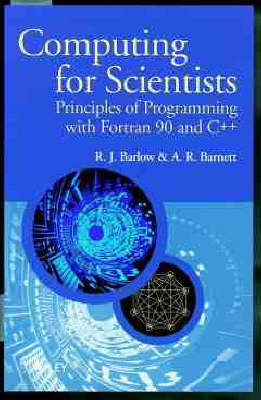
Principles of Programming
Seiten
1998
John Wiley & Sons Ltd (Verlag)
978-0-471-95114-8 (ISBN)
John Wiley & Sons Ltd (Verlag)
978-0-471-95114-8 (ISBN)
- Titel ist leider vergriffen;
keine Neuauflage - Artikel merken
This introduction to computer programming takes a problem-solving approach. Each problem has been chosen for its relevance to everyday scientific needs. Using Fortran 90 and C++ this text explains the principles of programming.
Computing for Scientists focuses on the principles involved in scientific programming. Topics of importance and interest to scientists are presented in a thoughtful and thought-provoking way, with coverage ranging from high-level object-oriented software to low-level machine-code operations. Taking a problem-solving approach, this book gives the reader an insight into the ways programs are implemented and what actually happens when they run. Throughout, the importance of good programming style is emphasised and illustrated. Two languages, Fortran 90 and C++, are used to provide contrasting examples, and explain how various techniques are used and when they are appropriate or inappropriate. For scientists and engineers needing to write programs of their own or understand those written by others, Computing for Scientists: Is a carefully written introduction to programming, taking the reader from the basics to a considerable level of sophistication. Emphasises an understanding of the principles and the development of good programming skills. Includes optional "starred" sections containing more specialised and advanced material for the more ambitious reader.
Assumes no prior knowledge, and has many examples and exercises with solutions included at the back of the book.
Computing for Scientists focuses on the principles involved in scientific programming. Topics of importance and interest to scientists are presented in a thoughtful and thought-provoking way, with coverage ranging from high-level object-oriented software to low-level machine-code operations. Taking a problem-solving approach, this book gives the reader an insight into the ways programs are implemented and what actually happens when they run. Throughout, the importance of good programming style is emphasised and illustrated. Two languages, Fortran 90 and C++, are used to provide contrasting examples, and explain how various techniques are used and when they are appropriate or inappropriate. For scientists and engineers needing to write programs of their own or understand those written by others, Computing for Scientists: Is a carefully written introduction to programming, taking the reader from the basics to a considerable level of sophistication. Emphasises an understanding of the principles and the development of good programming skills. Includes optional "starred" sections containing more specialised and advanced material for the more ambitious reader.
Assumes no prior knowledge, and has many examples and exercises with solutions included at the back of the book.
Basic Concepts. Variables and Operators. Data Structure. Control. Subprograms: Functions and Subroutines. Characters and Strings. Pointers. Input and Output. Numerical Methods. Object-Oriented Programming. Appendices.
| Reihe/Serie | Manchester Physics Series |
|---|---|
| Zusatzinfo | illustrations |
| Verlagsort | Chichester |
| Sprache | englisch |
| Maße | 171 x 250 mm |
| Gewicht | 640 g |
| Themenwelt | Mathematik / Informatik ► Informatik ► Programmiersprachen / -werkzeuge |
| ISBN-10 | 0-471-95114-5 / 0471951145 |
| ISBN-13 | 978-0-471-95114-8 / 9780471951148 |
| Zustand | Neuware |
| Informationen gemäß Produktsicherheitsverordnung (GPSR) | |
| Haben Sie eine Frage zum Produkt? |
Mehr entdecken
aus dem Bereich


aus dem Bereich
Grundlagen und praktische Anwendungen von Transpondern, kontaktlosen …
Buch (2023)
Hanser (Verlag)
CHF 125,95


