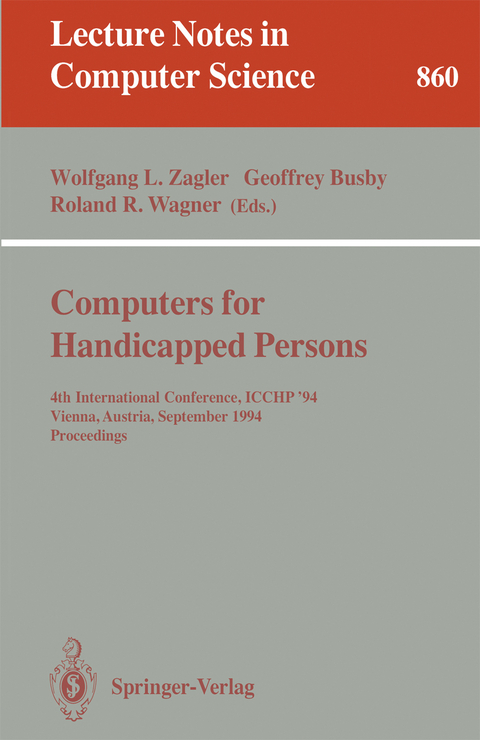
Computers for Handicapped Persons
Springer Berlin (Verlag)
978-3-540-58476-6 (ISBN)
The book contains 95 refereed contributions, including 9 scientific posters and 13 short reports, and addresses all current aspects of computers for handicapped persons and human-computer interaction from the point of view of human disabilities.
Communications and information technology for persons with disabilities - The Canadian national strategy as an example.- An intelligent information system for blind people - AI technology and philosophical aspects.- Adapting graphical user interfaces for use by visually handicapped computer users: Current results and continuing research.- Training blind people in the use of graphical user interfaces.- Artificial visual speech synchronized with a speech synthesis system.- Notational representation of sign language: A structural description of hand configuration.- Further advances in real-time voice to text with steno interpreters.- A uniform control interface for various electronic aids.- An integrated system for communication and equipments control using radio link.- Autonomy - A flexible and easy-to-use assistive system to support the independence of handicapped and elderly persons.- Screen Reader/2 - Programmed access to the GUI.- Designing an offscreen model for a GUI.- Screen reader for Windows based on speech output.- The New Wireless LinguControl.- The FeelMouse: Making computer screens feelable.- Unexpected benefits of Voice Type computing.- Robot control methods using the RAID workstation.- The ultrasonic navigating robot, WALKY.- NavChair: An example of a shared-control system for assistive technologies.- Using spatial audio for the enhanced presentation of synthesised speech within screen-readers for blind computer users.- Multimodal concept for a new generation of screen reader.- Auditory extension of user interfaces.- An attempt to define fully-accessible workstation levels of accessibility.- Graz Brain-Computer Interface (BCI) II.- Human-computer interfacing for the severely physically disabled.- Day and assessment training technology centres.- TheNorth America association of rehabilitation programs in computer technology seeks to network with other training programs.- Disability and rehabilitation database in Chinese language.- Toward a single global market for assistive technology.- Using structure within electronic documents to make editors more accessible.- Distinguishing pattern-types in printed documents.- Structuring documents: the key to increasing access to information for the print disabled.- Study Center for Visually Impaired Persons supportive system for blind and partially sighted Students at the University of Karlsruhe/Germany.- Support Centre for Visually impaired Students.- Educational endeavour "Computer Science for the Blind" state of the art and experiences in supporting visually handicapped students.- Modellversuch "Informatik für Blinde".- Cottage industry at NewLink.- Telework for Handicapped people: an experience.- Ableprofessionals: A recruiting and accommodation service for Atlanta employers.- "NewsReader" - a comfortable digital newspaper and bookreading system.- Digital talking books - a report from a practical, ongoing project.- The electronic kiosk accessing newspapers with electronic media.- Students support services at a scientific university.- Assistive technology in us higher education: The University of Wisconsin-Whitewater experience.- Leadership and Technology Management (LTM) the strategic management of technology in a consumer-driven environment.- Multimedia information system on assistive devices.- REHA - A multimedia system to learn about IT-systems for disabled persons.- Introducing voice control - Widening the perspective.- Mathtalk: The design of an interface for reading algebra using speech.- A method of access to computer aided softwareengineering (CASE) tools for blind software engineers.- Automatic image processing in developmental testing of visual-motor integration.- Computer neuropsychological training in mentally retarded children.- Computer training in cognitive remediation of the traumatic head injured.- Computer utilisation for speaking re-education.- The effectiveness of the Intonation Meter for teaching intonation to deaf persons.- Application of Artificial I
| Erscheint lt. Verlag | 7.9.1994 |
|---|---|
| Reihe/Serie | Lecture Notes in Computer Science |
| Zusatzinfo | XX, 632 p. |
| Verlagsort | Berlin |
| Sprache | englisch |
| Maße | 155 x 235 mm |
| Gewicht | 970 g |
| Themenwelt | Mathematik / Informatik ► Informatik ► Betriebssysteme / Server |
| Informatik ► Software Entwicklung ► User Interfaces (HCI) | |
| Schlagworte | Audio • Computer Assisted Education • Computergestützte Ausbildung • Graphical Uunser Interface • Graphische Benutzungsoberflächen • Hardcover, Softcover / Informatik, EDV/Informatik • Human Computer Interaction • Image Processing • Information Technology • Management • Mensch-Computer Schnittstelle • Multimedia • Performance • robot • Speach and Sound • Sprache und Ton • Text • text processing • Textverarbeitung |
| ISBN-10 | 3-540-58476-5 / 3540584765 |
| ISBN-13 | 978-3-540-58476-6 / 9783540584766 |
| Zustand | Neuware |
| Informationen gemäß Produktsicherheitsverordnung (GPSR) | |
| Haben Sie eine Frage zum Produkt? |
aus dem Bereich