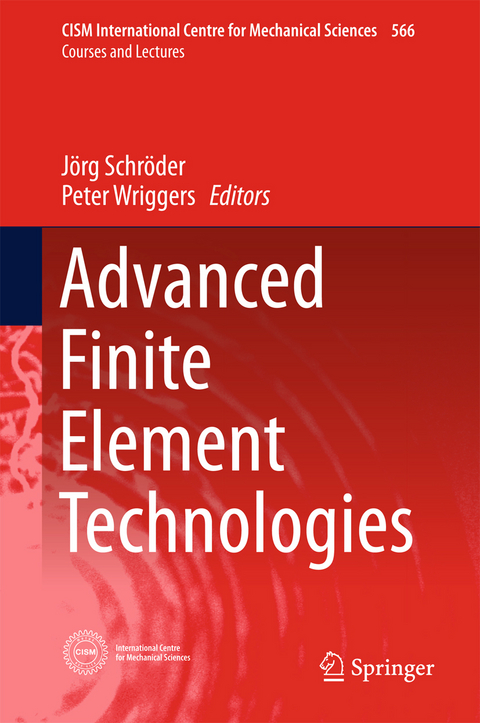
Advanced Finite Element Technologies (eBook)
VII, 236 Seiten
Springer International Publishing (Verlag)
978-3-319-31925-4 (ISBN)
Preface 6
Contents 7
Functional Analysis, Boundary Value Problems and Finite Elements 8
1 Introduction 8
1.1 Weak Formulations 10
2 Function Spaces and Operators 11
3 The Finite Element Method 19
References 22
Discretization Methods for Solids Undergoing Finite Deformations 23
1 Basic Equations of Continuum Mechanics 23
1.1 Kinematics 24
1.2 Balance Equations 26
1.3 Constitutive Equations 28
1.4 Weak Forms of Balance of Momentum 31
1.5 Variational Functionals 33
1.6 Linearization of Variational Formulations 37
2 Finite Element Methods 38
2.1 Requirements for Solid Elements 38
2.2 Nonlinear Finite Element Formulations 40
2.3 Three-Dimensional Finite Strain Element 40
2.4 Mixed Elements for Incompressibility 45
2.5 Mixed Element for Finite Deformations 47
3 Conclusions 55
References 55
Three-Field Mixed Finite Element Methods in Elasticity 58
1 Introduction 58
2 Governing Equations 59
3 A General Three-Field Formulation 62
4 Finite Element Formulations of the Mixed Problems 64
4.1 Well-Posedness 65
5 Extension to Problems of Nonlinear Elasticity 66
5.1 An Application: Mixed Enhanced Strains 71
References 72
Stress-Based Finite Element Methods in Linear and Nonlinear Solid Mechanics 74
1 Introduction 74
2 Stress-Based Mixed Formulation Based on the Hellinger--Reissner Principle 77
3 Stress-Displacement First-Order System Least Squares 79
4 Stress Reconstruction for Displacement-Pressure Approaches 82
5 Extension to Finite-Strain Hyperelasticity 89
5.1 A Least Squares Finite Element Method for Isotropic Hyperelastic Materials 91
5.2 Gauss--Newton Iterative Method 92
5.3 Least Squares Formulation for neo-Hookean Model 94
5.4 Computational Results 101
References 107
Tutorial on Hybridizable Discontinuous Galerkin (HDG) for Second-Order Elliptic Problems 110
1 Introduction 110
2 Problem Statement 112
3 Functional and Interpolation Setting 113
4 The Hybridizable Discontinuous Galerkin 115
4.1 The Strong Forms 115
4.2 The Weak Forms 115
4.3 The Discrete Forms and the Corresponding Equations 117
4.4 Numerical Example 119
4.5 Neumann Local Problems 123
4.6 Numerical Example 126
5 Postprocessed Solution 127
References 133
Least-Squares Mixed Finite Element Formulations for Isotropic and Anisotropic Elasticity at Small and Large Strains 135
1 Introduction 135
2 Mechanical Foundations 138
2.1 Placements, Deformation, and Stress Tensors 138
2.2 Transverse Isotropic Hyperelasticity 144
2.3 Generalized Convexity Conditions 145
3 Least-Squares Method 147
3.1 General Least-Squares Approach 148
3.2 Introductory Example 149
3.3 Interpolation Spaces 154
3.4 Interpolation Functions 154
4 LSFEM--Linear Elasticity 160
4.1 Linear Elasticity 161
4.2 Cantilever Beam, Linear Elastic 163
4.3 Cook's Membrane, Quasi-incompressible Elastic 165
5 LSFEM--Hyperelasticity 169
5.1 Isotropic Hyperelasticity 170
5.2 3D Plate, Hyperelastic 171
5.3 Compression Test, Quasi-incompressible, Hyperelastic 172
5.4 Transverse Isotropic Hyperelasticity 173
5.5 Cantilever Beam, Transverse Isotropic, Hyperelastic 174
References 176
Theoretical and Numerical Elastoplasticity 180
1 Introduction 180
1.1 Elastic--Plastic Behaviour in One Dimension 181
2 Three-Dimensional Elastoplastic Behaviour 182
3 The Primal Variational Problem 188
4 Solution Algorithms 190
5 Elastoplasticity at Large Deformations 192
5.1 The Incremental Problem 195
References 197
On the Use of Anisotropic Triangles with Mixed Finite Elements: Application to an ``Immersed'' Approach for Incompressible Flow Problems 198
1 Introduction 198
2 A 1D Interface Toy Problem 200
2.1 Model Problem 201
2.2 A Single Field Formulation 202
2.3 Discrete Formulation and Error Estimates 203
2.4 Numerical Tests 205
2.5 Conclusive Remarks 207
3 Extension to 2D: An Anisotropic Remeshing Strategy 208
3.1 Immersed Approaches 208
3.2 Geometry 211
3.3 The Incompressible Stokes Problem 213
3.4 Triangular Shape Regularity Mesh Restrictions 216
3.5 Numerical Tests 223
4 Conclusive Remarks 234
References 236
| Erscheint lt. Verlag | 19.5.2016 |
|---|---|
| Reihe/Serie | CISM International Centre for Mechanical Sciences | CISM International Centre for Mechanical Sciences |
| Zusatzinfo | VII, 236 p. 92 illus., 47 illus. in color. |
| Verlagsort | Cham |
| Sprache | englisch |
| Themenwelt | Mathematik / Informatik ► Mathematik ► Wahrscheinlichkeit / Kombinatorik |
| Technik ► Bauwesen | |
| Schlagworte | Advanced discretization methods • Advanced finite element technologies • discontinuous Galerkin methods • Least-Squares Methods • Mathematical FEM fundamentals |
| ISBN-10 | 3-319-31925-6 / 3319319256 |
| ISBN-13 | 978-3-319-31925-4 / 9783319319254 |
| Informationen gemäß Produktsicherheitsverordnung (GPSR) | |
| Haben Sie eine Frage zum Produkt? |
 PDF (Wasserzeichen)
DRM: Digitales Wasserzeichen
Dieses eBook enthält ein digitales Wasserzeichen und ist damit für Sie personalisiert. Bei einer missbräuchlichen Weitergabe des eBooks an Dritte ist eine Rückverfolgung an die Quelle möglich.
Dateiformat: PDF (Portable Document Format)
Mit einem festen Seitenlayout eignet sich die PDF besonders für Fachbücher mit Spalten, Tabellen und Abbildungen. Eine PDF kann auf fast allen Geräten angezeigt werden, ist aber für kleine Displays (Smartphone, eReader) nur eingeschränkt geeignet.
Systemvoraussetzungen:
PC/Mac: Mit einem PC oder Mac können Sie dieses eBook lesen. Sie benötigen dafür einen PDF-Viewer - z.B. den Adobe Reader oder Adobe Digital Editions.
eReader: Dieses eBook kann mit (fast) allen eBook-Readern gelesen werden. Mit dem amazon-Kindle ist es aber nicht kompatibel.
Smartphone/Tablet: Egal ob Apple oder Android, dieses eBook können Sie lesen. Sie benötigen dafür einen PDF-Viewer - z.B. die kostenlose Adobe Digital Editions-App.
Buying eBooks from abroad
For tax law reasons we can sell eBooks just within Germany and Switzerland. Regrettably we cannot fulfill eBook-orders from other countries.
aus dem Bereich