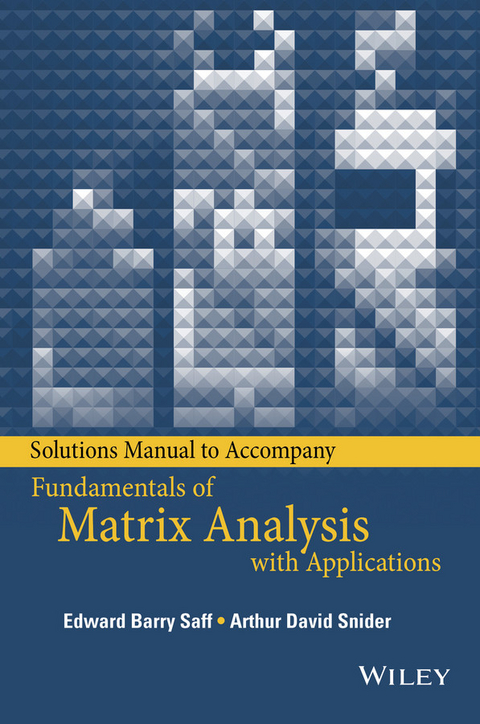
Solutions Manual to accompany Fundamentals of Matrix Analysis with Applications (eBook)
268 Seiten
Wiley (Verlag)
978-1-118-99634-8 (ISBN)

Edward Barry Saff, PhD, is Professor of Mathematics and Director of the Center for Constructive Approximation at Vanderbilt University. Dr. Saff is an Inaugural Fellow of the American Mathematical Society, Foreign Member of the Bulgarian Academy of Science, and the recipient of both a Guggenheim and Fulbright Fellowship. He is Editor-in-Chief of two research journals, Constructive Approximation and Computational Methods and Function Theory, and has authored or coauthored over 250 journal articles and eight books. Dr. Saff also serves as an organizer for a sequence of international research conferences that help to foster the careers of mathematicians from developing countries. Arthur Da vid Snider, PhD, PE, is Professor Emeritus at the University of South Florida, where he served on the faculties of the Departments of Mathematics, Physics, and Electrical Engineering. Previously an analyst at the Massachusetts Institute of Technology's Draper Lab and recipient of the USF Krivanek Distinguished Teacher Award, he consults in industry and has authored or coauthored over 100 journal articles and eight books. With the support of the National Science Foundation, Dr. Snider also pioneered a course in fine art appreciation for engineers.
1 Systems of Linear Algebraic Equations 1
1.1 Linear Algebraic Equations 1
1.2 Matrix Representation of Linear Systems and the Gauss-Jordan Algorithm 12
1.3 The Complete Gauss Elimination Algorithm 17
1.4 Echelon Form and Rank 26
1.5 Computational Considerations 34
2 Matrix Algebra 39
2.1 Matrix Multiplication 39
2.2 Some Useful Applications of Matrix Operators 48
2.3 The Inverse and the Transpose 54
2.4 Determinants 61
2.5 Three Important Determinant Rules 68
PART I REVIEW PROBLEMS FOR PART I 79
3 Vector Spaces 89
3.1 General Spaces, Subspaces, and Spans 89
3.2 Linear Dependence 93
3.3 Bases, Dimension, and Rank 97
4 Orthogonality 105
4.1 Orthogonal Vectors and the Gram-Schmidt Algorithm 105
4.2 Orthogonal Matrices 115
4.3 Least Squares 123
4.4 Function Spaces 133
PART II REVIEW PROBLEMS FOR PART II 140
5 Eigenvectors and Eigenvalues 144
5.1 Eigenvector Basics 144
5.2 Calculating Eigenvalues and Eigenvectors 155
5.3 Symmetric and Hermitian Matrices 168
6 Similarity 181
6.1 Similarity Transformations and Diagonalizability 181
6.2 Principal Axes and Normal Modes 189
6.3 Schur Decomposition and Its Implications 198
6.4 The Singular Value Decomposition 212
6.5 The Power Method and the QR Algorithm 217
7 Linear Systems of Differential Equations 221
7.1 First-Order Linear Systems 221
7.2 The Matrix Exponential Function 230
7.3 The Jordan Normal Form 236
7.4 Matrix Exponentiation via Generalized Eigenvectors 246
PART III REVIEW PROBLEMS FOR PART III 255
| Erscheint lt. Verlag | 20.5.2016 |
|---|---|
| Sprache | englisch |
| Themenwelt | Mathematik / Informatik ► Mathematik ► Algebra |
| Mathematik / Informatik ► Mathematik ► Wahrscheinlichkeit / Kombinatorik | |
| Technik | |
| Schlagworte | Electrical & Electronics Engineering • Elektrotechnik u. Elektronik • linear algebra • Lineare Algebra • Mathematics • Mathematik • Numerical Methods & Algorithms • Numerische Methoden u. Algorithmen • Regression Analysis • Regressionsanalyse • Statistics • Statistik |
| ISBN-10 | 1-118-99634-8 / 1118996348 |
| ISBN-13 | 978-1-118-99634-8 / 9781118996348 |
| Informationen gemäß Produktsicherheitsverordnung (GPSR) | |
| Haben Sie eine Frage zum Produkt? |
 PDF (Adobe DRM)
Kopierschutz: Adobe-DRM
Adobe-DRM ist ein Kopierschutz, der das eBook vor Mißbrauch schützen soll. Dabei wird das eBook bereits beim Download auf Ihre persönliche Adobe-ID autorisiert. Lesen können Sie das eBook dann nur auf den Geräten, welche ebenfalls auf Ihre Adobe-ID registriert sind.
Details zum Adobe-DRM
Dateiformat: PDF (Portable Document Format)
Mit einem festen Seitenlayout eignet sich die PDF besonders für Fachbücher mit Spalten, Tabellen und Abbildungen. Eine PDF kann auf fast allen Geräten angezeigt werden, ist aber für kleine Displays (Smartphone, eReader) nur eingeschränkt geeignet.
Systemvoraussetzungen:
PC/Mac: Mit einem PC oder Mac können Sie dieses eBook lesen. Sie benötigen eine
eReader: Dieses eBook kann mit (fast) allen eBook-Readern gelesen werden. Mit dem amazon-Kindle ist es aber nicht kompatibel.
Smartphone/Tablet: Egal ob Apple oder Android, dieses eBook können Sie lesen. Sie benötigen eine
Geräteliste und zusätzliche Hinweise
Buying eBooks from abroad
For tax law reasons we can sell eBooks just within Germany and Switzerland. Regrettably we cannot fulfill eBook-orders from other countries.
aus dem Bereich