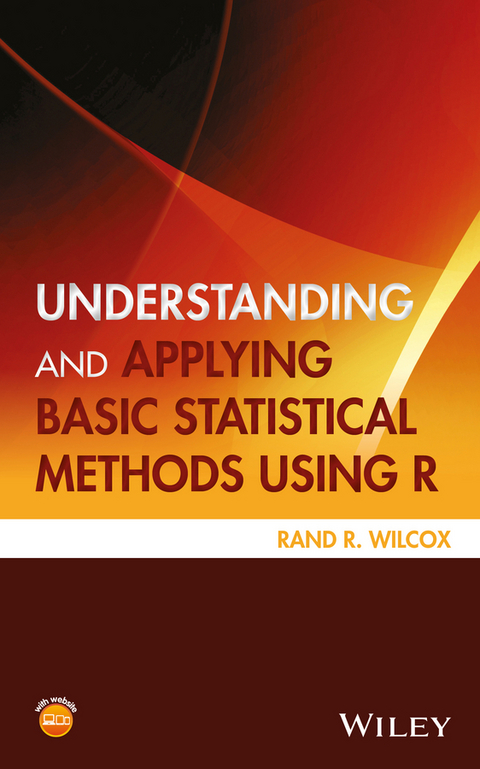
Understanding and Applying Basic Statistical Methods Using R (eBook)
John Wiley & Sons (Verlag)
978-1-119-06141-0 (ISBN)
Features a straightforward and concise resource for introductory statistical concepts, methods, and techniques using R
Understanding and Applying Basic Statistical Methods Using R uniquely bridges the gap between advances in the statistical literature and methods routinely used by non-statisticians. Providing a conceptual basis for understanding the relative merits and applications of these methods, the book features modern insights and advances relevant to basic techniques in terms of dealing with non-normality, outliers, heteroscedasticity (unequal variances), and curvature.
Featuring a guide to R, the book uses R programming to explore introductory statistical concepts and standard methods for dealing with known problems associated with classic techniques. Thoroughly class-room tested, the book includes sections that focus on either R programming or computational details to help the reader become acquainted with basic concepts and principles essential in terms of understanding and applying the many methods currently available. Covering relevant material from a wide range of disciplines, Understanding and Applying Basic Statistical Methods Using R also includes:
- Numerous illustrations and exercises that use data to demonstrate the practical importance of multiple perspectives
- Discussions on common mistakes such as eliminating outliers and applying standard methods based on means using the remaining data
- Detailed coverage on R programming with descriptions on how to apply both classic and more modern methods using R
- A companion website with the data and solutions to all of the exercises
Understanding and Applying Basic Statistical Methods Using R is an ideal textbook for an undergraduate and graduate-level statistics courses in the science and/or social science departments. The book can also serve as a reference for professional statisticians and other practitioners looking to better understand modern statistical methods as well as R programming.
Rand R. Wilcox, PhD, is Professor in the Department of Psychology at the University of Southern California, Fellow of the Association for Psychological Science, and an associate editor for four statistics journals. He is also a member of the International Statistical Institute. The author of more than 320 articles published in a variety of statistical journals, he is also the author eleven other books on statistics. Dr. Wilcox is creator of WRS (Wilcox' Robust Statistics), which is an R package for performing robust statistical methods. His main research interest includes statistical methods, particularly robust methods for comparing groups and studying associations.
Rand R. Wilcox, PhD, is Professor in the Department of Psychology at the University of Southern California, Fellow of the Association for Psychological Science, and an associate editor for four statistics journals. He is also a member of the International Statistical Institute. The author of more than 320 articles published in a variety of statistical journals, he is also the author eleven other books on statistics. Dr. Wilcox is creator of WRS (Wilcox' Robust Statistics), which is an R package for performing robust statistical methods. His main research interest includes statistical methods, particularly robust methods for comparing groups and studying associations.
Features a straightforward and concise resource for introductory statistical concepts, methods, and techniques using R Understanding and Applying Basic Statistical Methods Using R uniquely bridges the gap between advances in the statistical literature and methods routinely used by non-statisticians. Providing a conceptual basis for understanding the relative merits and applications of these methods, the book features modern insights and advances relevant to basic techniques in terms of dealing with non-normality, outliers, heteroscedasticity (unequal variances), and curvature. Featuring a guide to R, the book uses R programming to explore introductory statistical concepts and standard methods for dealing with known problems associated with classic techniques. Thoroughly class-room tested, the book includes sections that focus on either R programming or computational details to help the reader become acquainted with basic concepts and principles essential in terms of understanding and applying the many methods currently available. Covering relevant material from a wide range of disciplines, Understanding and Applying Basic Statistical Methods Using R also includes: Numerous illustrations and exercises that use data to demonstrate the practical importance of multiple perspectives Discussions on common mistakes such as eliminating outliers and applying standard methods based on means using the remaining data Detailed coverage on R programming with descriptions on how to apply both classic and more modern methods using R A companion website with the data and solutions to all of the exercises Understanding and Applying Basic Statistical Methods Using R is an ideal textbook for an undergraduate and graduate-level statistics courses in the science and/or social science departments. The book can also serve as a reference for professional statisticians and other practitioners looking to better understand modern statistical methods as well as R programming.Rand R. Wilcox, PhD, is Professor in the Department of Psychology at the University of Southern California, Fellow of the Association for Psychological Science, and an associate editor for four statistics journals. He is also a member of the International Statistical Institute. The author of more than 320 articles published in a variety of statistical journals, he is also the author eleven other books on statistics. Dr. Wilcox is creator of WRS (Wilcox Robust Statistics), which is an R package for performing robust statistical methods. His main research interest includes statistical methods, particularly robust methods for comparing groups and studying associations.
Rand R. Wilcox, PhD, is Professor in the Department of Psychology at the University of Southern California, Fellow of the Association for Psychological Science, and an associate editor for four statistics journals. He is also a member of the International Statistical Institute. The author of more than 320 articles published in a variety of statistical journals, he is also the author eleven other books on statistics. Dr. Wilcox is creator of WRS (Wilcox' Robust Statistics), which is an R package for performing robust statistical methods. His main research interest includes statistical methods, particularly robust methods for comparing groups and studying associations.
Chapter 1
INTRODUCTION
Why are statistical methods important? One reason is that they play a fundamental role in a wide range of disciplines including physics, chemistry, astronomy, manufacturing, agriculture, communications, pharmaceuticals, medicine, biology, kinesiology, sports, sociology, political science, linguistics, business, economics, education, and psychology. Basic statistical techniques impact your life.
At its simplest level, statistics involves the description and summary of events. How many home runs did Babe Ruth hit? What is the average rainfall in Seattle? But from a scientific point of view, it has come to mean much more. Broadly defined, it is the science, technology, and art of extracting information from observational data, with an emphasis on solving real-world problems. As Stigler (1986, p. 1) has so eloquently put it:
Modern statistics provides a quantitative technology for empirical science; it is a logic and methodology for the measurement of uncertainty and for examination of the consequences of that uncertainty in the planning and interpretation of experimentation and observation.
To help elucidate the types of problems addressed in this book, consider an experiment aimed at investigating the effects of ozone on weight gain in rats (Doksum and Sievers, 1976). The experimental group consisted of 22 seventy-day-old rats kept in an ozone environment for 7 days. A control group of 23 rats, of the same age, was kept in an ozone-free environment. The results of this experiment are shown in Table 1.1.
Table 1.1 Weight Gain of Rats in Ozone Experiment
| Control | 41.0 | 38.4 | 24.4 | 25.9 | 21.9 | 18.3 | 13.1 | 27.3 | 28.5 | −16.9 |
| Ozone | 10.1 | 6.1 | 20.4 | 7.3 | 14.3 | 15.5 | −9.9 | 6.8 | 28.2 | 17.9 |
| Control | 26.0 | 17.4 | 21.8 | 15.4 | 27.4 | 19.2 | 22.4 | 17.7 | 26.0 | 29.4 |
| Ozone | −9.0 | −12.9 | 14.0 | 6.6 | 12.1 | 15.7 | 39.9 | −15.9 | 54.6 | −14.7 |
| Control | 21.4 | 26.6 | 22.7 |
| Ozone | 44.1 | −9.0 |
How should these two groups be compared? A natural reaction is to compute the average weight gain for both groups. The averages turn out to be 11 for the ozone group and 22.4 for the control group. The average is higher for the control group suggesting that for the typical rat, weight gain will be less in an ozone environment. However, serious concerns come to mind upon a moment's reflection. Only 22 rats were kept in the ozone environment, and only 23 rats were in the control group. Suppose 100 rats had been used, or 1,000, or even a million. Is it reasonable to conclude that the ozone group would still have a smaller average than the control group? What about using the average to reflect the weight gain for the typical rat? Are there other methods for summarizing data that might have practical value when characterizing the differences between the groups? A goal of this book is to introduce the basic tools for answering these questions.
Most of the basic statistical methods currently taught and used were developed prior to the year 1960 and are based on strategies developed about 200 years ago. Of particular importance was the work of Pierre-Simon Laplace (1749–1827) and Carl Friedrich Gauss (1777–1855). Approximately a century ago, major advances began to appear, which dominate how researchers analyze data today. Especially important was the work of Karl Pearson (1857–1936) Jerzy Neyman (1894–1981), Egon Pearson (1895–1980), and Sir Ronald Fisher (1890–1962). For various reasons summarized in subsequent chapters, it was once thought that these methods generally perform well in terms of extracting accurate information from data. But in recent years, it has become evident that this is not always the case. Indeed, three major insights have revealed conditions where methods routinely used today can be highly unsatisfactory.
The good news is that many new and improved methods have been developed that are aimed at dealing with known problems associated with the more commonly used techniques. In practical terms, modern technology offers the opportunity to get a deeper and more accurate understanding of data. So, a major goal of this book is to introduce basic methods in a manner that builds a conceptual foundation for understanding when commonly used techniques perform in a satisfactory manner and when this is not the case. Another goal is to provide some understanding of when and why more modern methods have practical value.
This book does not describe the mathematical underpinnings of routinely used statistical techniques, but rather the concepts and principles that are used. Generally, the essence of statistical reasoning can be understood with little training in mathematics beyond basic high school algebra. However, there are several key components underlying the basic strategies to be described, the result being that it is easy to lose track of where we are going when the individual components are being explained. Consequently, it might help to provide a brief overview of what is covered in this book.
1.1 Samples Versus Populations
A key aspect of most statistical methods is the distinction between a sample of participants or objects and a population of participants or objects. A population of participants or objects consists of all those participants or objects that are relevant in a particular study. In the weight-gain experiment with rats, there are millions of rats that could be used if sufficient resources were available. To be concrete, suppose there are a billion rats and the goal is to determine the average weight gain if all 1 billion were kept in an ozone environment. Then, these 1 billion rats compose the population of rats we wish to study. The average gain for these rats is called the population mean. In a similar manner, there is an average weight gain for all 1 billion rats that might be raised in an ozone-free environment instead. This is the population mean for rats raised in an ozone-free environment. The obvious problem is that it is impractical to measure all 1 billion rats. In the experiment, only 22 rats were kept in an ozone environment. These 22 rats are an example of a sample.
Definition. A sample is any subset of the population of individuals or things under study.
Example
Imagine that a new method for treating depression is tried on 20 individuals. Further imagine that after treatment with the new method, depressive symptoms are measured and the average is found to be 16. So, we have information about the 20 individuals in the study, but of particular importance is knowing the average that would result if all individuals suffering from depression were treated with the new method. The population corresponds to all individuals suffering from depression. The sample consists of the 20 individuals who were treated with the new method. A basic issue is the uncertainty of how well the average based on the 20 individuals in the study reflects the average if all depressed individuals were to receive the new treatment.
Example
Shortly after the Norman Conquest, around the year 1100, there was already a need for methods that indicate how well a sample reflects a population of objects. The population of objects in this case consisted of coins produced on any given day.It was desired that the weight of each coin be close to some specified amount. As a check on the manufacturing process, a selection of each day's coins was reserved in a box (“the Pyx”) for inspection. In modern terminology, the coins selected for inspection are an example of a sample, and the goal is to generalize to the population of coins, which in this case is all the coins produced on that day.
Three Fundamental Components of Statistics Statistical techniques consist of a wide range of goals, techniques, and strategies. Three fundamental components worth stressing are given as follows:
- Design. Roughly, this refers to a procedure for planning experiments so that data yield valid and objective conclusions. Well-chosen experimental designs maximize the amount of information that can be obtained for a given amount of experimental effort.
- Description. This refers to numerical and graphical methods for summarizing data.
- Inference. This refers to making predictions or generalizations about a population of individuals or things based on a sample of observations.
Design is a vast subject, and only the most basic issues are discussed here. The immediate goal is to describe some fundamental reasons why design is important. As a simple illustration, imagine you are interested in factors that affect health. In North America, where fat accounts for a third of the calories consumed, the death rate from heart disease is 20 times higher than in rural China where the typical diet is closer to 10% fat. What are we to make of this? Should we eliminate...
| Erscheint lt. Verlag | 16.5.2016 |
|---|---|
| Reihe/Serie | Statistics in Practice |
| Statistics in Practice | Statistics in Practice |
| Sprache | englisch |
| Themenwelt | Mathematik / Informatik ► Mathematik ► Computerprogramme / Computeralgebra |
| Mathematik / Informatik ► Mathematik ► Statistik | |
| Mathematik / Informatik ► Mathematik ► Wahrscheinlichkeit / Kombinatorik | |
| Technik | |
| Schlagworte | curvature </p> • Empirische Sozialforschung • Heteroscedasticity • <p>Statistics • non-normality • outliers • psychological methods • Psychological Methods, Research & Statistics • Psychologie • Psychologische Methoden, Forschung u. Statistik • Psychology • Social Science • statistical software • Statistical Software / R • Statistics • Statistics for Social Sciences • Statistik • Statistik in den Sozialwissenschaften • Statistiksoftware / R |
| ISBN-10 | 1-119-06141-5 / 1119061415 |
| ISBN-13 | 978-1-119-06141-0 / 9781119061410 |
| Informationen gemäß Produktsicherheitsverordnung (GPSR) | |
| Haben Sie eine Frage zum Produkt? |
 EPUB (Adobe DRM)
Kopierschutz: Adobe-DRM
Adobe-DRM ist ein Kopierschutz, der das eBook vor Mißbrauch schützen soll. Dabei wird das eBook bereits beim Download auf Ihre persönliche Adobe-ID autorisiert. Lesen können Sie das eBook dann nur auf den Geräten, welche ebenfalls auf Ihre Adobe-ID registriert sind.
Details zum Adobe-DRM
Dateiformat: EPUB (Electronic Publication)
EPUB ist ein offener Standard für eBooks und eignet sich besonders zur Darstellung von Belletristik und Sachbüchern. Der Fließtext wird dynamisch an die Display- und Schriftgröße angepasst. Auch für mobile Lesegeräte ist EPUB daher gut geeignet.
Systemvoraussetzungen:
PC/Mac: Mit einem PC oder Mac können Sie dieses eBook lesen. Sie benötigen eine
eReader: Dieses eBook kann mit (fast) allen eBook-Readern gelesen werden. Mit dem amazon-Kindle ist es aber nicht kompatibel.
Smartphone/Tablet: Egal ob Apple oder Android, dieses eBook können Sie lesen. Sie benötigen eine
Geräteliste und zusätzliche Hinweise
Buying eBooks from abroad
For tax law reasons we can sell eBooks just within Germany and Switzerland. Regrettably we cannot fulfill eBook-orders from other countries.
aus dem Bereich