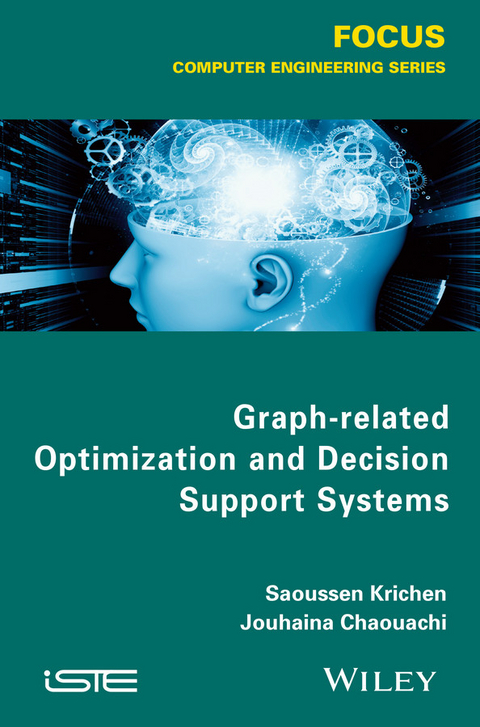
Graph-related Optimization and Decision Support Systems (eBook)
100 Seiten
Wiley (Verlag)
978-1-118-98424-6 (ISBN)
Constrained optimization is a challenging branch of operations research that aims to create a model which has a wide range of applications in the supply chain, telecommunications and medical fields. As the problem structure is split into two main components, the objective is to accomplish the feasible set framed by the system constraints. The aim of this book is expose optimization problems that can be expressed as graphs, by detailing, for each studied problem, the set of nodes and the set of edges. This graph modeling is an incentive for designing a platform that integrates all optimization components in order to output the best solution regarding the parameters' tuning. The authors propose in their analysis, for optimization problems, to provide their graphical modeling and mathematical formulation and expose some of their variants. As a solution approaches, an optimizer can be the most promising direction for limited-size instances. For large problem instances, approximate algorithms are the most appropriate way for generating high quality solutions. The authors thus propose, for each studied problem, a greedy algorithm as a problem-specific heuristic and a genetic algorithm as a metaheuristic.
Constrained optimization is a challenging branch of operations research that aims to create a model which has a wide range of applications in the supply chain, telecommunications and medical fields. As the problem structure is split into two main components, the objective is to accomplish the feasible set framed by the system constraints. The aim of this book is expose optimization problems that can be expressed as graphs, by detailing, for each studied problem, the set of nodes and the set of edges. This graph modeling is an incentive for designing a platform that integrates all optimization components in order to output the best solution regarding the parameters' tuning. The authors propose in their analysis, for optimization problems, to provide their graphical modeling and mathematical formulation and expose some of their variants. As a solution approaches, an optimizer can be the most promising direction for limited-size instances. For large problem instances, approximate algorithms are the most appropriate way for generating high quality solutions. The authors thus propose, for each studied problem, a greedy algorithm as a problem-specific heuristic and a genetic algorithm as a metaheuristic.
1
Basic Concepts in Optimization and Graph Theory
1.1. Introduction
An optimization problem is a formal specification of a set of proposals related to a specific framework that includes one or numerous decision makers, one or several objectives to be achieved and a set of structural constraints. Optimization has been practiced in numerous fields of study as it provides a primary tool for modeling and solving complex and hard constrained problems. After the 1960s, integer programming formulations and approximate approaches have received considerable attention as useful tools for solving optimization problems. Depending on the problem structure and its complexity, appropriate solution approaches were proposed to generate appropriate solutions in a reasonable computation time. Several optimization studies are formulated as a problem whose goal is to find the best solution, which corresponds to the minimum or maximum value of a single-objective function. The challenge of solving combinatorial problems lies in their computational complexity since most of them are non-deterministic polynomial-time (NP)-hard [GAR 79]. This complexity can mainly be expressed in terms of the relationship between the search space and the difficulty of finding a solution. The search space in combinatorial optimization problems is discrete and multidimensional. The higher the dimensionality, the larger the search space, and the harder the problem. The remainder of this chapter is organized as follows. In section 1.2, we highlight the terminology adopted throughout this book. Section 1.3 deals with the mathematical structure of an optimization problem and enumerates its main variants. Section 1.4 illustrates the previously announced principles by a didactic example. Section 1.5 outlines the main features of an optimization problem.
1.2. Notation
We present in the following the major symbols used for defining an optimization problem:
| Symbols | Description |
| n | the number of decision variables |
| k | the number of objectives |
| x = (x1,...,xn)T | the vector of decision variables |
| c(p,n) | the cost matrix |
| A | the matrix of constraints |
| B | Resources limitations |
| EO | The set of efficient solutions in the objective space |
| ED | The set of efficient solutions in the decision space |
1.3. Problem structure and variants
Assuming the linearity of an optimization problem, its mathematical modeling is outlined as follows:
[1.1]
[1.2]
[1.3]
where x = (x1,…,xn)T denotes the vector of decision variables, p, b and A are constant vectors and matrix of coefficients, respectively.
Many variants of this formulation can be pointed out:
1.4. Features of an optimization problem
Optimization problems can be classified in terms of the nature of the objective function and the nature of the constraints. Special forms of the objective function and the constraints give rise to specialized models that can efficiently model the problem under study. From this point of view, various types of optimization models can be highlighted: linear and nonlinear, single and multiobjective optimization problems, and continuous and combinatorial programming models. Based on such features, we have to define the following points:
1.5. A didactic example
Let us consider the following optimization problem involving two decision variables x1 and x2. We show in this illustrative example how the solution changes in terms of the nature of the decision variables that can be either continuous or binary and the number of objectives k = 1, 2. Hence, four optimization problems follow:
As previously mentioned, the resolution of the single-objective optimization problem yields to the finding of the optimal solution that varies depending on the nature of the decision variables. However, if a second objective is added, the resolution generates a set of Pareto-optimal solutions, as it is the case for k = 2.
1.6. Basic concepts in graph theory
A graph G is defined as a couple of sets G = (V, E): a vertex set V and an edge set E.
Figure 1.1. An example of a graph with n = 4 and e = 5
A simple graph is a graph that contains neither loops nor multiple edges. Simple graphs can be directed as shown in Figure 1.2(a), undirected as is the case of Figure 1.2(b) or/and weighted as shown in Figure 1.2(c). A weighted graph can designate a road network where each edge is labeled by the distance between the corresponding vertices. Weights can also express the traveling cost between two adjacent vertices.
Figure 1.2. Types of simple graphs
1.6.1. Degree of a graph
The degree of a vertex x in a graph G, denoted by dG(x), is the number of edges where x is one of their endpoints. Note that .
1.6.2. Matrix representation of a graph
An alternative representation of a graph is the matrix representation A that designates the adjacency matrix. It is a symmetric square matrix of order n if the graph is undirected. If the graph is weighted, the matrix reports the distances’ values if the corresponding vertices are adjacent and 0 elsewhere. Table 1.1 corresponds to the matrix...
| Erscheint lt. Verlag | 10.9.2014 |
|---|---|
| Sprache | englisch |
| Themenwelt | Mathematik / Informatik ► Informatik ► Theorie / Studium |
| Mathematik / Informatik ► Mathematik ► Angewandte Mathematik | |
| ISBN-10 | 1-118-98424-2 / 1118984242 |
| ISBN-13 | 978-1-118-98424-6 / 9781118984246 |
| Informationen gemäß Produktsicherheitsverordnung (GPSR) | |
| Haben Sie eine Frage zum Produkt? |
 EPUB (Adobe DRM)
Größe: 3,0 MB
Kopierschutz: Adobe-DRM
Adobe-DRM ist ein Kopierschutz, der das eBook vor Mißbrauch schützen soll. Dabei wird das eBook bereits beim Download auf Ihre persönliche Adobe-ID autorisiert. Lesen können Sie das eBook dann nur auf den Geräten, welche ebenfalls auf Ihre Adobe-ID registriert sind.
Details zum Adobe-DRM
Dateiformat: EPUB (Electronic Publication)
EPUB ist ein offener Standard für eBooks und eignet sich besonders zur Darstellung von Belletristik und Sachbüchern. Der Fließtext wird dynamisch an die Display- und Schriftgröße angepasst. Auch für mobile Lesegeräte ist EPUB daher gut geeignet.
Systemvoraussetzungen:
PC/Mac: Mit einem PC oder Mac können Sie dieses eBook lesen. Sie benötigen eine
eReader: Dieses eBook kann mit (fast) allen eBook-Readern gelesen werden. Mit dem amazon-Kindle ist es aber nicht kompatibel.
Smartphone/Tablet: Egal ob Apple oder Android, dieses eBook können Sie lesen. Sie benötigen eine
Geräteliste und zusätzliche Hinweise
Buying eBooks from abroad
For tax law reasons we can sell eBooks just within Germany and Switzerland. Regrettably we cannot fulfill eBook-orders from other countries.
aus dem Bereich