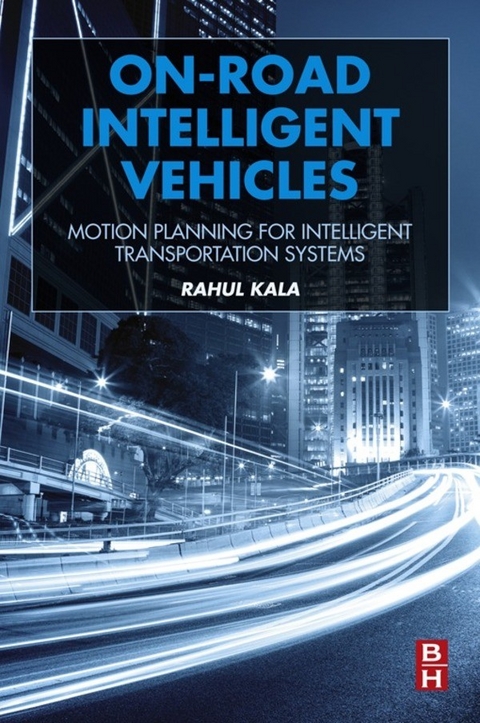
On-Road Intelligent Vehicles (eBook)
536 Seiten
Elsevier Science (Verlag)
978-0-12-803756-0 (ISBN)
Rahul Kala is an assistant professor at the Centre of Intelligent Robotics, Indian Institute of Information Technology, Allahabad, India, where he received his B.Tech. and M.Tech. degrees in information technology. He received his Ph.D. degree in cybernetics from the University of Reading, UK in 2013. Dr. Kala has authored four books, 100 scientific papers, and is an active reviewer of leading journals of the domain. He has received numerous scholarships and grants from the Government of India, and is a recipient of the Best PhD Dissertation award from the IEEE Intelligent Transportation Systems Society.
On-Road Intelligent Vehicles: Motion Planning for Intelligent Transportation Systems deals with the technology of autonomous vehicles, with a special focus on the navigation and planning aspects, presenting the information in three parts. Part One deals with the use of different sensors to perceive the environment, thereafter mapping the multi-domain senses to make a map of the operational scenario, including topics such as proximity sensors which give distances to obstacles, vision cameras, and computer vision techniques that may be used to pre-process the image, extract relevant features, and use classification techniques like neural networks and support vector machines for the identification of roads, lanes, vehicles, obstacles, traffic lights, signs, and pedestrians. With a detailed insight into the technology behind the vehicle, Part Two of the book focuses on the problem of motion planning. Numerous planning techniques are discussed and adapted to work for multi-vehicle traffic scenarios, including the use of sampling based approaches comprised of Genetic Algorithm and Rapidly-exploring Random Trees and Graph search based approaches, including a hierarchical decomposition of the algorithm and heuristic selection of nodes for limited exploration, Reactive Planning based approaches, including Fuzzy based planning, Potential Field based planning, and Elastic Strip and logic based planning. Part Three of the book covers the macroscopic concepts related to Intelligent Transportation Systems with a discussion of various topics and concepts related to transportation systems, including a description of traffic flow, the basic theory behind transportation systems, and generation of shock waves. - Provides an overall coverage of autonomous vehicles and Intelligent Transportation Systems- Presents a detailed overview, followed by the challenging problems of navigation and planning- Teaches how to compare, contrast, and differentiate navigation algorithms
| Erscheint lt. Verlag | 27.4.2016 |
|---|---|
| Sprache | englisch |
| Themenwelt | Informatik ► Theorie / Studium ► Künstliche Intelligenz / Robotik |
| Technik ► Bauwesen | |
| Technik ► Elektrotechnik / Energietechnik | |
| Technik ► Fahrzeugbau / Schiffbau | |
| Technik ► Maschinenbau | |
| ISBN-10 | 0-12-803756-3 / 0128037563 |
| ISBN-13 | 978-0-12-803756-0 / 9780128037560 |
| Informationen gemäß Produktsicherheitsverordnung (GPSR) | |
| Haben Sie eine Frage zum Produkt? |
 EPUB (Adobe DRM)
Kopierschutz: Adobe-DRM
Adobe-DRM ist ein Kopierschutz, der das eBook vor Mißbrauch schützen soll. Dabei wird das eBook bereits beim Download auf Ihre persönliche Adobe-ID autorisiert. Lesen können Sie das eBook dann nur auf den Geräten, welche ebenfalls auf Ihre Adobe-ID registriert sind.
Details zum Adobe-DRM
Dateiformat: EPUB (Electronic Publication)
EPUB ist ein offener Standard für eBooks und eignet sich besonders zur Darstellung von Belletristik und Sachbüchern. Der Fließtext wird dynamisch an die Display- und Schriftgröße angepasst. Auch für mobile Lesegeräte ist EPUB daher gut geeignet.
Systemvoraussetzungen:
PC/Mac: Mit einem PC oder Mac können Sie dieses eBook lesen. Sie benötigen eine
eReader: Dieses eBook kann mit (fast) allen eBook-Readern gelesen werden. Mit dem amazon-Kindle ist es aber nicht kompatibel.
Smartphone/Tablet: Egal ob Apple oder Android, dieses eBook können Sie lesen. Sie benötigen eine
Geräteliste und zusätzliche Hinweise
Buying eBooks from abroad
For tax law reasons we can sell eBooks just within Germany and Switzerland. Regrettably we cannot fulfill eBook-orders from other countries.
aus dem Bereich