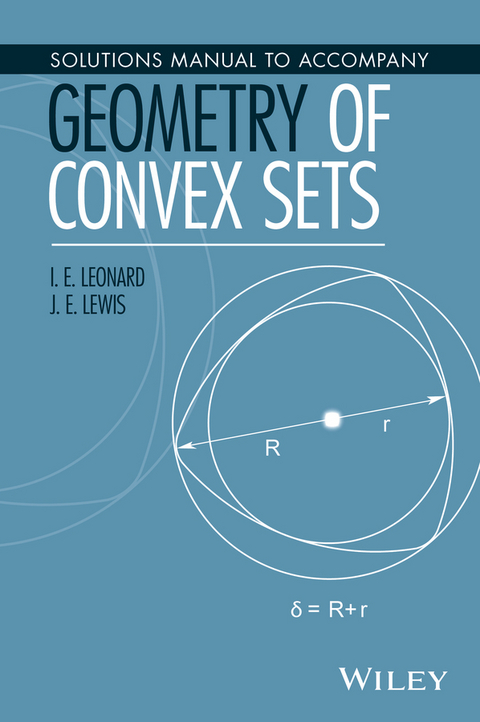
Solutions Manual to Accompany Geometry of Convex Sets (eBook)
John Wiley & Sons (Verlag)
978-1-119-18411-9 (ISBN)
A Solutions Manual to accompany Geometry of Convex Sets
Geometry of Convex Sets begins with basic definitions of the concepts of vector addition and scalar multiplication and then defines the notion of convexity for subsets of n-dimensional space. Many properties of convex sets can be discovered using just the linear structure. However, for more interesting results, it is necessary to introduce the notion of distance in order to discuss open sets, closed sets, bounded sets, and compact sets. The book illustrates the interplay between these linear and topological concepts, which makes the notion of convexity so interesting.Thoroughly class-tested, the book discusses topology and convexity in the context of normed linear spaces, specifically with a norm topology on an n-dimensional space.
Geometry of Convex Sets also features:
- An introduction to n-dimensional geometry including points; lines; vectors; distance; norms; inner products; orthogonality; convexity; hyperplanes; and linear functionals
- Coverage of n-dimensional norm topology including interior points and open sets; accumulation points and closed sets; boundary points and closed sets; compact subsets of n-dimensional space; completeness of n-dimensional space; sequences; equivalent norms; distance between sets; and support hyperplanes ·
- Basic properties of convex sets; convex hulls; interior and closure of convex sets; closed convex hulls; accessibility lemma; regularity of convex sets; affine hulls; flats or affine subspaces; affine basis theorem; separation theorems; extreme points of convex sets; supporting hyperplanes and extreme points; existence of extreme points; Krein-Milman theorem; polyhedral sets and polytopes; and Birkhoff's theorem on doubly stochastic matrices
- Discussions of Helly's theorem; the Art Gallery theorem; Vincensini's problem; Hadwiger's theorems; theorems of Radon and Caratheodory; Kirchberger's theorem; Helly-type theorems for circles; covering problems; piercing problems; sets of constant width; Reuleaux triangles; Barbier's theorem; and Borsuk's problem
Geometry of Convex Sets is a useful textbook for upper-undergraduate level courses in geometry of convex sets and is essential for graduate-level courses in convex analysis. An excellent reference for academics and readers interested in learning the various applications of convex geometry, the book is also appropriate for teachers who would like to convey a better understanding and appreciation of the field to students.
I. E. Leonard, PhD, was a contract lecturer in the Department of Mathematical and Statistical Sciences at the University of Alberta. The author of over 15 peer-reviewed journal articles, he is a technical editor for the Canadian Applied Mathematical Quarterly journal.
J. E. Lewis, PhD, is Professor Emeritus in the Department of Mathematical Sciences at the University of Alberta. He was the recipient of the Faculty of Science Award for Excellence in Teaching in 2004 as well as the PIMS Education Prize in 2002.
I. E. Leonard, PhD, is Contract Lecturer in the Department of Mathematical and Statistical Sciences at the University of Alberta. The author of over 15 peer reviewed journal articles, he is a technical editor for the Canadian Applied Mathematical Quarterly. J. E. Lewis, PhD, is Professor Emeritus in the Department of Mathematical Sciences at the University of Alberta. He was the recipient of the Faculty of Science Award for Excellence in Teaching in 2004 as well as the PIMS Education Prize in 2002.
Preface vii
1 Introduction to N-Dimensional Geometry 1
1.2 Points Vectors and Parallel Lines 1
1.2.5 Problems 1
1.4 Inner Product and Orthogonality 3
1.4.3 Problems 3
1.6 Hyperplanes and Linear Functionals 5
1.6.3 Problems 5
2 Topology 13
2.3 Accumulation Points and Closed Sets 13
2.3.4 Problems 13
2.6 Applications of Compactness 20
2.6.5 Problems 20
3 Convexity 35
3.2 Basic Properties of Convex Sets 35
3.2.1 Problems 35
3.3 Convex Hulls 43
3.3.1 Problems 43
3.4 Interior and Closure of Convex Sets 52
3.4.4 Problems 52
3.5 Affine Hulls 55
3.5.4 Problems 55
3.6 Separation Theorems 66
3.6.2 Problems 66
3.7 Extreme Points of Convex Sets 78
3.7.7 Problems 78
4 Helly's Theorem 89
4.1 Finite Intersection Property 89
4.1.2 Problems 89
4.3 Applications of Helly's Theorem 92
4.3.9 Problems 92
4.4 Sets of Constant Width 99
4.4.8 Problems 99
Bibliography 109
Index 113
Chapter 1
Introduction to N-Dimensional Geometry
1.2 Points, Vectors, and Parallel Lines
1.2.5 Problems
A remark about the exercises is necessary. Certain questions are phrased as statements to avoid the incessant use of “prove that”. See Problem 1, for example. Such statements are supposed to be proved. Other questions have a “true–false” or “yes–no” quality. The point of such questions is not to guess, but to justify your answer. Questions marked with are considered to be more challenging. Hints are given for some problems. Of course, a hint may contain statements that must be proved.
- 1. Let be a nonempty set in . If every three points of are collinear, then is collinear.
Solution
Let and be two distinct points in , then there is a unique line passing through these two points. Now let be an arbitrary point in , from the hypothesis, , and must be on some line , and since and uniquely determine the line , we must have . Therefore, every point in is on the line .
- 3. Given that the line has the linear equation
show that the point
is on the line, and that the vector is parallel to the line.
Hint. If is on the line and if is also on the line, then must be parallel to the line.
Solution
Substituting the coordinates of this point into the linear equation for , we see that
so that the given point is on .
Since not both and are 0, we may assume that , and let
then both and are on the line , and therefore is parallel to . However,
so the vector is parallel to .
Note that this follows immediately from the fact that the vector
is the normal vector to the line .
- 5. The centroid of three noncollinear points , and in is defined to be
Show that this definition of the centroid yields the synthetic definition of the centroid of the triangle with vertices , namely, the point at which the three medians of the triangle intersect. Prove also that the medians do indeed intersect at a common point.
Solution
Given a triangle with vertices , let be the midpoint of the segment and let be the point along the median which is the distance from to .
We have , and since , then
If we define and similarly, then we see that
so that the point lies on each of the three medians. Thus, this is the synthetic definition of the centroid and the medians intersect at a single point.
1.4 Inner Product and Orthogonality
1.4.3 Problems
In the following exercises, assume that “distance” means “Euclidean distance” unless otherwise stated.
- 1.
- a. The unit cube in is the set of points
Draw the unit cube in , , and .
- b. What is the length of the longest line segment that you can place in the unit cube of ?
- c. What is the radius of the smallest Euclidean ball that contains the unit cube of ?
Solution
- a. The unit cubes are sketched below.
- b. If and are points in the unit cube in , then the Euclidean distance between and is
where and for .
The maximum distance will occur when and for , that is, when and are vertices of the cube that are diagonally opposite. In this case, the maximum distance is
- c. The smallest Euclidean ball that contains the unit cube is one that has diameter equal to , the length of the longest line segment in the cube. The ball is
and has radius .
- a. The unit cube in is the set of points
- 3. Find the distance between the points and using
- a. the metric,
- b. the “sup” metric,
- c. the Euclidean metric.
Solution
If and , then
Therefore,
- a. With the metric,
- b. With the “sup” metric,
- c. With the Euclidean metric,
- 5. Show that a positive homothet of a closed ball is a closed ball.
Solution
Let , and , we will show that
Let , then where , and therefore
so that , and
Conversely, if , then letting , we have
that is
so that , and
1.6 Hyperplanes and Linear Functionals
1.6.3 Problems
In the following exercises, unless otherwise stated, assume that the closed unit ball is the closed unit ball in the Euclidean norm.
- *1. Find a hyperplane in that is tangent to the unit cube at the point . Verify your answer.
Solution
Let be the linear functional represented by , then the hyperplane
is tangent to the unit cube at .
To verify this, note that the point is in , since
Also, for any point in the cube, for , so that and .
- 3. Find an equation for the hyperplane of
- a. Problem 2 (a),
- b. Problem 2 (b).
Solution
- a. The hyperplane through the point is perpendicular to the line through through the points and . Therefore,
Since is on , we have
and the equation of the hyperplane is
- b. The hyperplane tangent to the unit sphere at is perpendicular to the line through the points and . Therefore,
Since is on , we have
so that
that is, . The equation of the hyperplane is
- 5. Given the linear functional , find
- a. the point on the closed unit ball where is a maximum,
- b. the point in the hyperplane that is closest to the origin,
- c. the point in the hyperplane that is closest to the origin.
Solution
- a. If , then from the Cauchy-Schwarz inequality we have
and so for all .
Now let , then
so that , and
Therefore, attains its maximum on the closed unit ball at .
- b. The hyperplane has equation
and the line through the points and is perpendicular to and has parametric equations
for . The point on the hyperplane with minimum Euclidean norm; that is, the point closed to the origin, is the point where the line intersects . Therefore,
so that , and the closest point on to is .
- c. Analogous to part (b), the point on the hyperplane
closest to the origin is the point with .
Thus, we want
that is, .
The point on closest to the origin is .
- 7. Let be the linear functional on represented by the vector and let be the set
- a. Determine which points of are on the same side of .
- b. Which point or points of are closest to ?
- c. Which points of are on the same side of as the origin?
- d. Find the point or points of that are closest to .
Solution
For each , then value of is given by
and for , we have
- a. The points , and , are on one side of ; that is, in the halfspace
while the points , , and are on the other side; that is, in the halfspace
- b. Since , the point of closest to is the point .
- c. Only the point is in the halfspace
while the points , , , and are in the halfspace
- d. Since , while for all other points , the point closest to is .
- 9. Given that is the hyperplane , and given that , find such that is exactly the same as .
Solution
Note that the point if and only if , that is, if and only if .
This last equation is true if and only if , that is, if and only if .
Taking , then , so that , and therefore .
- 11. Let be the line
where and are distinct points in , and let be a linear functional on such that and . Find
- a. the point where intersects the hyperplane ,
- b. the scalar such that the hyperplane passes through the midpoint of the line segment joining and .
Solution
- a. If is on , then
so that , and the hyperplane intersects the line at the point .
- b. We want
so that .
- 13. Given that , where the linear functional on is represented by the vector , find
- a. a line through that intersects in exactly one point,
- b. a line through that misses .
Solution
- a. The vector is perpendicular to the hyperplane , and Therefore the line through the origin in the direction of intersects in exactly one point.
- b. Since , then . We take the vector and note that
and the vector is perpendicular to . Thus, and are in , so the line through and lies entirely in and so misses .
- 15. If the hyperplane intersects the straight line in exactly one point, then for every scalar , the hyperplane
intersects in exactly one point.
Hint. Conclude that this must happen because of what we know from Problems 12 and 14.
Solution
If the line misses , then lies in a hyperplane parallel to , which is parallel to . This contradicts the fact that intersects in exactly one point. If the line intersects in more than one point, then ...
| Erscheint lt. Verlag | 27.4.2016 |
|---|---|
| Sprache | englisch |
| Themenwelt | Mathematik / Informatik ► Mathematik ► Geometrie / Topologie |
| Technik | |
| Schlagworte | Angewandte Mathematik • Applied mathematics • boundary points • Combinatorial Geometry • Convex sets • covering problems • finite Mathematics • Geometrie u. Topologie • Geometry • Geometry & Topology • Helly’s theorem • Hyperplanes • Klee’s reduction • Mathematics • Mathematik • Modern/Abstract Algebra • Moderne u. abstrakte Algebra • proofs • Sets • Subsets • Subspaces • Theorems • transversal problems |
| ISBN-10 | 1-119-18411-8 / 1119184118 |
| ISBN-13 | 978-1-119-18411-9 / 9781119184119 |
| Informationen gemäß Produktsicherheitsverordnung (GPSR) | |
| Haben Sie eine Frage zum Produkt? |
 EPUB (Adobe DRM)
Kopierschutz: Adobe-DRM
Adobe-DRM ist ein Kopierschutz, der das eBook vor Mißbrauch schützen soll. Dabei wird das eBook bereits beim Download auf Ihre persönliche Adobe-ID autorisiert. Lesen können Sie das eBook dann nur auf den Geräten, welche ebenfalls auf Ihre Adobe-ID registriert sind.
Details zum Adobe-DRM
Dateiformat: EPUB (Electronic Publication)
EPUB ist ein offener Standard für eBooks und eignet sich besonders zur Darstellung von Belletristik und Sachbüchern. Der Fließtext wird dynamisch an die Display- und Schriftgröße angepasst. Auch für mobile Lesegeräte ist EPUB daher gut geeignet.
Systemvoraussetzungen:
PC/Mac: Mit einem PC oder Mac können Sie dieses eBook lesen. Sie benötigen eine
eReader: Dieses eBook kann mit (fast) allen eBook-Readern gelesen werden. Mit dem amazon-Kindle ist es aber nicht kompatibel.
Smartphone/Tablet: Egal ob Apple oder Android, dieses eBook können Sie lesen. Sie benötigen eine
Geräteliste und zusätzliche Hinweise
Buying eBooks from abroad
For tax law reasons we can sell eBooks just within Germany and Switzerland. Regrettably we cannot fulfill eBook-orders from other countries.
aus dem Bereich