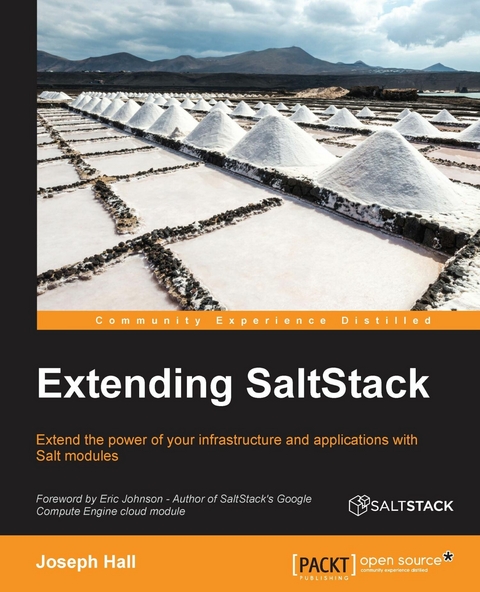
Extending SaltStack (eBook)
240 Seiten
Packt Publishing (Verlag)
978-1-78588-816-8 (ISBN)
Extend the power of your infrastructure and applications with Salt modules
About This Book
- Get the most up-to-date practical resource on writing new Salt modules and extending Salt
- Learn through use cases and encounter both commonly-used modules as well as advanced ones
- Effectively troubleshoot problems and hiccups encountered while building and putting modules to work
Who This Book Is For
This book is for both new and existing Salt developers who are looking to build and write new Salt modules. Some prior Python development experience is expected.
What You Will Learn
- Understand the working of Salt's Loader system
- Write several of the most common types of Salt modules
- Interact between different kinds of modules and build new ones
- Submit open source modules upstream to the Salt project
- Make Salt interact with third-party services and applications
In Detail
Salt already ships with a very powerful set of tools, but that doesn't mean that they all suit your needs perfectly. By adding your own modules and enhancing existing ones, you can bring the functionality that you need to increase your productivity. Extending SaltStack follows a tutorial-based approach to explain different types of modules, from fundamentals to complete and full-functioning modules.
Starting with the Loader system that drives Salt, this book will guide you through the most common types of modules. First you will learn how to write execution modules. Then you will extend the configuration using the grain, pillar, and SDB modules. Next up will be state modules and then the renderers that can be used with them. This will be followed with returner and output modules, which increase your options to manage return data. After that, there will be modules for external file servers, clouds, beacons, and finally external authentication and wheel modules to manage the master.
With this guide in hand, you will be prepared to create, troubleshoot, and manage the most common types of Salt modules and take your infrastructure to new heights!
Style and approach
This book follows a step-by-step tutorial-based approach explaining the different types of modules, from fundamentals to complete and full-functioning modules.
Extend the power of your infrastructure and applications with Salt modulesAbout This BookGet the most up-to-date practical resource on writing new Salt modules and extending SaltLearn through use cases and encounter both commonly-used modules as well as advanced onesEffectively troubleshoot problems and hiccups encountered while building and putting modules to workWho This Book Is ForThis book is for both new and existing Salt developers who are looking to build and write new Salt modules. Some prior Python development experience is expected.What You Will LearnUnderstand the working of Salt's Loader systemWrite several of the most common types of Salt modulesInteract between different kinds of modules and build new onesSubmit open source modules upstream to the Salt projectMake Salt interact with third-party services and applicationsIn DetailSalt already ships with a very powerful set of tools, but that doesn't mean that they all suit your needs perfectly. By adding your own modules and enhancing existing ones, you can bring the functionality that you need to increase your productivity. Extending SaltStack follows a tutorial-based approach to explain different types of modules, from fundamentals to complete and full-functioning modules.Starting with the Loader system that drives Salt, this book will guide you through the most common types of modules. First you will learn how to write execution modules. Then you will extend the configuration using the grain, pillar, and SDB modules. Next up will be state modules and then the renderers that can be used with them. This will be followed with returner and output modules, which increase your options to manage return data. After that, there will be modules for external file servers, clouds, beacons, and finally external authentication and wheel modules to manage the master.With this guide in hand, you will be prepared to create, troubleshoot, and manage the most common types of Salt modules and take your infrastructure to new heights!Style and approachThis book follows a step-by-step tutorial-based approach explaining the different types of modules, from fundamentals to complete and full-functioning modules.
| Erscheint lt. Verlag | 22.3.2016 |
|---|---|
| Sprache | englisch |
| Themenwelt | Mathematik / Informatik ► Informatik |
| ISBN-10 | 1-78588-816-1 / 1785888161 |
| ISBN-13 | 978-1-78588-816-8 / 9781785888168 |
| Informationen gemäß Produktsicherheitsverordnung (GPSR) | |
| Haben Sie eine Frage zum Produkt? |
 EPUB (Adobe DRM)
Kopierschutz: Adobe-DRM
Adobe-DRM ist ein Kopierschutz, der das eBook vor Mißbrauch schützen soll. Dabei wird das eBook bereits beim Download auf Ihre persönliche Adobe-ID autorisiert. Lesen können Sie das eBook dann nur auf den Geräten, welche ebenfalls auf Ihre Adobe-ID registriert sind.
Details zum Adobe-DRM
Dateiformat: EPUB (Electronic Publication)
EPUB ist ein offener Standard für eBooks und eignet sich besonders zur Darstellung von Belletristik und Sachbüchern. Der Fließtext wird dynamisch an die Display- und Schriftgröße angepasst. Auch für mobile Lesegeräte ist EPUB daher gut geeignet.
Systemvoraussetzungen:
PC/Mac: Mit einem PC oder Mac können Sie dieses eBook lesen. Sie benötigen eine
eReader: Dieses eBook kann mit (fast) allen eBook-Readern gelesen werden. Mit dem amazon-Kindle ist es aber nicht kompatibel.
Smartphone/Tablet: Egal ob Apple oder Android, dieses eBook können Sie lesen. Sie benötigen eine
Geräteliste und zusätzliche Hinweise
Buying eBooks from abroad
For tax law reasons we can sell eBooks just within Germany and Switzerland. Regrettably we cannot fulfill eBook-orders from other countries.
aus dem Bereich