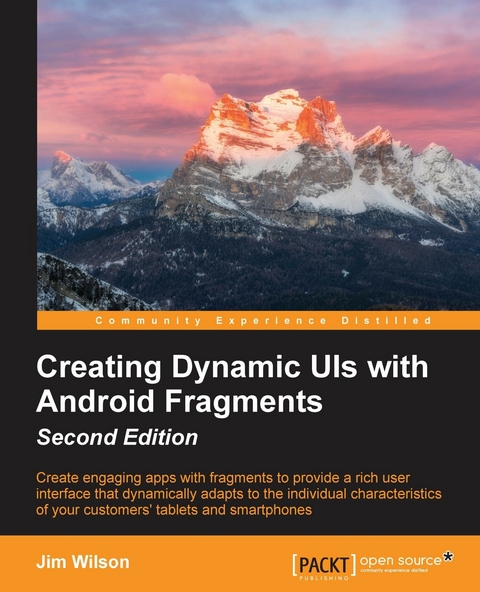
Creating Dynamic UIs with Android Fragments - Second Edition (eBook)
154 Seiten
Packt Publishing (Verlag)
978-1-78588-276-0 (ISBN)

Create engaging apps with fragments to provide a rich user interface that dynamically adapts to the individual characteristics of your customers' tablets and smartphones
About This Book
- From an eminent author comes a book that will help you create engaging apps that dynamically adapt to individual device characteristics
- The only book that includes the latest fragment-oriented features and their role in Material design
- This book provides code-intensive discussions and detailed examples that help you understand better and learn faster.
Who This Book Is For
This book is for developers with a basic understanding of Android programming who would like to improve the appearance and usability of their applications by creating a more interactive user experience and dynamically adaptive UIs; providing better support for tablets and smartphones in a single app; and reducing the complexity of managing app UIs.
What You Will Learn
- Learn the role and capabilities of fragments
- Use Android Studio's fragment-oriented features
- Create an app UI that works effectively on smartphones and tablets
- Manage the creation and life cycle of fragments
- Dynamically manage fragments using the FragmentTransaction class
- Learn the application design for communicating between fragments
- Leverage fragments when implementing applications that take advantage of the latest features of Material Design
In Detail
Today's users expect mobile apps to be dynamic and highly interactive, with rich navigation features. These same apps must look fantastic whether running on a medium-resolution smartphone or high-resolution tablet. Fragments provide the toolset we need to meet these user expectations by enabling us to build our applications out of adaptable components that take advantage of the rich capabilities of each individual device and automatically adapt to their differences.
This book looks at the impact fragments have on Android UI design and their role in both simplifying many common UI challenges and in providing best practices for incorporating rich UI behaviors. We look closely at the roll of fragment transactions and how to work with the Android back stack. Leveraging this understanding, we explore several specialized fragment-related classes such as ListFragment and DialogFragment. We then go on to discuss how to implement rich navigation features such as swipe-based screen browsing, and the role of fragments when developing applications that take advantage of the latest aspects of Material Design.
You will learn everything you need to provide dynamic, multi-screen UIs within a single activity, and the rich UI features demanded by today's mobile users.
Style and approach
A fast-paced learning guide that gives a hands-on, code-intensive approach with a focus on real-world applications.
Create engaging apps with fragments to provide a rich user interface that dynamically adapts to the individual characteristics of your customers' tablets and smartphonesAbout This BookFrom an eminent author comes a book that will help you create engaging apps that dynamically adapt to individual device characteristicsThe only book that includes the latest fragment-oriented features and their role in Material designThis book provides code-intensive discussions and detailed examples that help you understand better and learn faster.Who This Book Is ForThis book is for developers with a basic understanding of Android programming who would like to improve the appearance and usability of their applications by creating a more interactive user experience and dynamically adaptive UIs; providing better support for tablets and smartphones in a single app; and reducing the complexity of managing app UIs.What You Will LearnLearn the role and capabilities of fragmentsUse Android Studio's fragment-oriented featuresCreate an app UI that works effectively on smartphones and tabletsManage the creation and life cycle of fragmentsDynamically manage fragments using the FragmentTransaction classLearn the application design for communicating between fragmentsLeverage fragments when implementing applications that take advantage of the latest features of Material DesignIn DetailToday's users expect mobile apps to be dynamic and highly interactive, with rich navigation features. These same apps must look fantastic whether running on a medium-resolution smartphone or high-resolution tablet. Fragments provide the toolset we need to meet these user expectations by enabling us to build our applications out of adaptable components that take advantage of the rich capabilities of each individual device and automatically adapt to their differences.This book looks at the impact fragments have on Android UI design and their role in both simplifying many common UI challenges and in providing best practices for incorporating rich UI behaviors. We look closely at the roll of fragment transactions and how to work with the Android back stack. Leveraging this understanding, we explore several specialized fragment-related classes such as ListFragment and DialogFragment. We then go on to discuss how to implement rich navigation features such as swipe-based screen browsing, and the role of fragments when developing applications that take advantage of the latest aspects of Material Design.You will learn everything you need to provide dynamic, multi-screen UIs within a single activity, and the rich UI features demanded by today's mobile users.Style and approachA fast-paced learning guide that gives a hands-on, code-intensive approach with a focus on real-world applications.
| Erscheint lt. Verlag | 23.3.2016 |
|---|---|
| Sprache | englisch |
| Themenwelt | Mathematik / Informatik ► Informatik |
| ISBN-10 | 1-78588-276-7 / 1785882767 |
| ISBN-13 | 978-1-78588-276-0 / 9781785882760 |
| Informationen gemäß Produktsicherheitsverordnung (GPSR) | |
| Haben Sie eine Frage zum Produkt? |
 EPUB (Adobe DRM)
Kopierschutz: Adobe-DRM
Adobe-DRM ist ein Kopierschutz, der das eBook vor Mißbrauch schützen soll. Dabei wird das eBook bereits beim Download auf Ihre persönliche Adobe-ID autorisiert. Lesen können Sie das eBook dann nur auf den Geräten, welche ebenfalls auf Ihre Adobe-ID registriert sind.
Details zum Adobe-DRM
Dateiformat: EPUB (Electronic Publication)
EPUB ist ein offener Standard für eBooks und eignet sich besonders zur Darstellung von Belletristik und Sachbüchern. Der Fließtext wird dynamisch an die Display- und Schriftgröße angepasst. Auch für mobile Lesegeräte ist EPUB daher gut geeignet.
Systemvoraussetzungen:
PC/Mac: Mit einem PC oder Mac können Sie dieses eBook lesen. Sie benötigen eine
eReader: Dieses eBook kann mit (fast) allen eBook-Readern gelesen werden. Mit dem amazon-Kindle ist es aber nicht kompatibel.
Smartphone/Tablet: Egal ob Apple oder Android, dieses eBook können Sie lesen. Sie benötigen eine
Geräteliste und zusätzliche Hinweise
Buying eBooks from abroad
For tax law reasons we can sell eBooks just within Germany and Switzerland. Regrettably we cannot fulfill eBook-orders from other countries.
aus dem Bereich