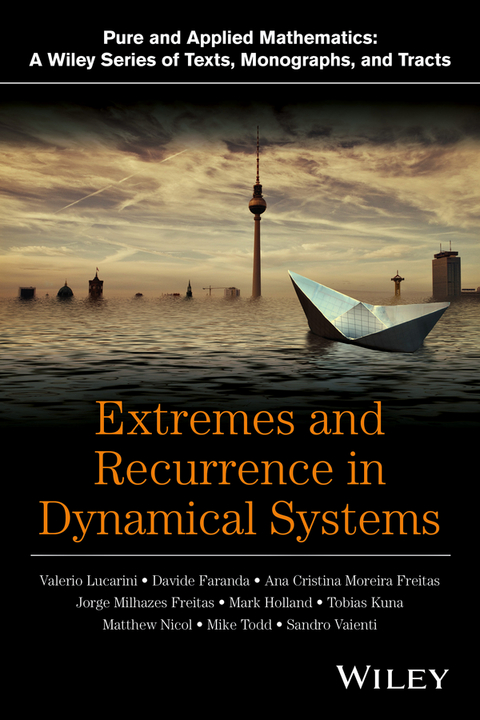
Extremes and Recurrence in Dynamical Systems (eBook)
John Wiley & Sons (Verlag)
978-1-118-63235-2 (ISBN)

Presents recent advances on the theory of extreme values that result from investigations of dynamical systems applications
Written by a team of international experts, Extremes and Recurrence in Dynamical Systems presents a unique point of view on the mathematical theory of extremes and how it relates to applications in the natural and social sciences. Featuring an interdisciplinary approach to new concepts in pure and applied mathematical research, the book skillfully combines the areas of statistical mechanics, probability theory, measure theory, dynamical systems, statistical inference, geophysics, and software application. Emphasizing statistical mechanics, the book introduces robust theoretical embedding for the application of extreme value theory and modeling through dynamical systems. Extremes and Recurrence in Dynamical Systems also features:
- A careful examination of how a dynamical system can be taken as a generator of stochastic processes
- Discussions on the applications of statistical inference in the theoretical and heuristic use of extremes
- Several examples of analysis of extremes in a physical and geophysical context
- A final summary of the main results presented with a discussion of forthcoming research guidelines
- An appendix with software Matlab® and Octave programming language to help readers to develop further understanding of the presented concepts
Extremes and Recurrence in Dynamical Systems is ideal for academics and practitioners in pure and applied mathematics, probability theory, statistics, chaos, theoretical and applied dynamical systems, statistical mechanics, geophysical fluid dynamics, geosciences and complexity science.
Written by a team of international experts, Extremes and Recurrence in Dynamical Systems presents a unique point of view on the mathematical theory of extremes and on its applications in the natural and social sciences. Featuring an interdisciplinary approach to new concepts in pure and applied mathematical research, the book skillfully combines the areas of statistical mechanics, probability theory, measure theory, dynamical systems, statistical inference, geophysics, and software application. Emphasizing the statistical mechanical point of view, the book introduces robust theoretical embedding for the application of extreme value theory in dynamical systems. Extremes and Recurrence in Dynamical Systems also features: A careful examination of how a dynamical system can serve as a generator of stochastic processes Discussions on the applications of statistical inference in the theoretical and heuristic use of extremes Several examples of analysis of extremes in a physical and geophysical context A final summary of the main results presented along with a guide to future research projects An appendix with software in Matlab programming language to help readers to develop further understanding of the presented concepts Extremes and Recurrence in Dynamical Systems is ideal for academics and practitioners in pure and applied mathematics, probability theory, statistics, chaos, theoretical and applied dynamical systems, statistical mechanics, geophysical fluid dynamics, geosciences and complexity science.VALERIO LUCARINI, PhD, is Professor of Theoretical Meteorology at the University of Hamburg, Germany and Professor of Statistical Mechanics at the University of Reading, UK.DAVIDE FARANDA, PhD, is Researcher at the Laboratoire des science du climat et de l environnement, IPSL, CEA Saclay, Universit Paris-Saclay, Gif-sur-Yvette, France.ANA CRISTINA GOMES MONTEIRO MOREIRA DE FREITAS, PhD, is Assistant Professor in the Faculty of Economics at the University of Porto, Portugal.JORGE MIGUEL MILHAZES DE FREITAS, PhD, is Assistant Professor in the Department of Mathematics of the Faculty of Sciences at the University of Porto, Portugal. MARK HOLLAND, PhD, is Senior Lecturer in Applied Mathematics in the College of Engineering, Mathematics and Physical Sciences at the University of Exeter, UK.TOBIAS KUNA, PhD, is Associate Professor in the Department of Mathematics and Statistics at the University of Reading, UK.MATTHEW NICOL, PhD, is Professor of Mathematics at the University of Houston, USA. MIKE TODD, PhD, is Lecturer in the School of Mathematics and Statistics at the University of St. Andrews, Scotland. SANDRO VAIENTI, PhD, is Professor of Mathematics at the University of Toulon and Researcher at the Centre de Physique Th orique, France.
VALERIO LUCARINI, PhD, is Professor of Theoretical Meteorology at the University of Hamburg, Germany and Professor of Statistical Mechanics at the University of Reading, UK. DAVIDE FARANDA, PhD, is Researcher at the Laboratoire des science du climat et de l'environnement, IPSL, CEA Saclay, Université Paris-Saclay, Gif-sur-Yvette, France. ANA CRISTINA GOMES MONTEIRO MOREIRA DE FREITAS, PhD, is Assistant Professor in the Faculty of Economics at the University of Porto, Portugal. JORGE MIGUEL MILHAZES DE FREITAS, PhD, is Assistant Professor in the Department of Mathematics of the Faculty of Sciences at the University of Porto, Portugal. MARK HOLLAND, PhD, is Senior Lecturer in Applied Mathematics in the College of Engineering, Mathematics and Physical Sciences at the University of Exeter, UK. TOBIAS KUNA, PhD, is Associate Professor in the Department of Mathematics and Statistics at the University of Reading, UK. MATTHEW NICOL, PhD, is Professor of Mathematics at the University of Houston, USA. MIKE TODD, PhD, is Lecturer in the School of Mathematics and Statistics at the University of St. Andrews, Scotland. SANDRO VAIENTI, PhD, is Professor of Mathematics at the University of Toulon and Researcher at the Centre de Physique Théorique, France.
"This book presents a comprehensive approach to the theory of extreme events (extreme values) from the perspective of dynamical systems. It is nicely written by a group of authors from different parts of the globe".... "This book presents all the signs of becoming a significant tool in pure and applied mathematical research" Idris Assani on behalf of Mathematical Reviews, October 17
CHAPTER 1
INTRODUCTION
1.1 A TRANSDISCIPLINARY RESEARCH AREA
The study of extreme events has long been a very relevant field of investigation at the intersection of different fields, most notably mathematics, geosciences, engineering, and finance [1–7]. While extreme events in a given physical system obey the same laws as typical events do, extreme events are rather special from a mathematical point of view as well as in terms of their impacts. Often, procedures like mode reduction techniques, which are able to reliably reproduce the typical behavior of a system, do not perform well in representing accurately extreme events and therefore, underestimate their variety. It is extremely challenging to predict extremes in the sense of defining precursors for specific events and, on longer time scales, to assess how modulations in the external factors (e.g., climate change in the case of geophysical extremes) have an impact on their properties.
Clearly, understanding the properties of the tail of the probability distribution of a stochastic variable attracts a lot of interest in many sectors of science and technology because extremes sometimes relate to situations of high stress or serious hazard, so that in many fields it is crucial to be able to predict their return times in order to cushion and gauge risks, such as in the case of the construction industry, the energy sector, agriculture, territorial planning, logistics, and financial markets, just to name a few examples. Intuitively, we associate the idea of an extreme event to something that is either very large, or something that is very rare, or, in more practical terms, to something with a rather abnormal impact with respect to an indicator (e.g., economic or environmental welfare) that we deem important. While overlaps definitely exist between such definitions, they are not equivalent.
An element of subjectivity is unavoidable when treating finite data—observational or synthetic—and when having a specific problem in mind: we might be interested in studying yearly or decadal temperature maxima in a given location, or the return period of river discharge larger than a prescribed value. Practical needs have indeed been crucial in stimulating the investigation of extremes, and most notably in the fields of hydrology [5] and finance [2], which provided the first examples of empirical yet extremely powerful approaches.
To take a relevant and instructive example, let us briefly consider the case of geophysical extremes, which do not only cost many human lives each year, but also cause significant economic damages [4, 8–10]; see also the discussion and historical perspective given in [11]. For instance, freak ocean waves are extremely hard to predict and can have devastating impacts on vessels and coastal areas [12–14]. Windstorms are well known to dominate the list of the costliest natural disasters, with many occurrences of individual events causing insured losses topping USD 1 billion [15, 16]. Temperature extremes, like heat waves and cold spells, have severe impacts on society and ecosystems [17–19]. Notable temperature-related extreme events are the 2010 Russian heat wave, which caused 500 wild fires around Moscow, reduced grain harvest by 30% and was the hottest summer in at least 500 years [20]; and the 2003 heat wave in Europe, which constituted the second hottest summer in this period [21]. The 2003 heat wave had significant societal consequences: for example, it caused additional deaths exceeding 70,000 [17]. On the other hand, recent European winters were very cold, with widespread cold spells hitting Europe during January 2008, December 2009, and January 2010. The increasing number of weather and climate extremes over the past few decades [22–24] has led to intense debates, not only among scientists but also policy makers and the general public, as to whether this increase is triggered by global warming.
Additionally, in some cases, we might be interested in exploring the spatial correlation of extreme events. See extensive discussion in [25, 26]. Intense precipitation events occurring at the same time within a river basin, which acts as a spatial integrator of precipitations, can cause extremely dangerous floods. Large-scale long- lasting droughts can require huge infrastructural investments to guarantee the welfare of entire populations as well as the production of agricultural goods. Extended wind storms can halt the production of wind energy in vast territories, dramatically changing the input of energy into the electric grid, with the ensuing potential risk of brown- or black-outs, or can seriously impact the air, land, and sea transportation networks. In general, weather and climate models need to resort to parametrizations for representing the effect of small-scale processes on the large-scale dynamics. Such parametrizations are usually constructed and tuned in order to capture as accurately as possible the first moments (mean, variance) of the large-scale climatic features. However, it is indeed much less clear how spatially extended extremes can be affected. Going back to a more conceptual problem, one can consider the case where we have two or more versions of the same numerical model of a fluid, which differ for the adopted spatial resolution. How can we compare the extremes of a local physical observable provided by the various versions of the model? Is there a coarse-graining procedure suited for upscaling to a common resolution the outputs of the models, such that we find a coherent representation of the extremes? In this regard, see in [27] a related analysis of extremes of precipitation in climate models.
When we talk about the impacts of geophysical extremes, a complex portfolio of aspects need to be considered, so the study of extremes leads naturally to comprehensive transdisciplinary areas of research. The impacts of geohazards depend strongly not only on the magnitude of the extreme event, but also on the vulnerability of the affected communities. Some areas, for example, coasts, are especially at risk of high-impact geophysical hazards, such as extreme floods caused by tsunami, storm surges, and freak waves. Delta regions of rivers face additional risks due to flooding resulting from intense and extensive precipitation events happening upstream the river basin, maybe at distances of thousands of kilometers. Sometimes, storm surges and excess precipitation act in synergy and create exceptional coastal flooding. Mountain areas are in turn, extremely sensitive to flash floods, landslides, and extreme solid and liquid precipitation events.
When observing the impacts of extreme events on the societal fabric, it can be noticed that a primary role is played by the level of resilience and preparedness of the affected local communities. Such levels can vary enormously, depending on many factors including the availability of technology; social structure; level of education; quality of public services; presence of social and political tensions, including conflicts; gender relations; and many others [28–30]. Geophysical extremes can wipe out or substantially damage the livelihood of entire communities, leading in some cases to societal breakdown and mass migration, as, for example, in the case of intense and persistent droughts. Prolonged and extreme climate fluctuations are nowadays deemed to be responsible for causing or accelerating the decline of civilizations—for example, the rapid collapse of the Mayan empire in the XI century, apparently fostered by an extreme multidecadal drought event [31]. Cold spells can also have severe consequences. An important but not so well-known example is the dramatic impacts of the recurrent ultra cold winter Dzud events in the Mongolian plains, which lead to the death of livestock due to starvation, and have been responsible for causing in the past the recurrent waves of migration of nomadic Mongolian populations and their clash with China, Central Asia, and Europe [32, 33]. The meteorological conditions and drivers of Dzud events are basically uninvestigated.
Nowadays, public and private decision makers are under great uncertainty and need support from science and technology to optimally address how to deal with forecasts of extreme events in order to address questions such as: How to evacuate a coastal region forecasted to be flooded as a result of a storm surge; and how to plan for successive severe winter conditions affecting Europe's transportation networks? How to minimize the risk of drought-induced collapse in the availability of staple food in Africa? How to adapt to climate change? Along these lines, today, a crucial part of advising local and national governments is not only the prediction of natural hazards, but also the communication of risk to a variety of public and private stakeholders, as, for example, in the health, energy, food, transport, and logistics sectors [23].
Other sectors of public and private interest where extremes play an important role are finance and (re-)insurance. Understanding and predicting events like the crash of the New York Stock Exchange of October 1987 and the Asian crisis have become extremely important for investors and institutions. The ability to assess the very high quantiles of a probability distribution, and delve into low-probability events is of great interest, because it translates into the ability to deal efficiently with extreme financial risks, as in the case of currency crises, stock market crashes, and large bond defaults, and, in the case of insurance, of low probability/high risk events [2].
The standard way to implement risk-management strategies has been, until recently,...
| Erscheint lt. Verlag | 28.3.2016 |
|---|---|
| Reihe/Serie | Pure and Applied Mathematics: A Wiley Series of Texts, Monographs and Tracts |
| Wiley Series in Pure and Applied Mathematics | Wiley Series in Pure and Applied Mathematics |
| Sprache | englisch |
| Themenwelt | Mathematik / Informatik ► Mathematik ► Analysis |
| Technik | |
| Schlagworte | Angewandte Wahrscheinlichkeitsrechnung u. Statistik • applied probability • Applied Probability & Statistics • Applied Statistics • Chaos • Chaos / Fractal / Dynamical Systems • Chaos, Fraktale u. dynamische Systeme • Climatic Extremes • computer software • Dynamical Systems • Dynamisches System • extreme value theory • fluid mechanics • Fractals • Geohazards • geophysical fluid dynamics • Georisks • Maschinenbau • Mathematics • Mathematik • max-stable processes • measure theory • mechanical engineering • Nonequilibrium Phenomena • nonlinear? dynamics • Probability Theory • Statistical Inference • Statistical Mechanics • Statistics • Statistik • Stochastic Processes • Strömungsmechanik • Time Series Analysis |
| ISBN-10 | 1-118-63235-4 / 1118632354 |
| ISBN-13 | 978-1-118-63235-2 / 9781118632352 |
| Informationen gemäß Produktsicherheitsverordnung (GPSR) | |
| Haben Sie eine Frage zum Produkt? |
 EPUB (Adobe DRM)
Kopierschutz: Adobe-DRM
Adobe-DRM ist ein Kopierschutz, der das eBook vor Mißbrauch schützen soll. Dabei wird das eBook bereits beim Download auf Ihre persönliche Adobe-ID autorisiert. Lesen können Sie das eBook dann nur auf den Geräten, welche ebenfalls auf Ihre Adobe-ID registriert sind.
Details zum Adobe-DRM
Dateiformat: EPUB (Electronic Publication)
EPUB ist ein offener Standard für eBooks und eignet sich besonders zur Darstellung von Belletristik und Sachbüchern. Der Fließtext wird dynamisch an die Display- und Schriftgröße angepasst. Auch für mobile Lesegeräte ist EPUB daher gut geeignet.
Systemvoraussetzungen:
PC/Mac: Mit einem PC oder Mac können Sie dieses eBook lesen. Sie benötigen eine
eReader: Dieses eBook kann mit (fast) allen eBook-Readern gelesen werden. Mit dem amazon-Kindle ist es aber nicht kompatibel.
Smartphone/Tablet: Egal ob Apple oder Android, dieses eBook können Sie lesen. Sie benötigen eine
Geräteliste und zusätzliche Hinweise
Buying eBooks from abroad
For tax law reasons we can sell eBooks just within Germany and Switzerland. Regrettably we cannot fulfill eBook-orders from other countries.
aus dem Bereich