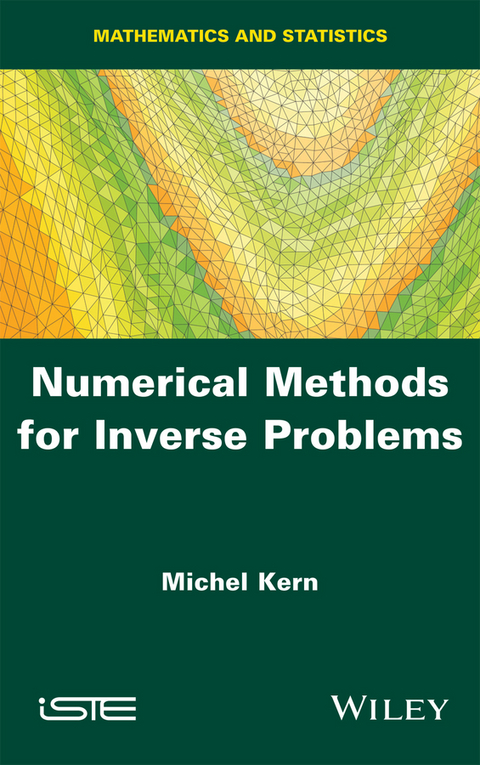
Numerical Methods for Inverse Problems (eBook)
240 Seiten
John Wiley & Sons (Verlag)
9781119136958 (ISBN)
The author uses practical examples to illustrate inverse problems in physical sciences. He presents the techniques and specific methods chosen to solve inverse problems in a general domain of application, choosing to focus on a small number of methods that can be used in most applications.
This book is aimed at readers with a mathematical and scientific computing background. Despite this, it is a book with a practical perspective. The methods described are applicable, have been applied, and are often illustrated by numerical examples.
Michel Kern is a research scientist in the Serena group at the Inria Research Center in Paris, France
Preface ix
Part 1. Introduction and Examples 1
Chapter 1. Overview of Inverse Problems 3
1.1. Direct and inverse problems 3
1.2. Well-posed and ill-posed problems 4
Chapter 2. Examples of Inverse Problems 9
2.1. Inverse problems in heat transfer 10
2.2. Inverse problems in hydrogeology 13
2.3. Inverse problems in seismic exploration 16
2.4. Medical imaging 21
2.5. Other examples 25
Part 2. Linear Inverse Problems 29
Chapter 3. Integral Operators and Integral Equations 31
3.1. Definition and first properties 31
3.2. Discretization of integral equations 36
3.2.1. Discretization by quadrature-collocation 36
3.2.2. Discretization by the Galerkin method 39
3.3. Exercises 42
Chapter 4. Linear Least Squares Problems - Singular Value Decomposition 45
4.1. Mathematical properties of least squares problems 45
4.1.1. Finite dimensional case 50
4.2. Singular value decomposition for matrices 52
4.3. Singular value expansion for compact operators 57
4.4. Applications of the SVD to least squares problems 60
4.4.1. The matrix case 60
4.4.2. The operator case 63
4.5. Exercises 65
Chapter 5. Regularization of Linear Inverse Problems 71
5.1. Tikhonov's method 72
5.1.1. Presentation 72
5.1.2. Convergence 73
5.1.3. The L-curve 81
5.2. Applications of the SVE 83
5.2.1. SVE and Tikhonov's method 84
5.2.2. Regularization by truncated SVE 85
5.3. Choice of the regularization parameter 88
5.3.1. Morozov's discrepancy principle 88
5.3.2. The L-curve 91
5.3.3. Numerical methods 92
5.4. Iterative methods 94
5.5. Exercises 98
Part 3. Nonlinear Inverse Problems 103
Chapter 6. Nonlinear Inverse Problems - Generalities 105
6.1. The three fundamental spaces 106
6.2. Least squares formulation 111
6.2.1. Difficulties of inverse problems 114
6.2.2. Optimization, parametrization, discretization 114
6.3. Methods for computing the gradient - the adjoint state method 116
6.3.1. The finite difference method 116
6.3.2. Sensitivity functions 118
6.3.3. The adjoint state method 119
6.3.4. Computation of the adjoint state by the Lagrangian 120
6.3.5. The inner product test 123
6.4. Parametrization and general organization 123
6.5. Exercises 125
Chapter 7. Some Parameter Estimation Examples 127
7.1. Elliptic equation in one dimension 127
7.1.1. Computation of the gradient 128
7.2. Stationary diffusion: elliptic equation in two dimensions 129
7.2.1. Computation of the gradient: application of the general method 132
7.2.2. Computation of the gradient by the Lagrangian 134
7.2.3. The inner product test 135
7.2.4. Multiscale parametrization 135
7.2.5. Example 136
7.3. Ordinary differential equations 137
7.3.1. An application example 144
7.4. Transient diffusion: heat equation 147
7.5. Exercises 152
Chapter 8. Further Information 155
8.1. Regularization in other norms 155
8.1.1. Sobolev semi-norms 155
8.1.2. Bounded variation regularization norm 157
8.2. Statistical approach: Bayesian inversion 157
8.2.1. Least squares and statistics 158
8.2.2. Bayesian inversion 160
8.3. Other topics 163
8.3.1. Theoretical aspects: identifiability 163
8.3.2. Algorithmic differentiation . 163
8.3.3. Iterative methods and large-scale problems 164
8.3.4. Software 164
Appendices 167
Appendix 1 169
Appendix 2 183
Appendix 3 193
Bibliography 205
Index 213
"The book is very carefully written, in a reader-friendly style. It can be considered
as an introductory textbook for the theory of ill-posed problems and their numerical
solution." (Mathematical Reviews/MathSciNet 11/05/2017)
| Erscheint lt. Verlag | 31.3.2016 |
|---|---|
| Sprache | englisch |
| Themenwelt | Mathematik / Informatik ► Mathematik ► Analysis |
| Technik | |
| Schlagworte | Applied Mathematics in Science • Mathematics • Mathematik • Mathematik in den Naturwissenschaften • Numerical Methods • numerische Methoden |
| ISBN-13 | 9781119136958 / 9781119136958 |
| Informationen gemäß Produktsicherheitsverordnung (GPSR) | |
| Haben Sie eine Frage zum Produkt? |
 PDF (Adobe DRM)
Kopierschutz: Adobe-DRM
Adobe-DRM ist ein Kopierschutz, der das eBook vor Mißbrauch schützen soll. Dabei wird das eBook bereits beim Download auf Ihre persönliche Adobe-ID autorisiert. Lesen können Sie das eBook dann nur auf den Geräten, welche ebenfalls auf Ihre Adobe-ID registriert sind.
Details zum Adobe-DRM
Dateiformat: PDF (Portable Document Format)
Mit einem festen Seitenlayout eignet sich die PDF besonders für Fachbücher mit Spalten, Tabellen und Abbildungen. Eine PDF kann auf fast allen Geräten angezeigt werden, ist aber für kleine Displays (Smartphone, eReader) nur eingeschränkt geeignet.
Systemvoraussetzungen:
PC/Mac: Mit einem PC oder Mac können Sie dieses eBook lesen. Sie benötigen eine
eReader: Dieses eBook kann mit (fast) allen eBook-Readern gelesen werden. Mit dem amazon-Kindle ist es aber nicht kompatibel.
Smartphone/Tablet: Egal ob Apple oder Android, dieses eBook können Sie lesen. Sie benötigen eine
Geräteliste und zusätzliche Hinweise
Buying eBooks from abroad
For tax law reasons we can sell eBooks just within Germany and Switzerland. Regrettably we cannot fulfill eBook-orders from other countries.
aus dem Bereich