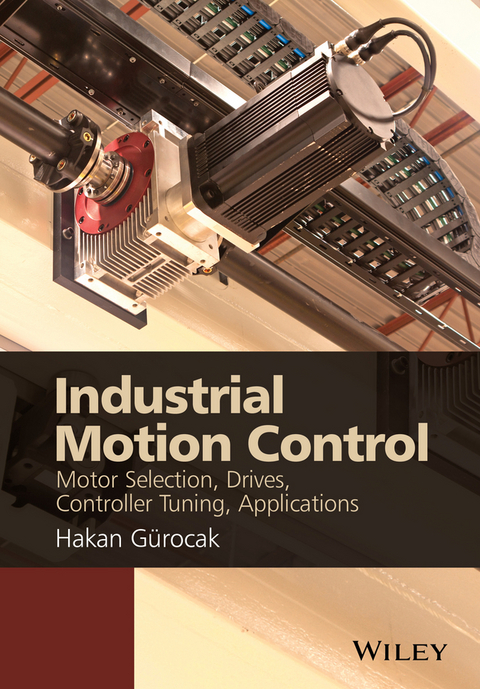
Industrial Motion Control (eBook)
John Wiley & Sons (Verlag)
978-1-118-40314-3 (ISBN)
Motion control is widely used in all types of industries including packaging, assembly, textile, paper, printing, food processing, wood products, machinery, electronics and semiconductor manufacturing. Industrial motion control applications use specialized equipment and require system design and integration. To design such systems, engineers need to be familiar with industrial motion control products; be able to bring together control theory, kinematics, dynamics, electronics, simulation, programming and machine design; apply interdisciplinary knowledge; and deal with practical application issues.
The book is intended to be an introduction to the topic for senior level undergraduate mechanical and electrical engineering students. It should also be resource for system design engineers, mechanical engineers, electrical engineers, project managers, industrial engineers, manufacturing engineers, product managers, field engineers, and programmers in industry.
Dr. Hakan Gürocak, Director, School of Engineering and Computer Science, Washington State University, Vancouver, USA
Hakan Gürocak is an active researcher in the areas of fuzzy logic, robotic precision assembly and haptic interfaces for virtual reality for over 19 years. He developed and has been offering the three mechatronics option courses at WSU Vancouver. With prior funding from NSF and Society of Manufacturing Engineers, he developed specialized hardware/software and curriculum for remote delivery of laboratory courses over the Internet in real-time. Dr Gurocak received the 2001 WSU Vancouver Faculty Research Excellence Award and the best paper awards in 2001 ASEE Conference in Manufacturing Division on remote delivery of laboratory courses, and in 2007 ASEE Mechanical Engineering Division on mechatronics education. Dr. Gürocak is an ABET Program Evaluator for mechanical engineering programs.
Dr. Hakan Gürocak, Director, School of Engineering and Computer Science, Washington State University, Vancouver, USA Hakan Gürocak is an active researcher in the areas of fuzzy logic, robotic precision assembly and haptic interfaces for virtual reality for over 19 years. He developed and has been offering the three mechatronics option courses at WSU Vancouver. With prior funding from NSF and Society of Manufacturing Engineers, he developed specialized hardware/software and curriculum for remote delivery of laboratory courses over the Internet in real-time. Dr Gurocak received the 2001 WSU Vancouver Faculty Research Excellence Award and the best paper awards in 2001 ASEE Conference in Manufacturing Division on remote delivery of laboratory courses, and in 2007 ASEE Mechanical Engineering Division on mechatronics education. Dr. Gürocak is an ABET Program Evaluator for mechanical engineering programs.
Preface
Over the past couple of decades, the academic community has made significant advances in developing educational materials and laboratory exercises for fundamental mechatronics and controls education. Students learn mathematical control theory, board-level electronics, interfacing, and microprocessors supplemented with educational laboratory equipment. As new mechanical and electrical engineering graduates become practicing engineers, many are engaged in projects where knowledge of industrial motion control technology is an absolute must since industrial automation is designed primarily around specialized motion control hardware and software.
This book is an introduction to industrial motion control, which is a widely used technology found in every conceivable industry. It is the heart of just about any automated machinery and process. Industrial motion control applications use specialized equipment and require system design and integration where control is just one aspect. To design such systems, engineers need to be familiar with industrial motion control products; be able to bring together control theory, kinematics, dynamics, electronics, simulation, programming and machine design; apply interdisciplinary knowledge; and deal with practical application issues. Most of these topics are already covered in engineering courses in typical undergraduate curricula but in a compartmentalized nature, which makes it difficult to grasp the connections between them.
As I wrote this book, my goal was to bring together theory, industrial machine design examples, industrial motion control products and practical guidelines. The context of studying industrial motion control systems naturally brought separately taught topics together and often crossed disciplinary lines. The content came from my personal experience in developing and teaching mechatronics and automation courses, working with undergraduate students and from many discussions with engineers in the motion control industry. For example, even though many types of motors are available, I chose to concentrate on three-phase AC servo and induction motors based on input from the motion control industry. By no means this is a comprehensive book on any of the topics covered. It is not an in-depth examination of control theory, motor design, or power electronics. Rather, it is a balanced coverage of theory and practical concepts. Much of this material is available in manufacturer data sheets, manuals, product catalogs, fragments in various college courses, websites, trade magazines, and as know-how among practicing engineers. The book presents these pieces in a cohesive way to provide the fundamentals while supplementing them with solved examples based on practical applications.
The book starts with an introduction to the building blocks of a typical motion control system in Chapter 1. A block diagram is provided and the basic function of each building block is explained.
Chapter 2 examines how the motion profile is generated when an axis of a machine makes a move. After an overview of basic kinematics, two common motion profiles are explained. The chapter concludes with two approaches for multiaxis coordination.
As the mechanical design of each axis and the overall machine are significant factors in achieving the desired motion, Chapter 3 focuses on drive-train design. Concepts of inertia reflection, torque reflection, and inertia ratio are introduced. Five types of transmission mechanisms are explored in depth. Torque–speed curves of motors, gearboxes, and motor selection procedures for different types of motors and axes with transmission mechanisms are provided.
Electric motors are by far the most commonly used actuators in industrial motion control. Chapter 4 begins with fundamental concepts such as electrical cycle, mechanical cycle, poles, and three-phase windings. Construction and operational details of AC servo and induction motors are provided. Torque generation performance of AC servo motors with sinusoidal and six-step commutation is compared. The chapter concludes with mathematical and simulation models for both types of motors.
Motion control systems employ an assortment of sensors and control components along with the motion controller. Chapter 5 starts with the presentation of various types of optical encoders for position measurement, limit switches, proximity sensors, photoelectric sensors, and ultrasonic sensors. Sinking or sourcing designations for sensor compatibility to I/O cards are explained. Next, control devices including push buttons, selector switches, and indicator lights are presented. The chapter concludes with an overview of motor starters, contactors, overload relays, soft-starters, and a three-wire motor control circuit.
A drive is the link between the motor and the controller. It amplifies small command signals generated by the controller to high-power voltage and current levels necessary to operate a motor. Chapter 6 begins by presenting the building blocks of drive electronics. The popular pulse width modulation (PWM) control technique is explained. Then, basic closed-loop control structures implemented in the drive are introduced. Single-loop PID position control and cascaded velocity and position loops with feedforward control are explored in depth. Mathematical and simulation models of the controllers are provided. Control algorithms use gains that must be tuned so that the servo system for each axis can follow its commanded trajectory as closely as possible. The chapter concludes by providing tuning procedures for the control algorithms presented earlier and includes practical ways to address integrator saturation.
The book concludes with Chapter 7, which is about programming and motion control applications. Linear, circular, and contour move modes of a motion controller are explored. The chapter continues by introducing algorithms for basic programmable logic controller (PLC) functionality that are commonly used in motioncontroller programs. The chapter concludes by reviewing how a motion controller can control a non-Cartesian machine, such as a robot, by computing its forward and inverse kinematics in real-time.
One of the challenges in writing a book like this is the variety of motion controller hardware and software in the market and their proprietary nature. Each controller manufacturer has its own programming language and programming environment for their products. Since the programming details are very specific to each hardware, I attempted to provide algorithmic outlines rather than complete programs in a specific programming language or structure. The product manuals and manufacturer suggestions must be closely followed in adapting these algorithms to a specific choice of motion controller hardware. Another challenge was the digital control systems implemented in the controllers. These sampled data systems would be modeled using the -transform (-domain). However, almost all undergraduate engineering programs include only coverage of the continuous-time systems modeled using the Laplace transform (-domain). Therefore, I chose to use the -domain in presenting the control system models. This approach provides a good approximation since today's controllers have very fast sampling frequencies and the mechanical systems they control have relatively slow dynamics.
As I presented concepts, especially for the solved drive-train examples, I used data for industrial products from datasheets and catalogs. Today, most of these resources are available on the Internet as provided in the references of the chapters. Over time, manufacturers will change their products and these catalogs may not be available anymore. However, the theoretical coverage and the practical selection procedures should equally apply to the similar, newer future products.
This book is intended to be an introduction to the topic for undergraduate mechanical and electrical engineering students. Since many practicing engineers are involved in motion control systems, it should also be a resource for system design engineers, project managers, industrial engineers, manufacturing engineers, product managers, field engineers, mechanical engineers, electrical engineers, and programmers in the industry. For example, the tuning procedures in Chapter 4 were demonstrated using mathematical simulations. But if a real system with a motion controller is available, then these procedures can simply be used to tune the controller of the real system without the need for any of the simulations. Similarly, Chapter 7 provides algorithms for common types of motion control applications such as winding. These algorithms can be a starting point to develop the control programs in the programming language of the real system. As stated earlier, the product manuals and manufacturer suggestions must be closely followed in adapting these algorithms to a specific choice of real motion controller hardware.
I am indebted to many people who helped me through the journey of writing this book. Many thanks to Mr. Ken Brown, President of Applied Motion Systems, Inc., Mr. Ed Diehl, President of Concept Systems, Inc., for our discussions about motion control systems, for the valuable suggestions and materials they provided. Specialthanks goes to Mr. Dimitri Dimitri, President of Delta Tau Data Systems, Inc., and Mr. Curtis Wilson, Vice President of Engineering and Research at Delta Tau Data Systems, Inc. for their contributions to our laboratory, to this book and for their in-depth technical guidance. I would also like to acknowledge the contributions by Mr. Dean Ehnes, Mechanical Engineer, Mr. John Tollefson, Electrical Engineer, and Mr. Brian Hutton, General...
| Erscheint lt. Verlag | 14.3.2016 |
|---|---|
| Sprache | englisch |
| Themenwelt | Informatik ► Weitere Themen ► CAD-Programme |
| Technik ► Elektrotechnik / Energietechnik | |
| Technik ► Maschinenbau | |
| Schlagworte | Control Systems Technology • Electrical & Electronics Engineering • Elektrotechnik u. Elektronik • Industrial Engineering • industrial<br />motion control<br />mechatronics • Industrielle Verfahrenstechnik • Maschinenbau • Maschinenbau - Entwurf • mechanical engineering • Mechanical Engineering - Design • Regelungstechnik |
| ISBN-10 | 1-118-40314-2 / 1118403142 |
| ISBN-13 | 978-1-118-40314-3 / 9781118403143 |
| Informationen gemäß Produktsicherheitsverordnung (GPSR) | |
| Haben Sie eine Frage zum Produkt? |
 EPUB (Adobe DRM)
Kopierschutz: Adobe-DRM
Adobe-DRM ist ein Kopierschutz, der das eBook vor Mißbrauch schützen soll. Dabei wird das eBook bereits beim Download auf Ihre persönliche Adobe-ID autorisiert. Lesen können Sie das eBook dann nur auf den Geräten, welche ebenfalls auf Ihre Adobe-ID registriert sind.
Details zum Adobe-DRM
Dateiformat: EPUB (Electronic Publication)
EPUB ist ein offener Standard für eBooks und eignet sich besonders zur Darstellung von Belletristik und Sachbüchern. Der Fließtext wird dynamisch an die Display- und Schriftgröße angepasst. Auch für mobile Lesegeräte ist EPUB daher gut geeignet.
Systemvoraussetzungen:
PC/Mac: Mit einem PC oder Mac können Sie dieses eBook lesen. Sie benötigen eine
eReader: Dieses eBook kann mit (fast) allen eBook-Readern gelesen werden. Mit dem amazon-Kindle ist es aber nicht kompatibel.
Smartphone/Tablet: Egal ob Apple oder Android, dieses eBook können Sie lesen. Sie benötigen eine
Geräteliste und zusätzliche Hinweise
Buying eBooks from abroad
For tax law reasons we can sell eBooks just within Germany and Switzerland. Regrettably we cannot fulfill eBook-orders from other countries.
aus dem Bereich