


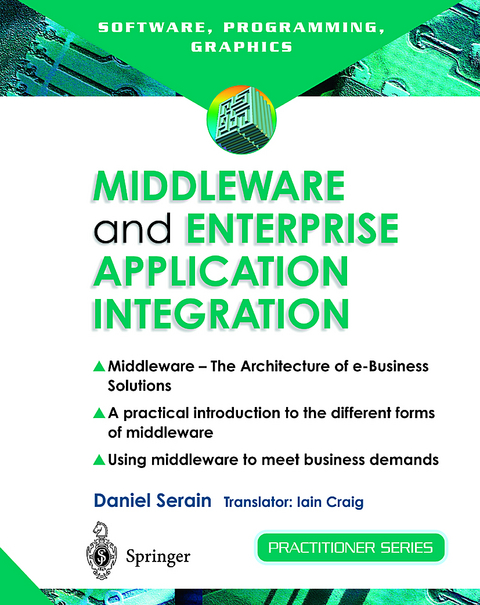
Middleware and Enterprise Application Integration
Springer London Ltd (Verlag)
978-1-85233-570-0 (ISBN)
- Titel ist leider vergriffen;
keine Neuauflage - Artikel merken
-Contributes to the diffusion and understanding of the importance of the role of middleware in the design of complex information systems. -Relevant text for courses on Information Technology applied to Business Management. -The first edition of this title was a bestseller.
1. Overview of Enterprise Application Integration.- 1.1 Problems to Solve.- 1.2 Application Integration: Semantic Level and System Level.- 1.3 Different Sorts of Middleware.- 1.4 Middleware and e-Business Architectures.- 1.5 Object-oriented Modelling for Constructing Architectures.- 1.6 Conclusion.- 2. RPC-based Middleware.- 2.1 The Client-Server Model.- 2.2 Client-Server and Procedure Call.- 2.3 Principles of the Remote Procedure Call Architecture.- 2.4 Concept of Contract Between Client and Server.- 2.5 Structure of Communication.- 2.6 The Standard.- 3. CORBA: Standard Object-based Middleware.- 3.1 Introduction.- 3.2 The CORBA Conceptual Model.- 3.3 The CORBA Architecture.- 3.4 The CORBA 2.0 Standard.- 3.5 Object Services.- 3.6 The CORBA 3.0 Standard.- 4. OLE/COM: Object-based Middleware from Microsoft.- 4.1 Introduction.- 4.2 The COM Object Model.- 4.3 OLE2.- 4.4 The DCOM Model.- 4.5 Microsoft Transaction Server (MTS).- 5. Comparison Between CORBA and OLE/COM.- 5.1 Introduction.- 5.2 Code Reuse: Inheritance and Aggregation.- 5.3 Composite Document Handling: OLE2 (COM) and OpenDoc (CORBA).- 5.4 Bridge Between CORBA and DCOM.- 5.5 Summary Table.- 6. Java RMI and Java Beans.- 6.1 The Java Language.- 6.2 Distributed Processing According to Java.- 6.3 Internet: Downloading and Execution of Applets.- 6.4 Remote Method Call: Java RMI.- 6.5 Component-based Software: Java Beans and ActiveX.- 7. Message-based Middleware.- 7.1 Introduction.- 7.2 Principal Functions.- 7.3 Evaluation of the Principal Products.- 8. Introduction to the Internet.- 8.1 The Network of Networks.- 8.2 Definition of the Principal Terms.- 8.3 The World Wide Web.- 9. e-Business Architectures.- 9.1 Information Publication on the Web.- 9.2 Interaction with an Enterprise Server.- 9.3 Transactions with an Application Server.- 9.4 Integrating the Application Server with the Back-office.- 9.5 B2B Example: Marketplaces.- 10. Conclusion.- 10.1 Choose Your Middleware.- 10.2 The Complete Approach: From Business Needs to Middleware Infrastructure.- Appendix A: Introduction to Object Technology.- A.1 The Concept of an Object.- A.2 Principal Characteristics of Object Technology.- Appendix B: MethodF”: A Method for Object-oriented Analysis and Design.- B.1 Introduction.- B.2 Specification Phase.- B.3 Analysis Phase.- B.4 Design Phase.- B.5 Implementation Phase.- B.6 Summary of MethodF’s Principal Steps.- Appendix C: Glossary.- Bibliography/Cybography.
| Erscheint lt. Verlag | 5.8.2002 |
|---|---|
| Reihe/Serie | Practitioner Series |
| Übersetzer | I. Craig |
| Zusatzinfo | 165 Illustrations, black and white; XII, 288 p. 165 illus. |
| Verlagsort | England |
| Sprache | englisch |
| Maße | 170 x 242 mm |
| Gewicht | 1540 g |
| Themenwelt | Mathematik / Informatik ► Informatik ► Netzwerke |
| Mathematik / Informatik ► Informatik ► Web / Internet | |
| ISBN-10 | 1-85233-570-X / 185233570X |
| ISBN-13 | 978-1-85233-570-0 / 9781852335700 |
| Zustand | Neuware |
| Informationen gemäß Produktsicherheitsverordnung (GPSR) | |
| Haben Sie eine Frage zum Produkt? |
aus dem Bereich


