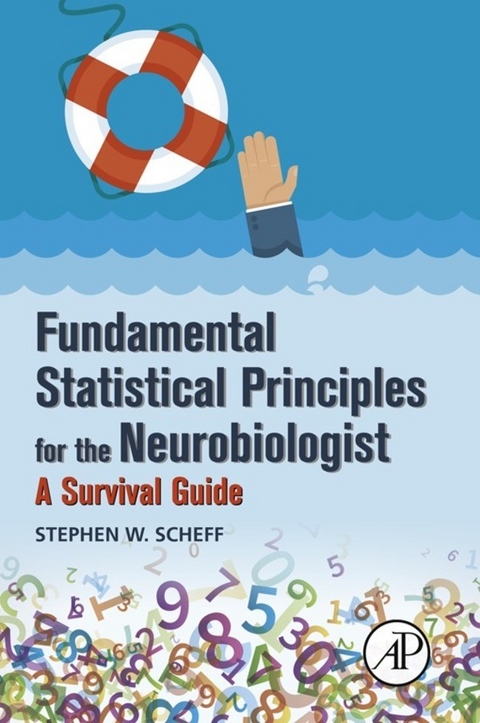
Fundamental Statistical Principles for the Neurobiologist (eBook)
234 Seiten
Elsevier Science (Verlag)
978-0-12-805051-4 (ISBN)
Stephen W. Scheff, Ph.D. is currently the Associate Director of the Sanders-Brown Center on Aging and a Professor in the Department of Anatomy & Neurobiology at the University of Kentucky. He graduated from Washington University in St. Louis with a degree in psychology and attained both a MA and Ph.D. in physiological psychology from the University of Missouri in Columbia, MO. He spent 6 years as a postdoctoral fellow/ staff scientist at the University of California - Irvine in the Department of Psychobiology. The author has been a member of the Society for Neuroscience since 1974 and a member of the Neurotrauma Society for over 10 years. He has served on numerous NIH study sections and DOD review panels. Dr. Scheff has worked in the fields of neuroplasticity, neurotrauma, and neurodegenerative diseases for the past 45 years and has published using a wide variety of techniques including behavior, neurophysiology, neuroanatomy, cell and molecular signaling and neurochemistry. He has taught human brain anatomy in the College of Medicine for more than 35 years and has trained numerous graduate students and postdoctoral fellows in the art of experimental design and statistics.
Fundamental Statistical Principles for Neurobiologists introduces readers to basic experimental design and statistical thinking in a comprehensive, relevant manner. This book is an introductory statistics book that covers fundamental principles written by a neuroscientist who understands the plight of the neuroscience graduate student and the senior investigator. It summarizes the fundamental concepts associated with statistical analysis that are useful for the neuroscientist, and provides understanding of a particular test in language that is more understandable to this specific audience, with the overall purpose of explaining which statistical technique should be used in which situation. Different types of data are discussed such as how to formulate a research hypothesis, the primary types of statistical errors and statistical power, followed by how to actually graph data and what kinds of mistakes to avoid. Chapters discuss variance, standard deviation, standard error, mean, confidence intervals, correlation, regression, parametric vs. nonparametric statistical tests, ANOVA, and post hoc analyses. Finally, there is a discussion on how to deal with data points that appear to be "e;outliers"e; and what to do when there is missing data, an issue that has not sufficiently been covered in literature. - An introductory guide to statistics aimed specifically at the neuroscience audience- Contains numerous examples with actual data that is used in the analysis- Gives the investigators a starting pointing for evaluating data in easy-to-understand language- Explains in detail many different statistical tests commonly used by neuroscientists
| Erscheint lt. Verlag | 11.2.2016 |
|---|---|
| Sprache | englisch |
| Themenwelt | Mathematik / Informatik ► Mathematik ► Statistik |
| Medizin / Pharmazie ► Medizinische Fachgebiete ► Neurologie | |
| Naturwissenschaften ► Biologie ► Humanbiologie | |
| Naturwissenschaften ► Biologie ► Zoologie | |
| Technik | |
| ISBN-10 | 0-12-805051-9 / 0128050519 |
| ISBN-13 | 978-0-12-805051-4 / 9780128050514 |
| Informationen gemäß Produktsicherheitsverordnung (GPSR) | |
| Haben Sie eine Frage zum Produkt? |
 EPUB (Adobe DRM)
Kopierschutz: Adobe-DRM
Adobe-DRM ist ein Kopierschutz, der das eBook vor Mißbrauch schützen soll. Dabei wird das eBook bereits beim Download auf Ihre persönliche Adobe-ID autorisiert. Lesen können Sie das eBook dann nur auf den Geräten, welche ebenfalls auf Ihre Adobe-ID registriert sind.
Details zum Adobe-DRM
Dateiformat: EPUB (Electronic Publication)
EPUB ist ein offener Standard für eBooks und eignet sich besonders zur Darstellung von Belletristik und Sachbüchern. Der Fließtext wird dynamisch an die Display- und Schriftgröße angepasst. Auch für mobile Lesegeräte ist EPUB daher gut geeignet.
Systemvoraussetzungen:
PC/Mac: Mit einem PC oder Mac können Sie dieses eBook lesen. Sie benötigen eine
eReader: Dieses eBook kann mit (fast) allen eBook-Readern gelesen werden. Mit dem amazon-Kindle ist es aber nicht kompatibel.
Smartphone/Tablet: Egal ob Apple oder Android, dieses eBook können Sie lesen. Sie benötigen eine
Geräteliste und zusätzliche Hinweise
Buying eBooks from abroad
For tax law reasons we can sell eBooks just within Germany and Switzerland. Regrettably we cannot fulfill eBook-orders from other countries.
aus dem Bereich