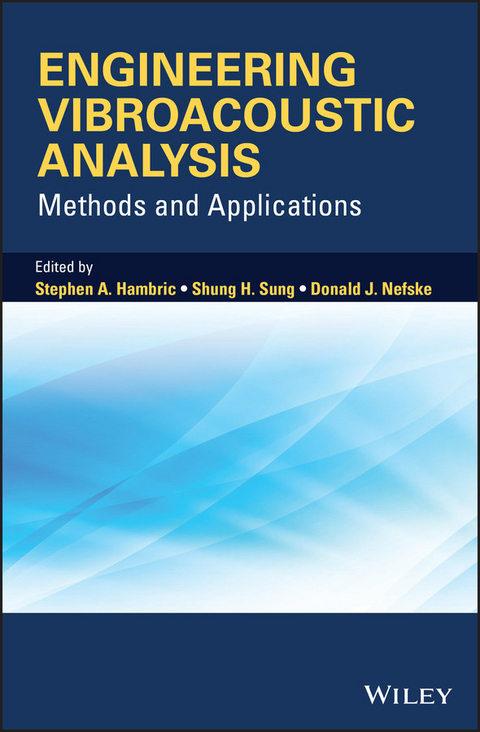
Engineering Vibroacoustic Analysis (eBook)
John Wiley & Sons (Verlag)
978-1-118-69401-5 (ISBN)
Edited by Stephen A. Hambric Center for Acoustics & Vibration, Pennsylvania State University, State College, Pennsylvania, USA Shung H. Sung Consultant, Troy, Michigan, USA Donald J. Nefske Consultant, Troy, Michigan, USA
1
Overview
Stephen A. Hambric1, Shung H. Sung2 and Donald J. Nefske2
1 Pennsylvania State University, University Park, PA, USA
2 Consultant, Troy, MI, USA
1.1 Introduction
Structural vibrations couple with interior and exterior acoustic fields to produce sound. A vibrating structure generates sound waves in an acoustic field, and conversely, the acoustic pressure affects the structural vibration, along with stresses that may degrade structural integrity. Computational methods for solving vibration and sound problems have been an ongoing development since the early 1960s when digital computers became available. Using computers, complicated analytical formulas that were available to represent structural and acoustic solutions were then able to be solved numerically.
For complicated geometrical systems, the finite element (FE) method was developed, where any shape, source, or boundary condition could be discretized. Structural and acoustic regions may be assembled to capture waveforms and their interactions, while various boundary conditions and forcing functions are generally applied. While the FE method is commonly used to solve interior structural-acoustic problems, the boundary element (BE) method was subsequently developed, which is more suitable for solving exterior structural-acoustic problems, although it is also often used for interior acoustics.
While the FE and BE methods are generally applicable in the low-frequency range, other methods were developed that depend on the frequency range of interest and the level of uncertainty of the structural-acoustic system. These methods include statistical energy analysis (SEA), which was the first such method that was developed for application in the high-frequency range to obtain approximate and statistically relevant solutions. Subsequently, transfer path analysis (TPA), energy FE analysis (EFEA), wave-based structural modeling, among others, have been developed to solve a wide range of structural-acoustic problems [1–3].
This book describes the vibroacoustic methods that are commonly used for predicting the structural and acoustic response in sound–structure interaction applications in transportation vehicles and other mechanical systems. Section 1.2 gives an overview of the traditional FE, BE, and SEA vibroacoustic methods. Section 1.3 gives an overview of the alternative newer methods, hybrid FE/SEA, hybrid TPA, EFEA, and wave-based structural modeling, that have been developed. The modeling, computational, and application considerations for choosing the different methods are then described in Section 1.4, followed by an outline of the book organization in Section 1.5.
1.2 Traditional Vibroacoustic Methods
1.2.1 Finite Element Method
The FE method has been and remains the most popular numerical modeling approach. While the FE method was originally developed to simulate static deformation and stress, it was subsequently extended to model structural vibration by including mass and damping effects. The FE modeling approach was then extended to model sound waves in acoustic enclosures and the structural-acoustic interaction with vibrating structures. It is thereby applicable to solve for the structural and acoustic responses in coupled structural-acoustic systems.
The FE method has also been developed for heavy fluid–structure interaction problems in the nuclear industry and nonlinear structural-acoustic interactions in unbounded acoustic domains such as in underwater acoustics applications. Besides sound pressure response prediction in air, structural-acoustic interaction has been analyzed for acoustic pressure loading effects on structures. This interaction is especially evident in aircraft fuselage designs that sustain intense pressure pulsations during launch or repetitive turbulence pressure loading on the fuselage surface. Similarly, structural-acoustic interaction effects have been assessed for nuclear reactor designs to ensure fatigue design criteria over long lifetimes (30–50 years). More recently, structural-acoustic interactions on medical devices have drawn increased interest.
The FE method was initially implemented in the later 1970s for structural-acoustic analysis of transportation vehicle interiors, such as automobiles, aircrafts, heavy trucks, and so on. With advanced software development for modeling and solving complicated structural systems, the FE method is now commonly used in transportation vehicle interior noise analysis and design. In these applications, the FE solution is generally obtained using the normal-mode synthesis method to predict the coupled structural-acoustic response. This modal approach involves significantly fewer degrees of freedom as compared with the direct solution method and is, therefore, more computationally efficient.
In acoustic noise control, impedance boundary conditions or acoustic interior absorption materials can be modeled using the FE method. Measured material behavior or a model representation of the material is required to represent these in the FE model. Recently, the structural-acoustic wave interaction in multimedia has drawn significant interest in geoacoustics, metamaterials, electroacoustics, and medical acoustics. To solve the highly nonlinear nature of some problems, the FE method is deemed a necessary tool. Finally, developing efficient solution methods to solve large complex problems continues to be a challenging and ongoing research area.
This book mainly covers linear structural-acoustic applications in transportation vehicles and mechanical systems, although as indicated earlier there are a wide range of other structural-acoustic applications using the FE method.
1.2.2 Boundary Element Method
Instead of discretizing a mesh throughout a volume as in the FE method, the BE method decomposes the solution in the integral form only at the boundary of an acoustic region. For exterior acoustics, the traditional FE method is not usually suitable to solve radiation and scattering problems involving an unbounded region. Instead, boundary integral approaches are more direct and straightforward for such problems.
For an unbounded acoustic region in exterior acoustics, the basic solution to the acoustic wave equation that satisfies the Sommerfeld radiation boundary condition of an infinite region is the free-space acoustic Green’s function. By applying the divergence theorem to the acoustic wave equation, the solution can be obtained in the form of the Helmholtz boundary integral equation or the Rayleigh boundary integral equation, which are then discretized using the BE formulation.
The acoustic BE method is also commonly applied to interior acoustics for predicting the sound pressure response resulting from structural vibrations, when the structural-acoustic interaction effect on the response can be neglected. Compared to the use of an FE model of an acoustic region, as in large interior enclosures or unbounded acoustic media, a BE model involves a much smaller mesh as only the boundary is discretized with elements. However, a computational penalty is required to solve the resulting complex fully populated matrices.
1.2.3 Statistical Energy Analysis
While many problems may be solved using simple modal summations computed by the FE method, others may be impractical due to significant number of elements or modes required. For very large structures, like aircraft or ships, it may not be possible to generate very finely meshed FE or BE models unless some form of component reduction method is employed. Even for smaller problems, FE and BE models are also impractical at high frequencies when dense meshes are needed. This is because traditional discretization techniques like FE and BE must subdivide models to the point that all structural and acoustic wavelengths are captured properly over all frequencies of interest. The most commonly cited criterion for this is to ensure at least six to eight subdivisions, or elements, represent each wavelength.
Based on the physics of high-frequency response, approximate methods have been developed which are not based on subdividing structures into small elements, but instead generalize groups of energy or waves that subdivide structural or acoustic regions into subsets. Instead of solving for the sound pressure and vibration response everywhere in a subset, a mean value of the energy response is obtained, from which spatially averaged pressure or vibration responses are calculated. The prevailing method that emerged from these developments is SEA. Instead of modeling vibration or sound directly, SEA tracks the flow of energy between groups of interconnected subsystem modes.
Here, the modal density (number of modes/frequency band) is the important parameter, with subsystems that are modally rich enjoying most of the vibroacoustic energy. Also, more modes in a subsystem result in less variation in the subsystem response. In this case, a mean energy estimate is quite accurate over the full region of the structure or acoustic subsystem, with only minor variations about that mean. As modal density increases with frequency, therefore SEA is most useful at high frequencies. At lower frequencies, however, variability about the mean response is much greater, and SEA is not as useful, particularly when an analyst is most interested in extreme response values at a particular location of interest or from a particular resonant...
| Erscheint lt. Verlag | 18.2.2016 |
|---|---|
| Sprache | englisch |
| Themenwelt | Informatik ► Weitere Themen ► CAD-Programme |
| Technik ► Maschinenbau | |
| Schlagworte | acoustics • Aeronautic & Aerospace Engineering • automotive engineering • Boundary Element • Fahrzeugtechnik • Finite Element • <p>Vibro-acoustic • Luft- u. Raumfahrttechnik • Maschinenbau • Maschinenbau - Entwurf • mechanical engineering • Mechanical Engineering - Design • noise control • power flow</p> • statistical energy • structural-acoustic • transfer path • Vibration |
| ISBN-10 | 1-118-69401-5 / 1118694015 |
| ISBN-13 | 978-1-118-69401-5 / 9781118694015 |
| Informationen gemäß Produktsicherheitsverordnung (GPSR) | |
| Haben Sie eine Frage zum Produkt? |
 EPUB (Adobe DRM)
Kopierschutz: Adobe-DRM
Adobe-DRM ist ein Kopierschutz, der das eBook vor Mißbrauch schützen soll. Dabei wird das eBook bereits beim Download auf Ihre persönliche Adobe-ID autorisiert. Lesen können Sie das eBook dann nur auf den Geräten, welche ebenfalls auf Ihre Adobe-ID registriert sind.
Details zum Adobe-DRM
Dateiformat: EPUB (Electronic Publication)
EPUB ist ein offener Standard für eBooks und eignet sich besonders zur Darstellung von Belletristik und Sachbüchern. Der Fließtext wird dynamisch an die Display- und Schriftgröße angepasst. Auch für mobile Lesegeräte ist EPUB daher gut geeignet.
Systemvoraussetzungen:
PC/Mac: Mit einem PC oder Mac können Sie dieses eBook lesen. Sie benötigen eine
eReader: Dieses eBook kann mit (fast) allen eBook-Readern gelesen werden. Mit dem amazon-Kindle ist es aber nicht kompatibel.
Smartphone/Tablet: Egal ob Apple oder Android, dieses eBook können Sie lesen. Sie benötigen eine
Geräteliste und zusätzliche Hinweise
Buying eBooks from abroad
For tax law reasons we can sell eBooks just within Germany and Switzerland. Regrettably we cannot fulfill eBook-orders from other countries.
aus dem Bereich