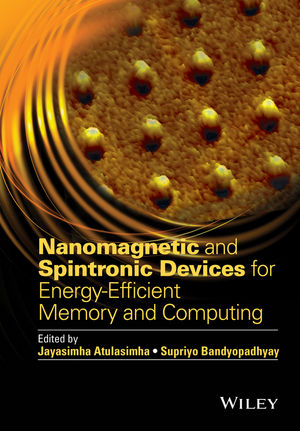
Nanomagnetic and Spintronic Devices for Energy-Efficient Memory and Computing (eBook)
John Wiley & Sons (Verlag)
978-1-118-86924-6 (ISBN)
Nanomagnetic and spintronic computing devices are strong contenders for future replacements of CMOS. This is an important and rapidly evolving area with the semiconductor industry investing significantly in the study of nanomagnetic phenomena and in developing strategies to pinpoint and regulate nanomagnetic reliably with a high degree of energy efficiency. This timely book explores the recent and on-going research into nanomagnetic-based technology.
Key features:
- Detailed background material and comprehensive descriptions of the current state-of-the-art research on each topic.
- Focuses on direct applications to devices that have potential to replace CMOS devices for computing applications such as memory, logic and higher order information processing.
- Discusses spin-based devices where the spin degree of freedom of charge carriers are exploited for device operation and ultimately information processing.
- Describes magnet switching methodologies to minimize energy dissipation.
- Comprehensive bibliographies included for each chapter enabling readers to conduct further research in this field.
Written by internationally recognized experts, this book provides an overview of a rapidly burgeoning field for electronic device engineers, field-based applied physicists, material scientists and nanotechnologists. Furthermore, its clear and concise form equips readers with the basic understanding required to comprehend the present stage of development and to be able to contribute to future development. Nanomagnetic and Spintronic Devices for Energy-Efficient Memory and Computing is also an indispensable resource for students and researchers interested in computer hardware, device physics and circuits design.
Professor Supriyo Bandyopadhyay, Virginia Commonwealth University, Virginia, USA
Supriyo Bandyopadhyay is Commonwealth Professor of Electrical and Computer Engineering at Virginia Commonwealth University where he directs the Quantum Device Laboratory. Prof. Bandyopadhyay has authored and co-authored over 300 research publications and he is currently a member of the editorial board of seven international journals. He is the current Chair of the Institute of Electrical and Electronics Engineers (IEEE) Technical Committee on Spintronics (Nanotechnology Council), and past-chair of the Technical Committee on Compound Semiconductor Devices and Circuits (Electron Device Society). He has been an IEEE Electron Device Society Distinguished Lecturer and served as a Vice President of the IEEE Nanotechnology Council. Prof. Bandyopadhyay is a Fellow of the Institute of Electrical and Electronics Engineers, the Institute of Physics, American Physical Society, the Electrochemical Society and the American Association for the Advancement of Science.
Professor Jayasimha Atulasimha, Virginia Commonwealth University, Virginia, USA
Jayasimha Atulasimha is Qimonda Associate Professor of Mechanical and Nuclear Engineering with a courtesy appointment in Electrical and Computer Engineering at the Virginia Commonwealth University, where he directs the Magnetism, Magnetic Materials and Magnetic Devices (M3) laboratory. He has authored or coauthored over 60 scientific articles including more than 40 journal publications on magnetostrictive materials, magnetization dynamics, and nanomagnetic computing and has given several invited talks at conferences, workshops and universities in the USA and abroad on these topics. His research interests include nanomagnetism, spintronics, magnetostrictive materials and nanomagnet-based computing devices. He received the NSF CAREER Award for
2013-2018. He currently serves on the Technical Committees for Spintronics, IEEE Nanotechnology Council, ASME Adaptive Structures and Material Systems, Device Research Conference (DRC), and as a Focus Topic organizer for the APS topical group on magnetism (GMAG). He is a member of ASME, APS and an IEEE Senior Member.
Nanomagnetic and spintronic computing devices are strong contenders for future replacements of CMOS. This is an important and rapidly evolving area with the semiconductor industry investing significantly in the study of nanomagnetic phenomena and in developing strategies to pinpoint and regulate nanomagnetic reliably with a high degree of energy efficiency. This timely book explores the recent and on-going research into nanomagnetic-based technology. Key features: Detailed background material and comprehensive descriptions of the current state-of-the-art research on each topic. Focuses on direct applications to devices that have potential to replace CMOS devices for computing applications such as memory, logic and higher order information processing. Discusses spin-based devices where the spin degree of freedom of charge carriers are exploited for device operation and ultimately information processing. Describes magnet switching methodologies to minimize energy dissipation. Comprehensive bibliographies included for each chapter enabling readers to conduct further research in this field. Written by internationally recognized experts, this book provides an overview of a rapidly burgeoning field for electronic device engineers, field-based applied physicists, material scientists and nanotechnologists. Furthermore, its clear and concise form equips readers with the basic understanding required to comprehend the present stage of development and to be able to contribute to future development. Nanomagnetic and Spintronic Devices for Energy-Efficient Memory and Computing is also an indispensable resource for students and researchers interested in computer hardware, device physics and circuits design.
Professor Supriyo Bandyopadhyay, Virginia Commonwealth University, Virginia, USA Supriyo Bandyopadhyay is Commonwealth Professor of Electrical and Computer Engineering at Virginia Commonwealth University where he directs the Quantum Device Laboratory. Prof. Bandyopadhyay has authored and co-authored over 300 research publications and he is currently a member of the editorial board of seven international journals. He is the current Chair of the Institute of Electrical and Electronics Engineers (IEEE) Technical Committee on Spintronics (Nanotechnology Council), and past-chair of the Technical Committee on Compound Semiconductor Devices and Circuits (Electron Device Society). He has been an IEEE Electron Device Society Distinguished Lecturer and served as a Vice President of the IEEE Nanotechnology Council. Prof. Bandyopadhyay is a Fellow of the Institute of Electrical and Electronics Engineers, the Institute of Physics, American Physical Society, the Electrochemical Society and the American Association for the Advancement of Science. Professor Jayasimha Atulasimha, Virginia Commonwealth University, Virginia, USA Jayasimha Atulasimha is Qimonda Associate Professor of Mechanical and Nuclear Engineering with a courtesy appointment in Electrical and Computer Engineering at the Virginia Commonwealth University, where he directs the Magnetism, Magnetic Materials and Magnetic Devices (M³) laboratory. He has authored or coauthored over 60 scientific articles including more than 40 journal publications on magnetostrictive materials, magnetization dynamics, and nanomagnetic computing and has given several invited talks at conferences, workshops and universities in the USA and abroad on these topics. His research interests include nanomagnetism, spintronics, magnetostrictive materials and nanomagnet-based computing devices. He received the NSF CAREER Award for 2013-2018. He currently serves on the Technical Committees for Spintronics, IEEE Nanotechnology Council, ASME Adaptive Structures and Material Systems, Device Research Conference (DRC), and as a Focus Topic organizer for the APS topical group on magnetism (GMAG). He is a member of ASME, APS and an IEEE Senior Member.
CHAPTER 1
Introduction to Spintronic and Nanomagnetic Computing Devices
Jayasimha Atulasimha1 and Supriyo Bandyopadhyay2
1Department of Mechanical and Nuclear Engineering, Virginia Commonwealth University, Richmond, VA, US
2Department of Electrical and Computer Engineering, Virginia Commonwealth University, Richmond, VA, USA
This book focuses on recent developments in two important and interrelated information processing device concepts and related phenomena: “spintronic devices” and “nanomagnetic devices.” In the former, individual electron spins are coherently manipulated as they flow through the active region of a device to elicit device functionality. In the latter, an ensemble of spins in a nanostructure acts collectively as a giant classical spin (a single domain nanomagnet) owing to mutual exchange coupling, and the giant spin polarization (or the magnetization of the nanomagnet) is switched between stable orientations to store and/or process binary data. These information processing paradigms have attracted attention because of their low energy dissipation, nonvolatility and relatively fast speed of operation.
1.1 Spintronic Devices
An iconic device in the field of spintronics is the Datta-Das [1] Spin Field Effect Transistor (SPINFET) in which the current flowing between two of the terminals (source and drain) is modulated with a gate potential that does not change the carrier concentration in the channel of the transistor, but instead changes the spin polarization of the carriers. The source and drain contacts are ferromagnets that act as spin polarizers and analyzers. The source injects spin polarized electrons, the gate voltage precesses the spins in the channel owing to Rashba spin–orbit interaction [2] and the drain selectively transmits electrons depending on the degree of precession they have undergone in the channel. Thus, by varying the gate voltage, one can vary the source-to-drain current and realize transistor action. The operation of the transistor is briefly explained in Figure 1.1.
Figure 1.1 Operation of a Datta-Das SPINFET. The source injects spin polarized electrons, polarized in the direction of source-to-drain current (x-direction). When the gate voltage is zero, the spins do not precess and are fully transmitted by the drain resulting in maximum (on) current. When the gate voltage is turned on, it produces an electric field Ey in the y-direction due to Rashba spin-orbit interaction that results in an effective magnetic field of flux density Bz in the z-direction. This field causes the electrons to precess about itself. The left panel shows a one-dimensional SPINFET and the right panel a two-dimensional SPINFET.
There are several impediments to practical room temperature implementation of the Datta-Das SPINFET. Foremost among them is the inefficiency of the spin polarizer and analyzer. The inability of ferromagnet/semiconductor interfaces to inject and detect spins with high efficiency results in low on–off ratios of the drain current [3]. The on–off ratio is also reduced significantly if the channel of the SPINFET is not strictly one-dimensional [4], that is, if it is not a quantum wire with only the lowest carrier subband occupied. Finally, coherent transportation and manipulation of spins over the length of the channel at room temperature is challenging. The channel has to be sufficiently long to allow at least one-half period of spin precession and retaining spin coherence over that length is difficult at room temperature. Recently, coherent spin transport was demonstrated in a strictly one-dimensional InSb nanowire at room temperature [5], raising hopes for the Datta-Das transistor. That, together with the vast improvement in spin injection and detection efficiencies made possible by the use of quantum point contacts [6] as source and drain, has made a significant advance toward the demonstration of the Datta-Das device. Very significant steps in that direction have been reported recently involving spin injection, detection and manipulation with quantum point contacts as well as spin manipulation using spin orbit coupling to realize all-electric and all-semiconductor spin field effect transistors [7].
Chapter 2 discusses the use of quantum point contacts (QPC) with lateral spin–orbit coupling (LSOC) to create a strongly spin-polarized current by tuning the asymmetric bias voltages on the side gates in the absence of any applied magnetic field. By injecting this strongly spin-polarized current into the channel of a SPINFET, high injection efficiency can be obtained. This chapter also explores the different regimes of operation of all-electric spin valves made of quantum point contact and quantum dots, with spin–orbit coupling, and the ramification of an all-electric spin valve for future spin-based devices, circuits, and architectures.
Chapter 3 explores and surveys interesting variations of the Datta-Das spin transistor by proposing devices that do not rely on the gate voltage controlled precession of spins in the channel. Instead it surveys two other devices:
- “Spin MOSFET,” comprising a regular MOSFET with ferromagnetic contacts whose magnetizations can be switched from parallel or antiparallel configuration, thereby turning the transistor on and off.
- “Pseudo-spin-MOSFET,” which is essentially a MOSFET with a magneto-tunneling junction, or MTJ connected to either the source or the drain.
This chapter further discusses the use of these two devices for energy-efficient (low power) nonvolatile logic circuits. Since the gating action and the parallel/antiparallel orientation of the magnetizations of two ferromagnetic contacts (in case of Spin-MOSFET) or the MTJ's magnetic layers (in case of Pseudo spin-MOSFET) can be independently controlled, these devices are well suited for nonvolatile bistable circuits. Finally, implementation of nonvolatile memory elements based on these devices is also discussed. In some sense, these devices are closer to “nanomagnetic devices” as the magnetic states of the MTJ/ferromagnetic contacts (nanomagnets) encode information.
1.2 Nanomagnetic Devices
Inherent advantages: Nanomagnets have two inherent advantages over transistors as binary switches: nonvolatility (or the ability to store information without any standby power dissipation) and the potential to switch from one stable state to another with extremely small energy dissipation. These are explained below:
-
Consider an elliptical Terfenol-D nanomagnet as shown in Figure 1.2 (rightmost figures) with major axis, minor axis and thickness respectively 110 nm, 90 nm and 6 nm. These dimensions ensure that the nanomagnet has a single domain [11] and that the shape anisotropy energy barrier (Eb), which separates the two degenerate minima in the potential energy profile of the nanomagnet (these minima correspond to the two stable magnetization orientations that are mutually antiparallel and aligned along the long axis), is 2.2 eV (85.12 kT at room temperature). That makes the probability of spontaneous magnetization flipping between the two stable orientations due to thermal agitations equal to e−Eb/kT = e−85 per attempt [8]. Therefore, if binary bit information has been written into the magnetization orientation of the nanomagnet, then that information is retained for a time of (1/f0) e85 = 2.6 × 10¹⁷ years, if we assume the attempt frequency f0 to be 1 THz [9]. In other words, the nanomagnet is nonvolatile. If we “write” binary information in the nanomagnet by orienting the magnetization along one of the two stable states, that information stays uncorrupted almost in perpetuity, even when no energy is supplied to the nanomagnet to retain the information.
Figure 1.2 Transistor, single-spin and single-domain nanomagnet encoding logical “0” and “1” states.
- The nanomagnet can not only retain information but also process it in a very energy-efficient way. The minimum energy dissipated in switching a charge-based device like a transistor at a temperature T is NkTln(1/p) independent of the switching speed [10] where N is the number of information carriers (electrons) in the transistor, k is the Boltzmann constant, and p is the bit error probability. This happens because the charges act independently of each other and there is no collective dynamics when switching takes place, resulting in N degrees of freedom for the charge ensemble. In c6ontrast, the minimum energy dissipated to switch a single-domain nanomagnet's magnetization is only ∼ kTln(1/p), since the exchange interaction between the many spins comprising a single domain nanomagnet makes all of them behave collectively like a giant single spin and rotate in unison [10, 11], resulting in a single degree of freedom. The collective dynamics of spins – absent among charges – make the nanomagnet a far more energy-efficient switch than a transistor. If we assume the same number of information carriers in a transistor and in a single domain nanomagnet in Figure 1.2, then for the same bit error probability, the ratio...
| Erscheint lt. Verlag | 3.2.2016 |
|---|---|
| Sprache | englisch |
| Themenwelt | Mathematik / Informatik ► Informatik ► Theorie / Studium |
| Technik ► Elektrotechnik / Energietechnik | |
| Schlagworte | Advanced computing hardware • Components & Devices • Electrical & Electronics Engineering • Elektrotechnik u. Elektronik • energy-efficient computing • Komponenten u. Bauelemente • Leistungselektronik • Magneto-elastic devices • MEMS • Nanomagnetic Logic • Non-volatile logic • Power Electronics • Spin based information processing • Spin Transfer Torque devices • spin transistors • Spintronics • Straintronics |
| ISBN-10 | 1-118-86924-9 / 1118869249 |
| ISBN-13 | 978-1-118-86924-6 / 9781118869246 |
| Informationen gemäß Produktsicherheitsverordnung (GPSR) | |
| Haben Sie eine Frage zum Produkt? |
 EPUB (Adobe DRM)
Kopierschutz: Adobe-DRM
Adobe-DRM ist ein Kopierschutz, der das eBook vor Mißbrauch schützen soll. Dabei wird das eBook bereits beim Download auf Ihre persönliche Adobe-ID autorisiert. Lesen können Sie das eBook dann nur auf den Geräten, welche ebenfalls auf Ihre Adobe-ID registriert sind.
Details zum Adobe-DRM
Dateiformat: EPUB (Electronic Publication)
EPUB ist ein offener Standard für eBooks und eignet sich besonders zur Darstellung von Belletristik und Sachbüchern. Der Fließtext wird dynamisch an die Display- und Schriftgröße angepasst. Auch für mobile Lesegeräte ist EPUB daher gut geeignet.
Systemvoraussetzungen:
PC/Mac: Mit einem PC oder Mac können Sie dieses eBook lesen. Sie benötigen eine
eReader: Dieses eBook kann mit (fast) allen eBook-Readern gelesen werden. Mit dem amazon-Kindle ist es aber nicht kompatibel.
Smartphone/Tablet: Egal ob Apple oder Android, dieses eBook können Sie lesen. Sie benötigen eine
Geräteliste und zusätzliche Hinweise
Buying eBooks from abroad
For tax law reasons we can sell eBooks just within Germany and Switzerland. Regrettably we cannot fulfill eBook-orders from other countries.
aus dem Bereich