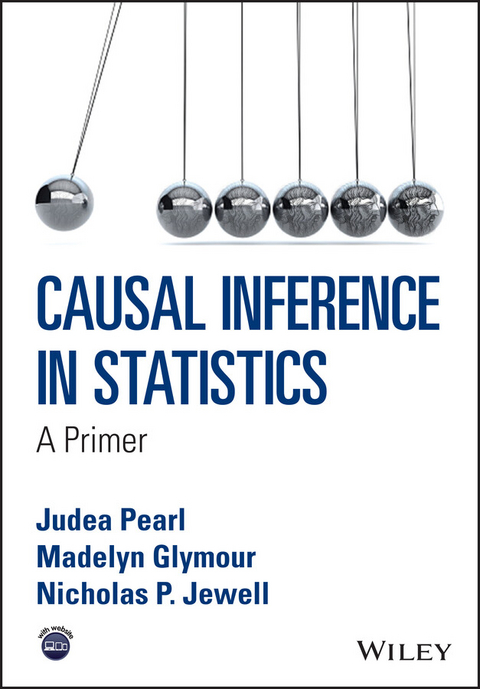
Causal Inference in Statistics (eBook)
John Wiley & Sons (Verlag)
978-1-119-18685-4 (ISBN)

Many of the concepts and terminology surrounding modern causal inference can be quite intimidating to the novice. Judea Pearl presents a book ideal for beginners in statistics, providing a comprehensive introduction to the field of causality. Examples from classical statistics are presented throughout to demonstrate the need for causality in resolving decision-making dilemmas posed by data. Causal methods are also compared to traditional statistical methods, whilst questions are provided at the end of each section to aid student learning.
Judea Pearl, Computer Science and Statistics, University of California, Los Angeles, USA.
Madelyn Glymour, Philosophy, Carnegie Mellon University, Pittsburgh, USA.
Nicholas P. Jewell, Biostatistics and Statistics, University of California, Berkeley, USA.
CAUSAL INFERENCE IN STATISTICS A Primer Causality is central to the understanding and use of data. Without an understanding of cause effect relationships, we cannot use data to answer questions as basic as "e;Does this treatment harm or help patients?"e; But though hundreds of introductory texts are available on statistical methods of data analysis, until now, no beginner-level book has been written about the exploding arsenal of methods that can tease causal information from data. Causal Inference in Statistics fills that gap. Using simple examples and plain language, the book lays out how to define causal parameters; the assumptions necessary to estimate causal parameters in a variety of situations; how to express those assumptions mathematically; whether those assumptions have testable implications; how to predict the effects of interventions; and how to reason counterfactually. These are the foundational tools that any student of statistics needs to acquire in order to use statistical methods to answer causal questions of interest. This book is accessible to anyone with an interest in interpreting data, from undergraduates, professors, researchers, or to the interested layperson. Examples are drawn from a wide variety of fields, including medicine, public policy, and law; a brief introduction to probability and statistics is provided for the uninitiated; and each chapter comes with study questions to reinforce the readers understanding.
Judea Pearl, Computer Science and Statistics, University of California, Los Angeles, USA. Madelyn Glymour, Philosophy, Carnegie Mellon University, Pittsburgh, USA. Nicholas P. Jewell, Biostatistics and Statistics, University of California, Berkeley, USA.
Cover 1
Title Page 5
Copyright 6
Dedication 7
Contents 9
About the Authors 11
Preface 13
List of Figures 17
About the Companion Website 21
Chapter 1 Preliminaries: Statistical and Causal Models 23
1.1 Why Study Causation 23
1.2 Simpson's Paradox 23
1.3 Probability and Statistics 29
1.3.1 Variables 29
1.3.2 Events 30
1.3.3 Conditional Probability 30
1.3.4 Independence 32
1.3.5 Probability Distributions 33
1.3.6 The Law of Total Probability 33
1.3.7 Using Bayes' Rule 35
1.3.8 Expected Values 38
1.3.9 Variance and Covariance 39
1.3.10 Regression 42
1.3.11 Multiple Regression 44
1.4 Graphs 46
1.5 Structural Causal Models 48
1.5.1 Modeling Causal Assumptions 48
1.5.2 Product Decomposition 51
Chapter 2 Graphical Models and Their Applications 57
2.1 Connecting Models to Data 57
2.2 Chains and Forks 57
2.3 Colliders 62
2.4 d-separation 67
2.5 Model Testing and Causal Search 70
Chapter 3 The Effects of Interventions 75
3.1 Interventions 75
3.2 The Adjustment Formula 77
3.2.1 To Adjust or not to Adjust? 80
3.2.2 Multiple Interventions and the Truncated Product Rule 82
3.3 The Backdoor Criterion 83
3.4 The Front-Door Criterion 88
3.5 Conditional Interventions and Covariate-Specific Effects 92
3.6 Inverse Probability Weighing 94
3.7 Mediation 97
3.8 Causal Inference in Linear Systems 100
3.8.1 Structural versus Regression Coefficients 102
3.8.2 The Causal Interpretation of Structural Coefficients 103
3.8.3 Identifying Structural Coefficients and Causal Effect 105
3.8.4 Mediation in Linear Systems 109
Chapter 4 Counterfactuals and Their Applications 111
4.1 Counterfactuals 111
4.2 Defining and Computing Counterfactuals 113
4.2.1 The Structural Interpretation of Counterfactuals 113
4.2.2 The Fundamental Law of Counterfactuals 115
4.2.3 From Population Data to Individual Behavior-An Illustration 116
4.2.4 The Three Steps in Computing Counterfactuals 118
4.3 Nondeterministic Counterfactuals 120
4.3.1 Probabilities of Counterfactuals 120
4.3.2 The Graphical Representation of Counterfactuals 123
4.3.3 Counterfactuals in Experimental Settings 125
4.3.4 Counterfactuals in Linear Models 128
4.4 Practical Uses of Counterfactuals 129
4.4.1 Recruitment to a Program 129
4.4.2 Additive Interventions 131
4.4.3 Personal Decision Making 133
4.4.4 Sex Discrimination in Hiring 135
4.4.5 Mediation and Path-disabling Interventions 136
4.5 Mathematical Tool Kits for Attribution and Mediation 138
4.5.1 A Tool Kit for Attribution and Probabilities of Causation 138
4.5.2 A Tool Kit for Mediation 142
References 149
Index 155
EULA 159
"Despite the fact that quite a few high-quality books on the topic of causal inference
have recently been published, this book clearly fills an important gap: that of providing
a simple and clear primer...Use of
counterfactuals [in the final chapter] is elegantly linked to the structural causal models outlined in the previous
chapters...[while]intriguing examples are used to
introduce and illustrate the main concepts and methods...Several thought provoking
study questions, in the form of exercises, are given throughout the presentation,
and they can be very helpful for a better understanding of the material and
looking further into the subtleties of the concepts introduced. In summary, there is no
doubt that a discussion of the basic ideas in causal inference should be included in all
introductory courses of statistics. This book could serve as a very useful companion to
the lectures." (Mathematical Reviews/MathSciNet April 2017)
| Erscheint lt. Verlag | 3.2.2016 |
|---|---|
| Sprache | englisch |
| Themenwelt | Mathematik / Informatik ► Mathematik ► Statistik |
| Mathematik / Informatik ► Mathematik ► Wahrscheinlichkeit / Kombinatorik | |
| Technik | |
| Schlagworte | cause effect relationships • Deduktion • Inferenzstatistik • Interpreting Data • Interventions • Law • <p>causal inference • Medical Statistics & Epidemiology • Medicine • Medizinische Statistik u. Epidemiologie • probability and statistics</p> • Public Policy • Statistics • Statistics for Social Sciences • Statistik • Statistik in den Sozialwissenschaften • tatistical methods |
| ISBN-10 | 1-119-18685-4 / 1119186854 |
| ISBN-13 | 978-1-119-18685-4 / 9781119186854 |
| Informationen gemäß Produktsicherheitsverordnung (GPSR) | |
| Haben Sie eine Frage zum Produkt? |
 PDF (Adobe DRM)
Kopierschutz: Adobe-DRM
Adobe-DRM ist ein Kopierschutz, der das eBook vor Mißbrauch schützen soll. Dabei wird das eBook bereits beim Download auf Ihre persönliche Adobe-ID autorisiert. Lesen können Sie das eBook dann nur auf den Geräten, welche ebenfalls auf Ihre Adobe-ID registriert sind.
Details zum Adobe-DRM
Dateiformat: PDF (Portable Document Format)
Mit einem festen Seitenlayout eignet sich die PDF besonders für Fachbücher mit Spalten, Tabellen und Abbildungen. Eine PDF kann auf fast allen Geräten angezeigt werden, ist aber für kleine Displays (Smartphone, eReader) nur eingeschränkt geeignet.
Systemvoraussetzungen:
PC/Mac: Mit einem PC oder Mac können Sie dieses eBook lesen. Sie benötigen eine
eReader: Dieses eBook kann mit (fast) allen eBook-Readern gelesen werden. Mit dem amazon-Kindle ist es aber nicht kompatibel.
Smartphone/Tablet: Egal ob Apple oder Android, dieses eBook können Sie lesen. Sie benötigen eine
Geräteliste und zusätzliche Hinweise
Buying eBooks from abroad
For tax law reasons we can sell eBooks just within Germany and Switzerland. Regrettably we cannot fulfill eBook-orders from other countries.
aus dem Bereich