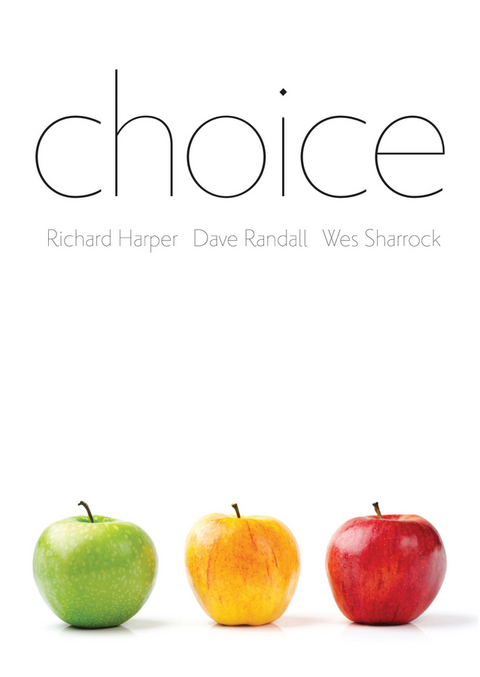

We make decisions every day. Yet we are sometimes perplexed by these decisions and the decisions of others. To complicate things further, we live in an age where there are more things to choose from than ever before ? the Internet is transforming our choices and making us more accountable for them: what we choose is recorded, modelled and used to predict our future behaviour.
So are we in a position to make better choices today than we were a decade ago? Certainly there are some who believe so. Psychologists claim we are subject to hidden mental processes that lead us to one thing rather than another; economists offer predictions about what people will buy; and some philosophers claim that our choices echo our evolutionary past.
Are these claims merited? Do they reflect the beginnings of a new science of choice? This book offers a critical overview of these and other claims, showing where they are justified and where they are exaggerated. It will be an essential reference for anyone interested in whether science can help us to understand both the ways people make choices in their everyday lives and how these may be changing.
Richard Harper is Principal Scientist at Social Shaping Research Cambridge
Dave Randall is Senior Professor, University of Siegen, Germany
Wes Sharrock is Professor at Manchester University
We make decisions every day. Yet we are sometimes perplexed by these decisions and the decisions of others. To complicate things further, we live in an age where there are more things to choose from than ever before the Internet is transforming our choices and making us more accountable for them: what we choose is recorded, modelled and used to predict our future behaviour. So are we in a position to make better choices today than we were a decade ago? Certainly there are some who believe so. Psychologists claim we are subject to hidden mental processes that lead us to one thing rather than another; economists offer predictions about what people will buy; and some philosophers claim that our choices echo our evolutionary past. Are these claims merited? Do they reflect the beginnings of a new science of choice? This book offers a critical overview of these and other claims, showing where they are justified and where they are exaggerated. It will be an essential reference for anyone interested in whether science can help us to understand both the ways people make choices in their everyday lives and how these may be changing.
Richard Harper is Principal Scientist at Social Shaping Research, Cambridge Dave Randall is Senior Professor, University of Siegen, Germany Wes Sharrock is Professor at Manchester University
Acknowledgements
Chapter 1 Choice: a twenty-first century science?
Chapter 2 The origins: choice in economics
Chapter 3 An experimental choice
Chapter 4 Choice in context
Chapter 5 Evolutionary Choice
Chapter 6 Modelling Choice
Chapter 7 A new place of choice: the Internet
Chapter 8 Reasons in action
Bibliography
Index
"In this excellent new book, Harper, Randall, and Sharrock offer a compelling criticism of scientific theories of human choice across a number of disciplines, from economics to socio-biology. The authors make a strong case for the view that human beings are considerably more rational than such accounts would have us think. In so doing, they give proponents of rational choice, nudge, and game theories much to worry about. This timely book is a must-read for anybody seeking a way through the conceptual entanglements we find ourselves in when attempting to explain human behaviour."
Constantine Sandis, Oxford Brookes University
2
THE ORIGINS: CHOICE IN ECONOMICS
In this, the first substantive chapter, we will explore some of the starting assumptions that are found in perhaps the most dominant of the social sciences, and certainly the one evoked as the source of ideas about reason and choice being a logical, rational matter. This is the discipline of economics, which has often been thought of as the most ‘scientific’ of the social science trades, doubtless because of its insistence on rigorous mathematical modelling. Perhaps more importantly for us, this modelling is based on what looks like simple assumptions – that people are motivated by self-interest, and specifically by money. Something that is less often stated is that the simplifying assumptions are precisely what allow models to be built in the first place. When these assumptions are described in detail (something we shall do shortly), many people would (rightly) observe that real people aren’t like that, and that they are more complex than the picture the economists paint, but they would be wrong to conclude that economists aren’t aware of this. The very fact that economists term their assumptions ‘simplifying’ indicates their awareness that actual situations in the lives of individuals – even when confined to the economic sphere – are much more complex than can be captured by the economic perspective. But part of the reason why this doesn’t worry economists is that their problem is not to understand how individual minds work; it is to understand how economies work. It is not what the model starts with (or consists in) that matters – the individual, the actor, the subject; it is what this ends with – the imagined economy. The basic model of homo economicus is provided not so as to draw non-economists into accepting a thoroughly misleading idea of what people are like – though this almost certainly is a consequence it can have – but in order to provide initial traction in working out how economies considered as an ensemble of innumerable economic choices organise themselves.
Having said that, the starting place of economics, though simple and regarded as such by economists themselves, as we say, needs some examination. If we recall the fish, chips and cake example from the first chapter, what we see is that economists make decisions about what choice looks like that preclude other apparently just as simple and reasonable starting places. They do this under the umbrella terms ‘rationality’ and ‘rational action’ in such a fashion that it is all too easy to forget quite how consequential their choice about choice can turn out to be.
To be economically rational
One can begin to explore this by recalling that the term ‘rational’ is often used in everyday language to describe the quality of people’s reasoning, typically in reference to some situation. ‘They think about it logically’, one might say. But this usage doesn’t imply that that person so described is therefore making the right decision; they may or they may not. What the phrase labels is merely the character of the reasoning process: it was or is logical. In this view, rational action originates in rational thought. Whether that is ‘good’ thought or appropriate action is another question.
For economists, the use of the term means something much more particular – something that relates to the ordering of preferences. At the most basic level, it implies that people choose on the basis of preferences which are hierarchical. When economists use the term ‘rational’ they also take for granted that this ordering is consistent through time – otherwise it would not be possible to predict people’s actions on the basis of their preferences. Basically, how people act today will be how they act tomorrow. In addition, though this is not necessarily implied when they say ‘rational’ (it being more a question of hope), economists treat people’s preferences as being mostly organised in pairs: if one prefers A to B, and one prefers B to C, then C to D, and D to E, then one prefers A to E. If, in other words, one’s preferences are paired in this way, then one would – one does – choose the first of the pair over the other, and that order of preference extends throughout the sequence so that it covers also the various other paired alternatives featuring those same items. One’s preferences are assumed to be consistently ordered and thus transitive. Finally, when economists use the term ‘rational’, they also imply its opposite. That is to say, given their definition, it would be by definition irrational, when offered a choice between A and E, to pick E. This is consequential, because it turns out that the definition of one, of rationality, by default creates a set of actions that is a contrast pair with the first: the rational goes with the irrational. It is no wonder then that, when economists look for rationality, they often find irrationality. And these categories are not necessarily related to how the persons in question – the rational actors, so to speak – think of their own actions; this contrast pair is a construct of economics.
Some economists question whether people’s rationality has all these features – its logical shape, its opposite, and so forth. (Those from other disciplines do so as well – something we shall come to much later.) Queries are made about whether there are cases of reverse preference, for example, when people at one time choose A over B but at another time choose B (this leads to stochastic models, among other things). Doubts are also raised as to whether behaviour that does not fit the starting model needs be described as ‘irrational’ or whether it should be labelled a different kind of rationality (and, if this is so, how one might label it). Since we are here exploring these things only at a fairly basic level, there is no need to go into these matters when our point is only that this basic notion of rationality, this view from economics, doesn’t really apply to the quality of reasoning at all but simply to the way in which (at least supposedly) people’s preferences operate. And, furthermore, this notion is somewhat generalising about human nature, insofar as it assumes that all people act this way – there are no odd bods choosing their preferences randomly, for example.
All these assumptions sound reasonable, and indeed they certainly afford a place to start about which few would dispute. But before we go further to examine what consequences follow on from this, consider by way of contrast an alternative starting description of rationality. Karl Popper, the great philosopher of science, argued that ‘situational rationality’ should be the basis of what is perceived as reasoned behaviour for the social sciences, and in this he wanted to include economics.1 This is not a rationality in terms of preference ordering but one which applies the standard of effectiveness to the choice of means for a particular end. It’s not choice between objects that matters, in other words, but how to get to one of those objects when they are treated as goals. Others too have suggested this contrast between types of rationality; the sociologist Max Weber explored this issue well before Popper.2 The point is that both views do seem reasonable starting places – simple, to be sure, and probably a good way to capture a lot of human action. But already one can see some of the consequences that follow on. Let us focus on Popper’s view to continue this.
There are, according to Popper, at least two ways of considering means–ends rationality in the social sciences. One adopts current scientific knowledge as the standard of assessment of people’s actions towards some end. Science is used to judge whether some actions are rational in effectively achieving the actor’s end. Typically, this view is illustrated by comparing those who consult an oracle or a witch doctor to cure their illness against those who use something like standard Western medical treatments to cure themselves. The latter are viewed as being more rational – much more rational – in this matter than the former. Both have a goal in mind, but, with regard to means – witchcraft or science – one is logically more likely to deliver that goal than the other.
The second view focuses on understanding the choices from the chooser’s point of view. As it happens, this is a concern that Popper had, though whether he quite understood what all this implies is moot. But, from that starting point, a rational choice is one which entails picking an end which is appropriate, given the chooser’s goals, where ‘appropriate’ may feature means which are conventionally considered appropriate in the situation. The point is not, in this view, to determine whether the chooser got the choice objectively right – i.e., by reference to, say, a scientific measure of what is right – but to understand, in the terms of the chooser’s own reasoning, whether they selected the means they did because they supposed that these were the best for their ends. That is where the question of rightness fits. If one figures the measure of that rightness out, one has a better understanding of why the individual used one means rather than possible alternatives, Popper argued. As it happens, he placed great...
| Erscheint lt. Verlag | 21.1.2016 |
|---|---|
| Sprache | englisch |
| Themenwelt | Informatik ► Software Entwicklung ► User Interfaces (HCI) |
| Sozialwissenschaften ► Soziologie | |
| Wirtschaft ► Betriebswirtschaft / Management ► Unternehmensführung / Management | |
| Schlagworte | Business & Management • Decision Sciences • economics</p> • <p>choice • Philosophie • Philosophy • Rationality • social sceince • Sociology • Soziologie • Theorie • Theorie der Entscheidungsfindung • Wirtschaft u. Management |
| ISBN-10 | 0-7456-8390-8 / 0745683908 |
| ISBN-13 | 978-0-7456-8390-4 / 9780745683904 |
| Informationen gemäß Produktsicherheitsverordnung (GPSR) | |
| Haben Sie eine Frage zum Produkt? |
 EPUB (Adobe DRM)
Kopierschutz: Adobe-DRM
Adobe-DRM ist ein Kopierschutz, der das eBook vor Mißbrauch schützen soll. Dabei wird das eBook bereits beim Download auf Ihre persönliche Adobe-ID autorisiert. Lesen können Sie das eBook dann nur auf den Geräten, welche ebenfalls auf Ihre Adobe-ID registriert sind.
Details zum Adobe-DRM
Dateiformat: EPUB (Electronic Publication)
EPUB ist ein offener Standard für eBooks und eignet sich besonders zur Darstellung von Belletristik und Sachbüchern. Der Fließtext wird dynamisch an die Display- und Schriftgröße angepasst. Auch für mobile Lesegeräte ist EPUB daher gut geeignet.
Systemvoraussetzungen:
PC/Mac: Mit einem PC oder Mac können Sie dieses eBook lesen. Sie benötigen eine
eReader: Dieses eBook kann mit (fast) allen eBook-Readern gelesen werden. Mit dem amazon-Kindle ist es aber nicht kompatibel.
Smartphone/Tablet: Egal ob Apple oder Android, dieses eBook können Sie lesen. Sie benötigen eine
Geräteliste und zusätzliche Hinweise
Buying eBooks from abroad
For tax law reasons we can sell eBooks just within Germany and Switzerland. Regrettably we cannot fulfill eBook-orders from other countries.
aus dem Bereich