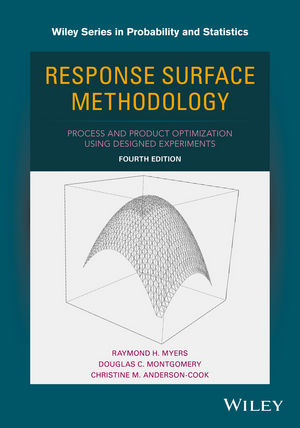
Response Surface Methodology (eBook)
John Wiley & Sons (Verlag)
978-1-118-91603-2 (ISBN)
Praise for the Third Edition:
'This new third edition has been substantially rewritten and updated with new topics and material, new examples and exercises, and to more fully illustrate modern applications of RSM.'
- Zentralblatt Math
Featuring a substantial revision, the Fourth Edition of Response Surface Methodology: Process and Product Optimization Using Designed Experiments presents updated coverage on the underlying theory and applications of response surface methodology (RSM). Providing the assumptions and conditions necessary to successfully apply RSM in modern applications, the new edition covers classical and modern response surface designs in order to present a clear connection between the designs and analyses in RSM.
With multiple revised sections with new topics and expanded coverage, Response Surface Methodology: Process and Product Optimization Using Designed Experiments, Fourth Edition includes:
- Many updates on topics such as optimal designs, optimization techniques, robust parameter design, methods for design evaluation, computer-generated designs, multiple response optimization, and non-normal responses
- Additional coverage on topics such as experiments with computer models, definitive screening designs, and data measured with error
- Expanded integration of examples and experiments, which present up-to-date software applications, such as JMP®, SAS, and Design-Expert®, throughout
- An extensive references section to help readers stay up-to-date with leading research in the field of RSM
An ideal textbook for upper-undergraduate and graduate-level courses in statistics, engineering, and chemical/physical sciences, Response Surface Methodology: Process and Product Optimization Using Designed Experiments, Fourth Edition is also a useful reference for applied statisticians and engineers in disciplines such as quality, process, and chemistry.
Raymond H. Myers, PhD, is Professor Emeritus in the Department of Statistics at Virginia Polytechnic Institute and State University. He has more than 40 years of academic experience in the areas of experimental design and analysis, response surface analysis, and designs for nonlinear models. A Fellow of the American Statistical Association (ASA) and the American Society for Quality (ASQ), Dr. Myers has authored numerous journal articles and books, including Generalized Linear Models: with Applications in Engineering and the Sciences, Second Edition, also published by Wiley.
Douglas C. Montgomery, PhD, is Regents' Professor of Industrial Engineering and Arizona State University Foundation Professor of Engineering. Dr. Montgomery has more than 30 years of academic and consulting experience and his research interest includes the design and analysis of experiments. He is a Fellow of the ASA and the Institute of Industrial Engineers, and an Honorary Member of the ASQ. He has authored numerous journal articles and books, including Design and Analysis of Experiments, Eighth Edition; Generalized Linear Models: with Applications in Engineering and the Sciences, Second Edition; Introduction to Introduction to Linear Regression Analysis, Fifth Edition; and Introduction to Time Series Analysis and Forecasting, Second Edition, all published by Wiley.
Christine M. Anderson-Cook, PhD, is a Research Scientist and Project Leader in the Statistical Sciences Group at the Los Alamos National Laboratory, New Mexico. Dr. Anderson-Cook has over 20 years of academic and consulting experience, and has written numerous journal articles on the topics of design of experiments, response surface methodology and reliability. She is a Fellow of the ASA and the ASQ.
Raymond H. Myers, PhD, is Professor Emeritus in the Department of Statistics at Virginia Polytechnic Institute and State University. He has more than 40 years of academic experience in the areas of experimental design and analysis, response surface analysis, and designs for nonlinear models. A Fellow of the American Statistical Association (ASA) and the American Society for Quality (ASQ), Dr. Myers has authored numerous journal articles and books, including Generalized Linear Models: with Applications in Engineering and the Sciences, Second Edition, also published by Wiley. Douglas C. Montgomery, PhD, is Regents' Professor of Industrial Engineering and Arizona State University Foundation Professor of Engineering. Dr. Montgomery has more than 30 years of academic and consulting experience and his research interest includes the design and analysis of experiments. He is a Fellow of the ASA and the Institute of Industrial Engineers, and an Honorary Member of the ASQ. He has authored numerous journal articles and books, including Design and Analysis of Experiments, Eighth Edition; Generalized Linear Models: with Applications in Engineering and the Sciences, Second Edition; Introduction to Introduction to Linear Regression Analysis, Fifth Edition; and Introduction to Time Series Analysis and Forecasting, Second Edition, all published by Wiley. Christine M. Anderson-Cook, PhD, is a Research Scientist and Project Leader in the Statistical Sciences Group at the Los Alamos National Laboratory, New Mexico. Dr. Anderson-Cook has over 20 years of academic and consulting experience, and has written numerous journal articles on the topics of design of experiments, response surface methodology and reliability. She is a Fellow of the ASA and the ASQ.
1
INTRODUCTION
1.1 RESPONSE SURFACE METHODOLOGY
Response surface methodology (RSM) is a collection of statistical and mathematical techniques useful for developing, improving, and optimizing processes. It also has important applications in the design, development, and formulation of new products, as well as in the improvement of existing product designs.
The most extensive applications of RSM are in the industrial world, particularly in situations where several input variables potentially influence performance measures or quality characteristics of the product or process. These performance measures or quality characteristics are called the response. They are typically measured on a continuous scale, although attribute responses, ranks, and sensory responses are not unusual. Most real-world applications of RSM will involve more than one response. The input variables are sometimes called independent variables, and they are subject to the control of the engineer or scientist, at least for purposes of a test or an experiment.
Figure 1.1 shows graphically the relationship between the response variable yield (y) in a chemical process and the two process variables (or independent variables) reaction time (ξ1) and reaction temperature (ξ2). Note that for each value of ξ1 and ξ2 there is a corresponding value of yield y and that we may view these values of the response yield as a surface lying above the time–temperature plane, as in Fig. 1.1a. It is this graphical perspective of the problem environment that has led to the term response surface methodology. It is also convenient to view the response surface in the two-dimensional time–temperature plane, as in Fig. 1.1b. In this presentation we are looking down at the time–temperature plane and connecting all points that have the same yield to produce contour lines of constant response. This type of display is called a contour plot.
Figure 1.1 (a) A theoretical response surface showing the relationship between yield of a chemical process and the process variables reaction time (ξ1) and reaction temperature (ξ2). (b) A contour plot of the theoretical response surface.
Clearly, if we could easily construct the graphical displays in Fig. 1.1, optimization of this process would be very straightforward. By inspection of the plot, we note that yield is maximized in the vicinity of time ξ1 = 4 hr and temperature ξ2 = 525°C. Unfortunately, in most practical situations, the true response function in Fig. 1.1 is unknown. The field of response surface methodology consists of the experimental strategies for exploring the space of the process or independent variables (here the variables ξ1 and ξ2), empirical statistical modeling to develop an appropriate approximating relationship between the yield and the process variables, and optimization methods for finding the levels or values of the process variables ξ1 and ξ2 that produce desirable values of the responses (in this case that maximize yield).
1.1.1 Approximating Response Functions
In general, suppose that the scientist or engineer (whom we will refer to as the experimenter) is concerned with a product, process, or system involving a response y that depends on the controllable input variables ξ1, ξ2, … , ξk. These input variables are also sometimes called factors, independent variables, or process variables. The actual relationship can be written
where the form of the true response function f is unknown and perhaps very complicated, and ϵ is a term that represents other sources of variability not accounted for in f. Thus ϵ includes effects such as measurement error on the response, other sources of variation that are inherent in the process or system (background noise, or common/special cause variation in the language of statistical process control), the effect of other (possibly unknown) variables, and so on. We will treat ϵ as a statistical error, often assuming it to have a normal distribution with mean zero and variance σ 2. If the mean of ϵ is zero, then
The variables ξ1, ξ2, … , ξk in Equation 1.2 are usually called the natural variables, because they are expressed in the natural units of measurement, such as degrees Celsius (°C), pounds per square inch (psi), or grams per liter for concentration. In much RSM work it is convenient to transform the natural variables to coded variables x1, x2, … , xk, which are usually defined to be dimensionless with mean zero and the same spread or standard deviation. In terms of the coded variables, the true response function (1.2) is now written as
Because the form of the true response function f is unknown, we must approximate it. In fact, successful use of RSM is critically dependent upon the experimenter's ability to develop a suitable approximation for f. Usually, a low-order polynomial in some relatively small region of the independent variable space is appropriate. In many cases, either a first-order or a second-order model is used. For the case of two independent variables, the first-order model in terms of the coded variables is
Figure 1.2 shows the three-dimensional response surface and the two-dimensional contour plot for a particular case of the first-order model, namely,
In three dimensions, the response surface for y is a plane lying above the x1, x2 space. The contour plot shows that the first-order model can be represented as parallel straight lines of constant response in the x1, x2 plane.
Figure 1.2 (a) Response surface for the first-order model η = 50 + 8x1 + 3x2. (b) Contour plot for the first-order model.
The first-order model is likely to be appropriate when the experimenter is interested in approximating the true response surface over a relatively small region of the independent variable space in a location where there is little curvature in f. For example, consider a small region around the point A in Fig. 1.1b; the first-order model would likely be appropriate here.
The form of the first-order model in Equation 1.4 is sometimes called a main effects model, because it includes only the main effects of the two variables x1 and x2. If there is an interaction between these variables, it can be added to the model easily as follows:
This is the first-order model with interaction. Figure 1.3 shows the three-dimensional response surface and the contour plot for the special case
Notice that adding the interaction term −4x1x2 introduces curvature into the response function. This leads to different rates of change of the response as x1 is changed for different fixed values of x2. Similarly, the rate of change in y across x2 varies for different fixed values of x1.
Figure 1.3 (a) Response surface for the first-order model with interaction η = 50 + 8x1 + 3x2 − 4x1x2. (b) Contour plot for the first-order model with interaction.
Often the curvature in the true response surface is strong enough that the first-order model (even with the interaction term included) is inadequate. A second-order model will likely be required in these situations. For the case of two variables, the second-order model is
This model would likely be useful as an approximation to the true response surface in a relatively small region around the point B in Fig. 1.1b, where there is substantial curvature in the true response function f.
Figure 1.4 presents the response surface and contour plot for the special case of the second-order model
Notice the mound-shaped response surface and elliptical contours generated by this model. Such a response surface could arise in approximating a response such as yield, where we would expect to be operating near a maximum point on the surface.
Figure 1.4 (a) Response surface for the second-order model η = 50 + 8x1 + 3x2 − 7x12 − 3x22 − 4x1x2. (b) Contour plot for the second-order model.
The second-order model is widely used in response surface methodology for several reasons. Among these are the following:
-
The second-order model is very flexible. It can take on a wide variety of functional forms, so it will often work well as an approximation to the true response surface. Figure 1.5 shows several different response surfaces and contour plots that can be generated by a...
| Erscheint lt. Verlag | 4.1.2016 |
|---|---|
| Reihe/Serie | Wiley Series in Probability and Statistics |
| Wiley Series in Probability and Statistics | Wiley Series in Probability and Statistics |
| Sprache | englisch |
| Themenwelt | Mathematik / Informatik ► Mathematik ► Statistik |
| Mathematik / Informatik ► Mathematik ► Wahrscheinlichkeit / Kombinatorik | |
| Technik ► Elektrotechnik / Energietechnik | |
| Technik ► Maschinenbau | |
| Schlagworte | Applied Statistics • Chemistry • Computer models • design evaluation • Design-Expert • Electrical & Electronics Engineering • Elektrotechnik u. Elektronik • Engineering • Experimental Design • experiments • JMP • <p>experimental design • missing data • Modeling • multiple responses • non-normal responses • optimal designs • Optimization • Physical Sciences • Productivity • Qualität, Produktivität u. Zuverlässigkeit • Qualität u. Zuverlässigkeit • Qualität, Produktivität u. Zuverlässigkeit • Qualität u. Zuverlässigkeit • quality • Quality & Reliability • Quality, Productivity & Reliability • regression modeling</p> • Reliability • Response surface methods • Robust Design • SAS • Software Algorithms • Statistics • Statistik • Versuchsplanung |
| ISBN-10 | 1-118-91603-4 / 1118916034 |
| ISBN-13 | 978-1-118-91603-2 / 9781118916032 |
| Informationen gemäß Produktsicherheitsverordnung (GPSR) | |
| Haben Sie eine Frage zum Produkt? |
 EPUB (Adobe DRM)
Kopierschutz: Adobe-DRM
Adobe-DRM ist ein Kopierschutz, der das eBook vor Mißbrauch schützen soll. Dabei wird das eBook bereits beim Download auf Ihre persönliche Adobe-ID autorisiert. Lesen können Sie das eBook dann nur auf den Geräten, welche ebenfalls auf Ihre Adobe-ID registriert sind.
Details zum Adobe-DRM
Dateiformat: EPUB (Electronic Publication)
EPUB ist ein offener Standard für eBooks und eignet sich besonders zur Darstellung von Belletristik und Sachbüchern. Der Fließtext wird dynamisch an die Display- und Schriftgröße angepasst. Auch für mobile Lesegeräte ist EPUB daher gut geeignet.
Systemvoraussetzungen:
PC/Mac: Mit einem PC oder Mac können Sie dieses eBook lesen. Sie benötigen eine
eReader: Dieses eBook kann mit (fast) allen eBook-Readern gelesen werden. Mit dem amazon-Kindle ist es aber nicht kompatibel.
Smartphone/Tablet: Egal ob Apple oder Android, dieses eBook können Sie lesen. Sie benötigen eine
Geräteliste und zusätzliche Hinweise
Buying eBooks from abroad
For tax law reasons we can sell eBooks just within Germany and Switzerland. Regrettably we cannot fulfill eBook-orders from other countries.
aus dem Bereich